

Your child knows the Urdu words for Ali, milk and drinking, but hesitates when joining them into a sentence. Urdu word order is a useful next focus: instead of translating each English word in place, show how one complete Urdu statement fits together.
This guide is for a child who understands the example words and can try a short spoken phrase. It uses one model, a small card activity and an illustrative parent response. The aim is a manageable sentence-building task, not a complete grammar course or a deadline for fluent speech.
Urdu word order: who, what, then the action group
For a common neutral statement containing an action and an object, a useful starting pattern is subject → object → verb. In plain language: who is doing it, what the action concerns, then the action words. Michigan State University’s Basic Urdu introduces subject–object–verb as the standard order, contrasting it with English.
Keep the scope clear. This is a starting pattern for the examples here, not a rule that every Urdu utterance has exactly three words. Other sentence types, emphasis and context need further explanation. Do not mark every different sentence you hear at home as wrong.
Here is the contrast:
- English: Ali / drinks / milk.
- Urdu, in spoken sequence: Ali / doodh / peeta hai.
- Complete Urdu: علی دودھ پیتا ہے۔
- Natural English meaning: Ali drinks milk.
“Ali milk drinks” is only an English arrangement aid. It is not a sentence to practise as natural English. In the Urdu example, keep پیتا ہے — peeta hai — together as the verb group rather than losing the final hai.
Check the meaning before moving cards
First, establish what the child wants to say. Ask in a comfortable language: “Who are we talking about? What does Ali drink?” If “milk” is unfamiliar in Urdu, model doodh before asking for the whole sentence.
Otherwise, a vocabulary gap can look like a word-order problem. A child might also arrange cards successfully by copying their positions without knowing what the sentence means. Check the message as well as the arrangement.
Use one neutral fictional statement. You do not need to ask the child to describe their own habits, and you should not assume the sentence suits every speaker. The example is about Ali; changing the speaker can change the verb form too. For this first task, leave that additional change aside.
Build one sentence in three meaningful chunks
Write or copy these three chunks onto separate pieces of paper:
- علی — Ali — the person.
- دودھ — doodh — milk.
- پیتا ہے — peeta hai — drinks.
Say the complete sentence naturally, then show how the chunks fit. If using Urdu script, place the first spoken chunk on the right and build towards the left. Roman Urdu and English read left to right, so their practice row runs the other way. Changing reading direction does not change the spoken sequence.
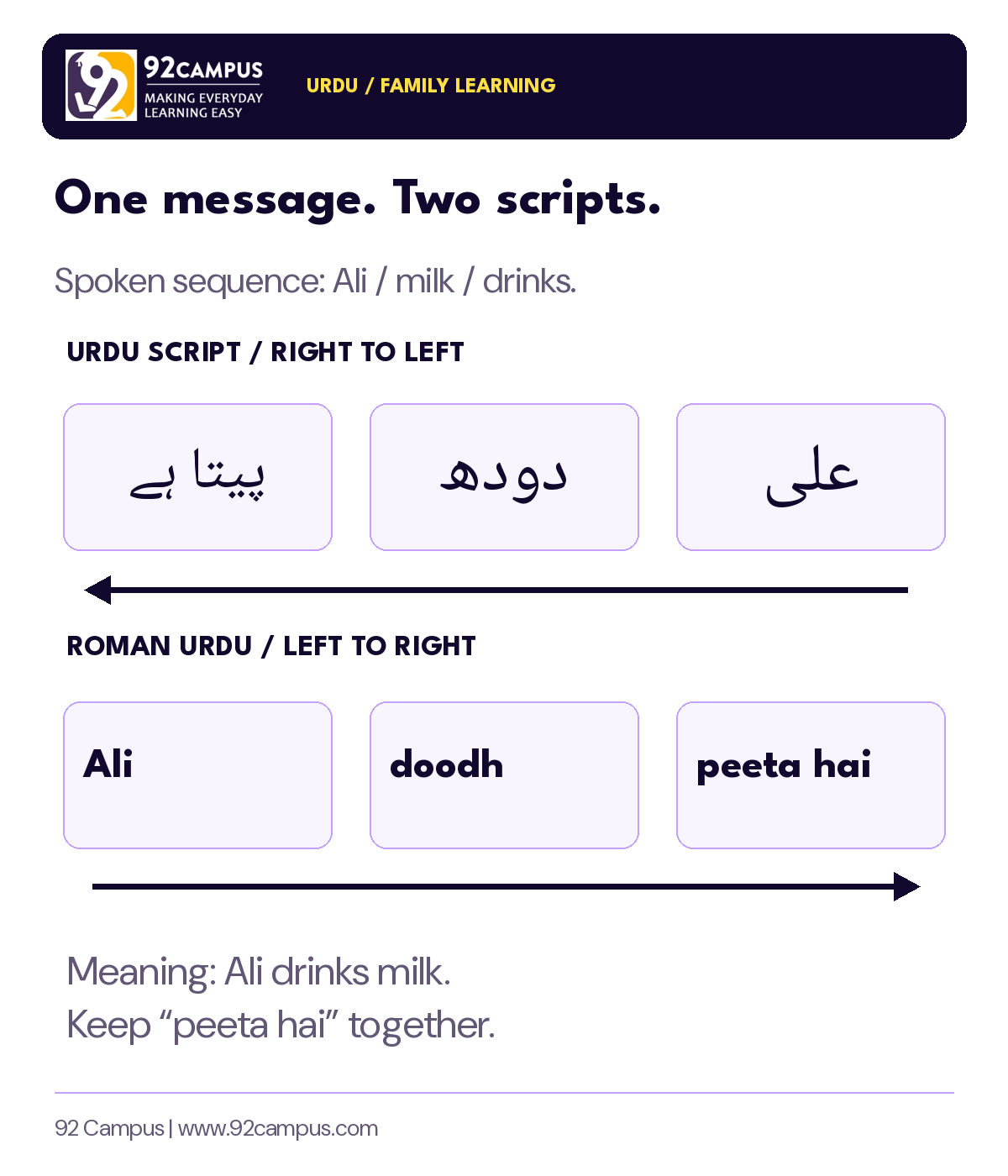
Invite your child to put the chunks together after hearing the model. Then ask what the sentence means. If reading the script is not yet a suitable task, let a fluent adult read it or use the Roman Urdu row as a parent reminder. Success with the reminder does not show independent Urdu-script reading.
A worked response when English order appears
Illustrative scenario: these responses are invented for the guide, not a real learner’s result or an approved academy lesson.
The child puts the chunks in the spoken sequence “Ali / peeta hai / doodh”, following the English example.
Parent: “I can see which person and drink you chose. Listen to our starting pattern: Ali / doodh / peeta hai. Let’s keep the action group at the end.”
After modelling once, the parent invites the child to arrange the chunks again. If the child needs a prompt, say: “Which chunk tells us the drink?” Point to that chunk only if needed, then let the child choose its place.
Record what happened honestly: “Placed the drink before the verb group after a model and one question.” This shows the support given. It does not establish that the child now uses the pattern without help.
Urdu word order allows more variation than a single beginner card pattern can show. Here, the parent is teaching a clear neutral model, not declaring that every other ordering is impossible. Ask the tutor about a different household sentence rather than correcting it from the card rule alone.
Change the drink, while keeping the rest steady
Once the original message is clear, try a small change: replace milk with water. This makes a different statement without introducing a new person or tense.
علی پانی پیتا ہے۔
Roman Urdu: Ali paani peeta hai.
English: Ali drinks water.
The chunks are now Ali / paani / peeta hai. Ask which piece changed and what the new sentence means. If the child needs the full model again, give it and note that support. A correct repeat immediately afterwards is different from building the statement without a model.
Then stop or return to ordinary conversation. These two statements are illustrative practice choices, not a prescribed daily quota. Do not add negatives, questions, several speakers and past tense merely because the first arrangement was completed.
The MSU explanation of tense and aspect shows that Urdu verb groups change with the kind of action being expressed. That is a reason to keep today’s task small, rather than treating every verb as a fixed word you can move unchanged into any sentence.
Separate word order from other learning needs
The child points correctly but cannot say the sentence. Acknowledge the meaning they understood. Offer a short model and invite a manageable spoken response. Do not count pointing as a spoken sentence.
The sentence sounds right, but the child cannot read it. Spoken sentence building and reading Urdu script are different goals. Use listening practice while agreeing an appropriate reading task separately.
The child changes the verb ending. Ask a fluent adult or tutor to check it. You can keep the order activity focused without pretending it teaches gender, number or every tense. Those details deserve their own suitable examples.
The child answers in English. Accept the message before modelling the Urdu statement. The guide to supporting Urdu replies covers participation more broadly. This article’s task is arranging a specific statement, not requiring Urdu for every reply.
Bring one actual sentence to the tutor
For your next Urdu word order discussion, keep a brief example of what the child tried, the intended meaning and the help given. “Can place the chunks after a model; needs help producing the whole statement” gives the tutor something concrete to hear and adapt.
If a familiar story contains a similar statement, the shared-reading guide can help you plan discussion around its meaning. Do not rearrange a published sentence without understanding its grammar and context.
92 Campus’s Urdu lessons consider listening, speaking and literacy separately. Share a sentence your child can understand or say and ask which sentence-building task would suit the next lesson. A trial request becomes a confirmed appointment after the team checks availability.
Join the conversation
Comments are reviewed before publication. Your name and approved comment will be public. Please leave out private learner or contact details.