
Your child knows that both men in the photographs are “Grandad”, but pauses when you say Dada or Nana. Urdu family words become easier to explain when you show the relationship from the child’s point of view. Start with one familiar person, follow the family connection, and then give the word.
You do not need a large family tree or a test at the next gathering. This guide offers a small reference, an original worked conversation and ways to notice whether your child is identifying the relationship or simply repeating your answer. The activities are editorial suggestions, not a prescribed teaching programme.
Start with the person whose relationship you are naming
Before asking “Who is this?”, make the viewpoint clear: “We are naming this person’s relationship to you.” Otherwise, a child may copy the word they hear a parent use for the same person.
For example, a mother may call her own father Abbu, while her child calls him Nana. The person has not changed; the relationship being named has. Say: “He is my father and your Nana.” Then show the connection through the mother.
If your child is learning through a fictional family, put a named child in the centre and keep that viewpoint throughout. Do not switch from the child’s relatives to the narrator’s relatives without explaining the change.
Four Urdu family words for grandparents
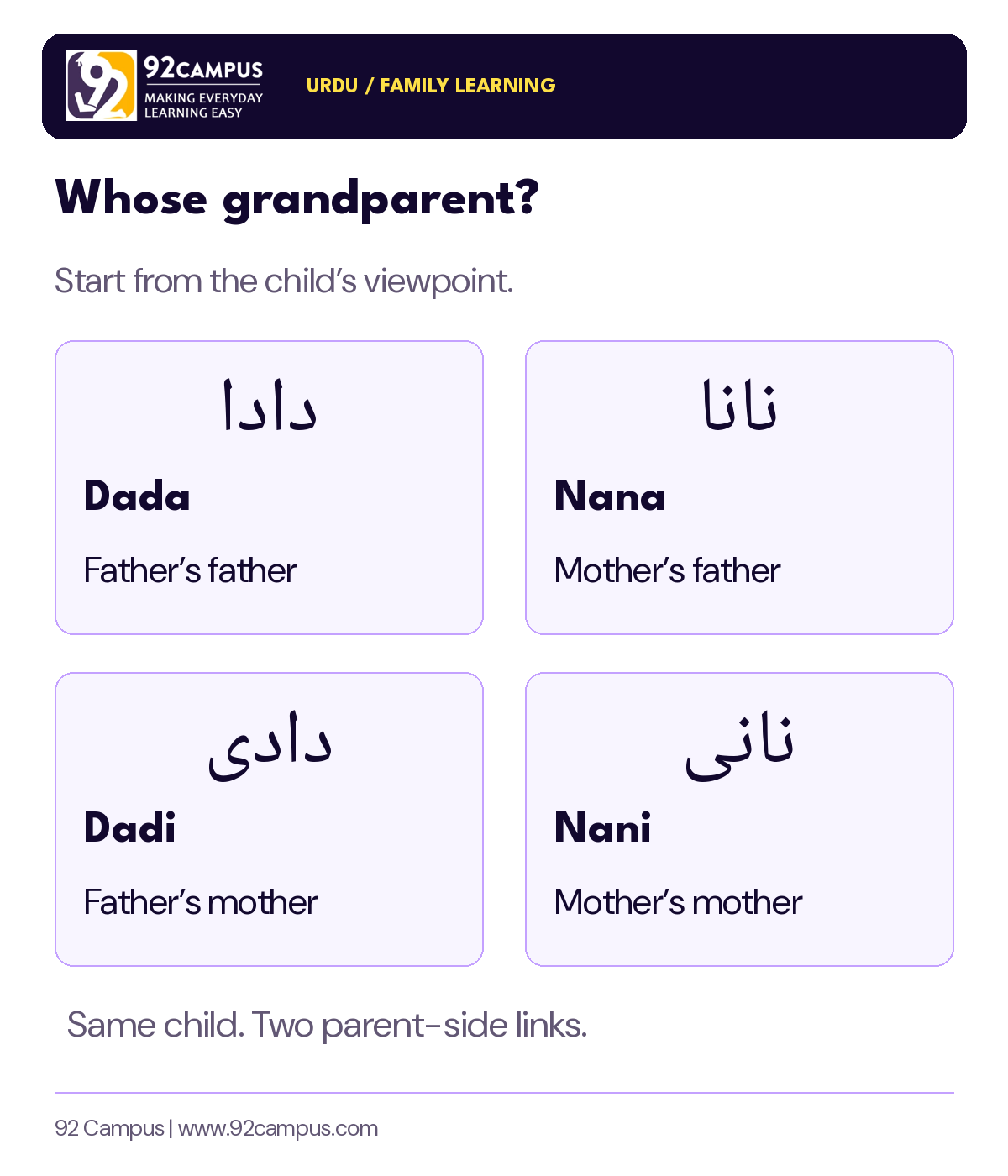
Michigan State University’s Basic Urdu family vocabulary distinguishes the four grandparent terms below. Here, “father’s side” and “mother’s side” describe the relationship, not where someone lives or which language they speak.
- دادا — Dada: father’s father.
- دادی — Dadi: father’s mother.
- نانا — Nana: mother’s father.
- نانی — Nani: mother’s mother.
Choose a pair that is meaningful and comfortable for your family. For instance, compare the child’s two grandfathers before adding the grandmothers. If a photograph or a real relative is not suitable, use invented names and simple drawings instead. Learning the words does not require sharing private family details.
Explain aunts and uncles through one family link
Once the viewpoint is clear, add a relative your child actually talks about. Sissel Østberg’s University of Leeds monograph, Appendix C, records the following father-side and mother-side distinctions:
- چچا — Chacha: father’s younger brother.
- تایا — Taya: father’s older brother.
- ماموں — Mamu: mother’s brother.
- پھوپھی — Phuphi: father’s sister.
- خالہ — Khala: mother’s sister.
These are reference meanings for the activity. Ask relatives what address forms your household uses, including familiar variants or affectionate additions. Roman Urdu spellings also vary: “Mamoo” and “Mamu”, for example, can identify the same word. Listen to a fluent speaker rather than treating an English spelling as a complete pronunciation guide.
For now, leave relatives by marriage and cousins for another conversation. Adding every possible label can obscure the distinction you meant to explain.
A worked conversation: why is he Nana, not Dada?
Illustrative example: the following family and responses are invented. They show a possible teaching exchange, not a documented student result.
Amina is looking at a drawing of her mother, Salma, and Salma’s father, Yusuf.
Parent: “Yusuf is Salma’s father. Salma is your mother. What is Yusuf’s relationship to you?”
Child: “Dada?”
Parent: “You remembered a word for a grandfather. Let’s follow the link: your mother, then her father. That is Nana.”
Next, the parent asks Amina to show the path in the drawing: “Point to your mother, then to her father.” If Amina points correctly but needs the word supplied, the parent can say: “You found the connection. I helped with the Urdu name.”
For a later comparison, use the father’s father and say Dada. Ask which parent the link passes through. This checks the relationship rather than whether the child remembers where a particular photograph sat on the table.
There is no need to repeat the question until the child performs perfectly. If the link itself is confusing, explain it in the language they understand comfortably, then return to the Urdu term.
Try a small “name, link, word” activity
Use two drawings or photographs, with permission where appropriate. Keep the names visible so remembering names does not become a second hidden task. These steps are options to adapt, not a proven sequence with a fixed completion time.
- Name the person. “This is Yusuf.” Establish who the picture represents.
- Show the link. “He is Salma’s father. Salma is Amina’s mother.” Trace the connection from Amina.
- Give or invite the Urdu word. Model Nana, offer a choice between Nana and Dada, or invite an answer without a choice if that is suitable.
- Change the arrangement. Move the pictures, keep the same relationships and ask again on another occasion. Notice whether the child follows the link.
Urdu family words can then appear naturally in a conversation: “We were talking about Nana. Which person in our drawing is Nana?” A point is useful evidence of understanding that question; it is not the same as saying the word without help.
If your child answers in English, acknowledge the message before modelling the Urdu term. The guide for children who understand Urdu but reply in English offers broader ways to invite participation without turning every exchange into a correction.
What to do when labels stay mixed up
The child calls both people “Grandad”. First confirm the family link in English or another familiar language. Then introduce the particular Urdu word. An accurate broad English answer is a starting point for the contrast, not a reason to shame the child.
The child copies a parent’s word. Clarify whose relationship is being named: “I say Abbu because he is my father. We are finding your word for him.” Keep the same central child in the example.
A family friend is called Uncle or Aunty. Explain the actual relationship before placing that person in a kinship activity. A familiar way of addressing someone does not, by itself, identify which family link they have.
The word is known, but the sound is uncertain. Ask a fluent speaker or tutor to model it. Choosing the relationship and pronouncing its name are separate things to practise. This guide supplies written words, not an audio pronunciation lesson.
Choose a useful next conversation
After practising Urdu family words, keep one brief observation: “Found the mother’s father in a changed picture layout; needed a choice to say Nana.” That is more informative than “finished the family sheet”. A copied answer and a response without a model should remain distinguishable.
For a next activity, talk about a relative in a familiar picture book, or use the Urdu–English shared-reading guide to plan a short discussion. Keep the focus on meaning rather than adding a whole vocabulary list at once.
92 Campus’s one-to-one Urdu lessons consider listening, speaking, reading and writing separately. Share which relationships your child understands and which Urdu words need support to discuss a suitable starting task. The team checks tutor availability and confirms the appointment after the request.
Join the conversation
Comments are reviewed before publication. Your name and approved comment will be public. Please leave out private learner or contact details.