
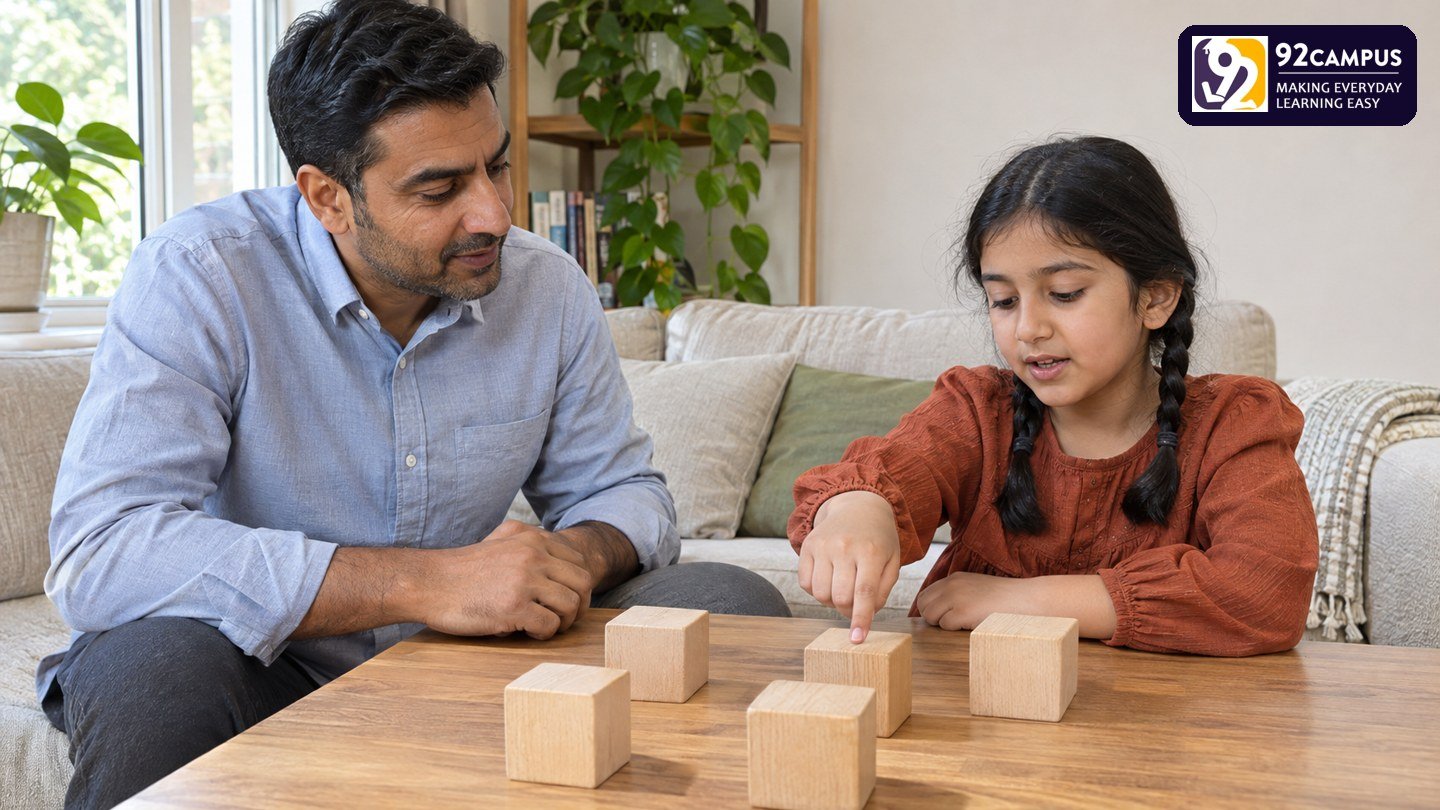
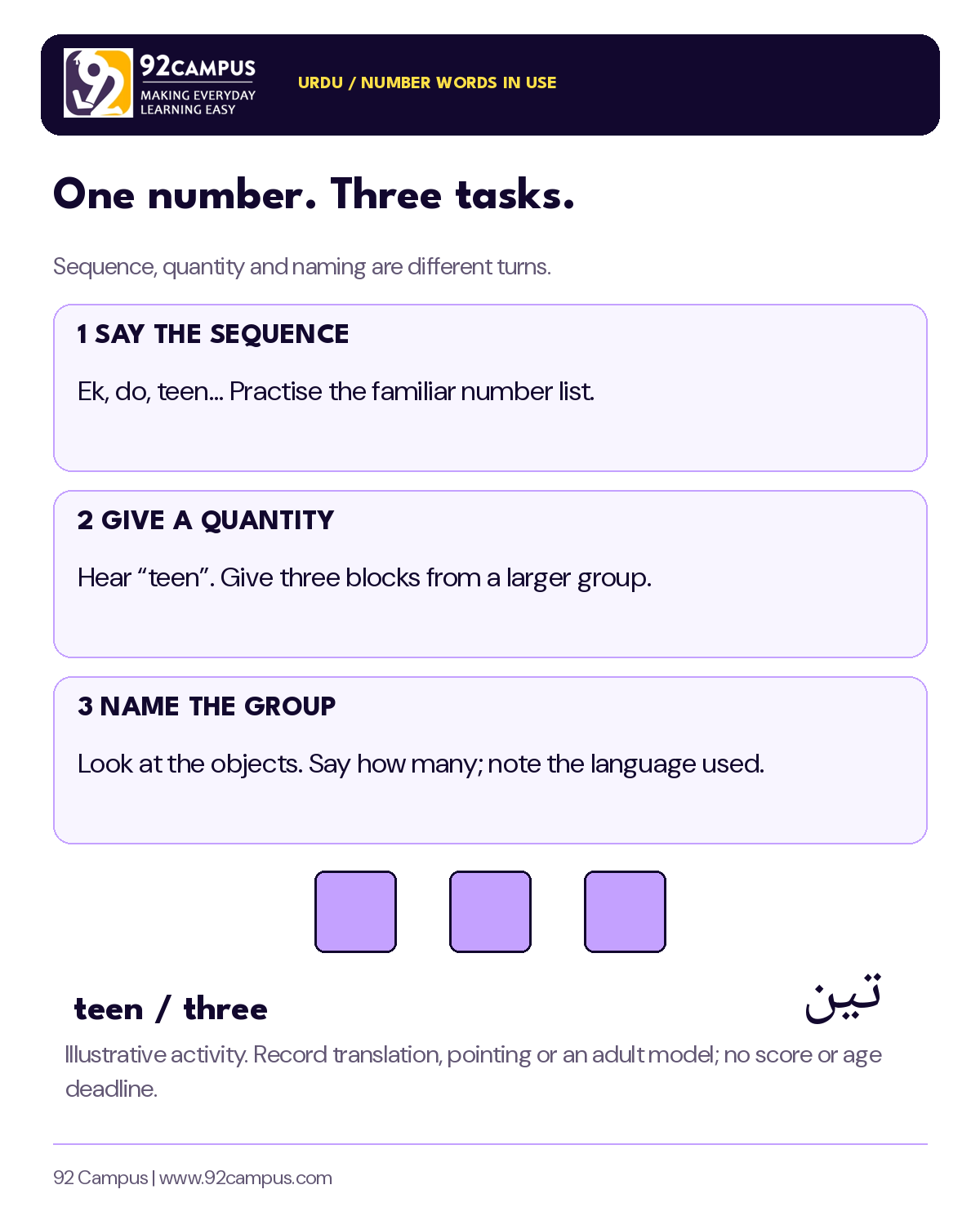
Your child can say “ek, do, teen…” all the way to ten. Then you ask for three blocks, and they hand you a handful. The number words are familiar, but using one of those words in a request is a different task.
Keep the counting song if your child enjoys it. Add a small exchange with real objects: hear a number, make that group, then say how many there are. You can begin with a quantity your child already handles comfortably instead of starting a longer list.
This guide is for Urdu-using families whose children are learning number words alongside English. The home activities and sample conversations are editorial suggestions, not a test of mathematics, language development or readiness for school.
Saying a list and using a quantity are different things to notice
The National Centre for Excellence in the Teaching of Mathematics distinguishes saying number words in order, matching one word to each object, and recognising that the final number gives the total. A familiar sequence alone does not demonstrate all three.
For an Urdu learner, add a separate question: is the amount familiar, but the Urdu name unfamiliar? A child who gives three objects after hearing “three”, but not after hearing teen, has shown different responses to those two words in that situation. Do not turn that single comparison into a judgement about their overall ability.
The Victorian Department of Education’s Urdu parent resource also describes touching objects while counting and talking about the total. Its guidance supports everyday quantity practice; it does not validate this article as a language assessment.
Start with a small, useful set of Urdu number words
The vocabulary below matches the first five number names in Michigan State University’s Basic Urdu conversation chapter. Roman Urdu spellings are reading aids; families may write the same sound differently.
- ایک — ek — one.
- دو — do — two.
- تین — teen — three.
- چار — chaar — four.
- پانچ — paanch — five.
This is a manageable example set, not a rule that every child must learn exactly five words before anything else. Use fewer if that makes the exchange clearer. Writing Urdu numerals is another task and is not required for this spoken activity.
Try a “give me three” block game
Use large blocks appropriate for your child, a clear surface and a container. Check that the object name is familiar first. Avoid changing the number word, object name and instruction all at once.
Show the meaning before inviting a turn
Put three blocks together and name the group: تین بلاکس۔ Teen blocks. “Three blocks.” Let the child watch you make the group. This is a demonstration, so any immediate copy is supported practice.
For a fuller request, an adult can use تین بلاکس دیں۔ Teen blocks dein. “Please give three blocks.” If the request itself is unfamiliar, teach it with a demonstration before expecting the number word to carry the task. Ask an Urdu-speaking tutor to model a natural household version if you are unsure of pronunciation.
Offer a listening turn without showing the answer
Place several blocks within reach. Ask for teen blocks without holding up three fingers or looking at a ready-made group of three. Let your child respond before you explain. If you translate or point, simply include that help in your note.
If they keep adding blocks, say, “We asked for teen. Let’s make that group together.” Count with them and stop at three. You are making the request understandable, rather than asking them to guess repeatedly.
Invite a quantity word in a separate turn
With the three blocks visible, ask کتنے بلاکس ہیں؟ Kitne blocks hain? “How many blocks are there?” A brief teen is enough for this activity. A full sentence can be modelled afterwards.
If the answer is “three”, acknowledge it: “Yes, three — teen.” Record that the child named the amount in English before the Urdu model. A correct quantity answer and an independently chosen Urdu word are useful, separate observations.
Respond to the part that was difficult
If the list is easy but the request is unclear: demonstrate a smaller group and the instruction, then try another comfortable turn. More recitation of the list does not answer which part of the request was unclear.
If the child says English number names: keep the objects as they are and offer the Urdu label. You do not need to pretend the English answer was meaningless. The guide for a child who understands Urdu but replies in English gives broader conversation support.
If they copy your hand movement: enjoy the shared practice. Later, offer a listening turn with your hands relaxed. Do not describe copying as an unsuccessful attempt; just distinguish it from a response to the spoken request alone.
If they want to recount: let them finish. Then name the group together. This activity does not require instant recognition, speed or a particular age milestone.
A filled example: one quantity, different support
The following exchange is fictional. It shows how a parent can record a useful question without labelling a child.
- The child recites ek through paanch with the adult. Note: shared sequence.
- The adult asks for teen blocks. The child gives five. Note: first response to that request was five objects.
- The adult says “three”, and the child gives three. Note: changed the number word into English; response followed translation.
- The adult models teen. The child repeats it. Note: repetition after a model, not an independently selected word.
A focused tutor question follows: “Should we practise hearing teen in a familiar request, or does the instruction need more modelling first?” The record does not establish a maths difficulty, a language diagnosis or a permanent learning level.
Blank and filled practice notes
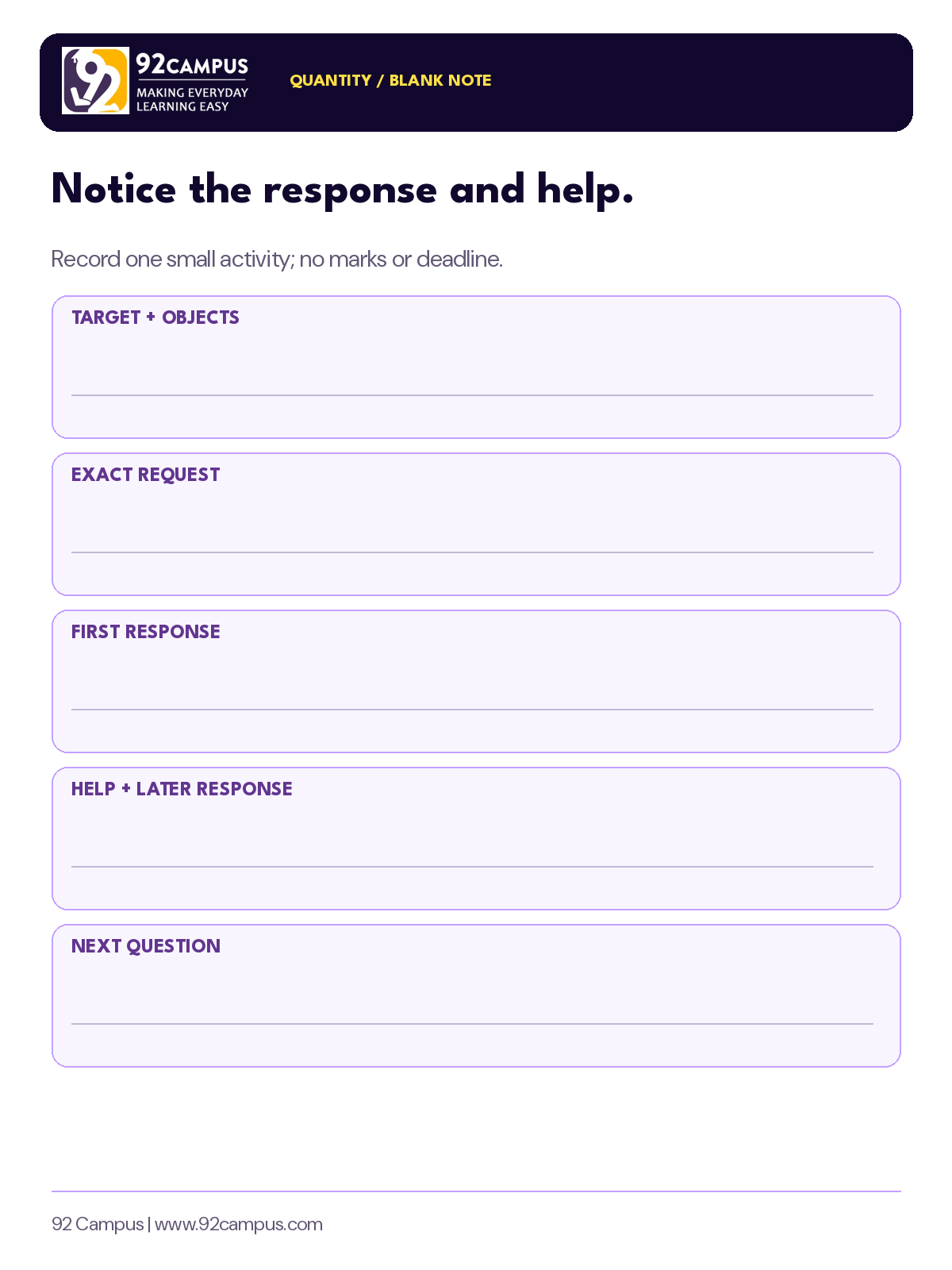
Copy these fields onto paper or save the sheets: target word and objects; exact request; first action or words; translation, gesture or model; next question. Keep the original response alongside the support so the final correct group does not hide how it was reached.
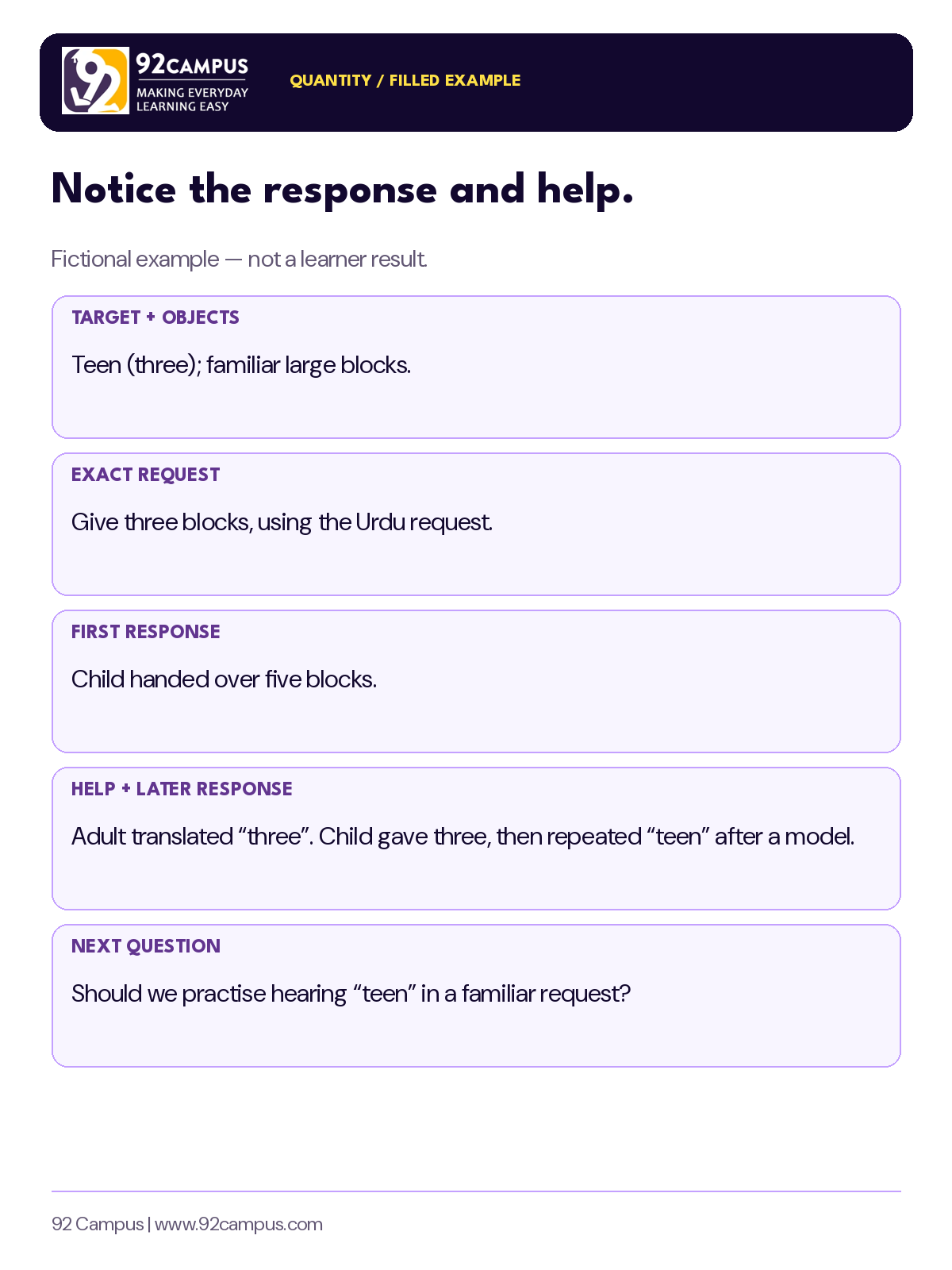
Filled illustrative note: Target: teen, familiar blocks. Request: give three blocks in Urdu. First response: five blocks. Help: adult translated “three”; child then gave three and repeated teen after a model. Next question: practise the number word in a familiar request, without assuming the sequence needs extending.
Choose the next language task, not a longer counting target
Next time, choose one change: a different familiar quantity, another object, or a chance to use the word without a model. You can also put the blocks away and return to ordinary conversation. No daily quota or fluency deadline is needed.
The Urdu location-word activity explores where objects go. Keep that as a separate task if you want to practise quantity today; asking for “three blocks under the box” introduces two relationships at once.
92 Campus Urdu lessons cover listening, speaking, reading and writing according to the learner’s starting point. Share the word your child can say and the request they found difficult, then discuss a suitable listening or speaking activity. If you request a trial, the team checks availability and confirms the tutor and local time.
Join the conversation
Comments are reviewed before publication. Your name and approved comment will be public. Please leave out private learner or contact details.