
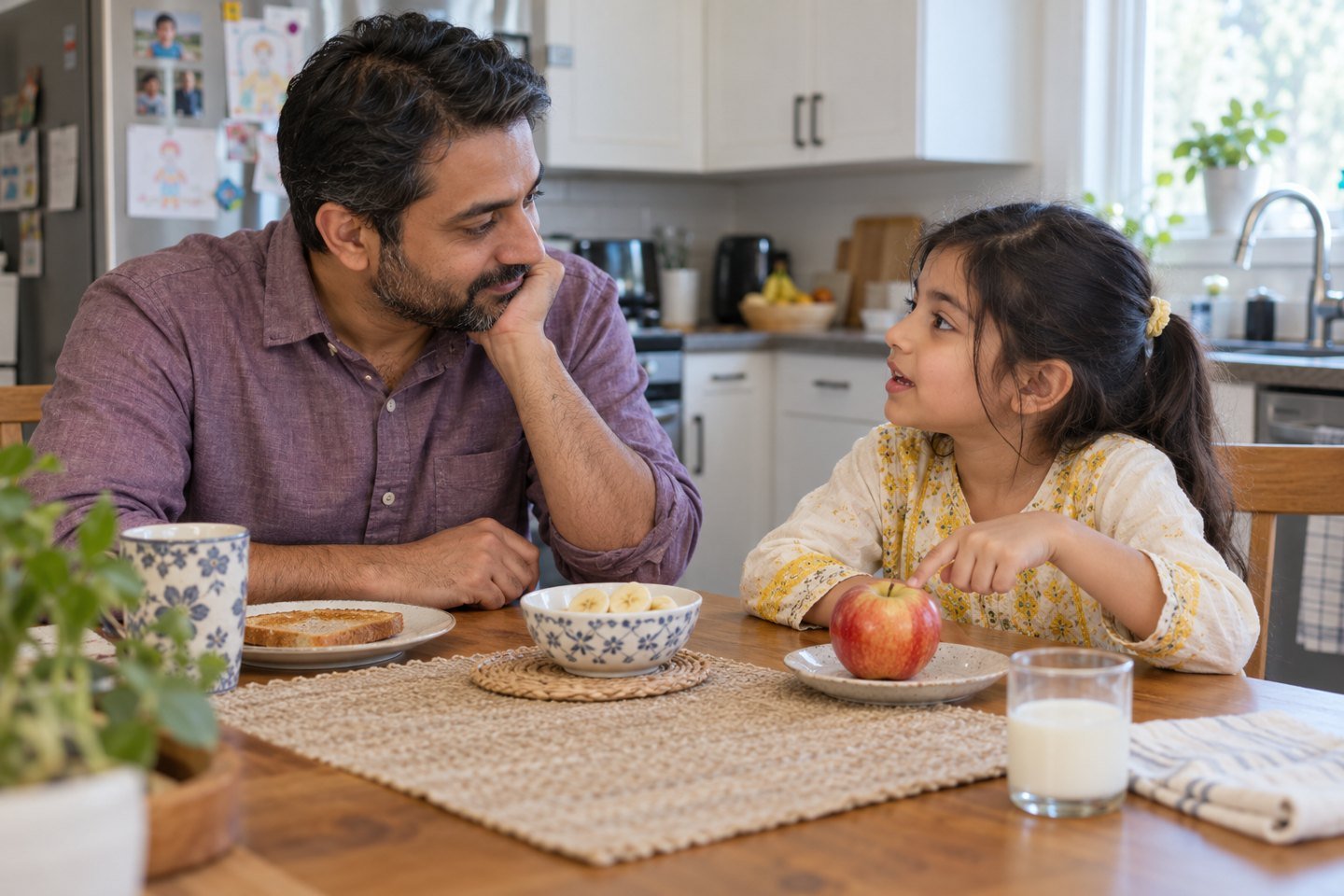
You ask, “Where are your shoes?” in Urdu. Your child points towards the door and answers, “They’re over there.” The instruction was understood. The reply came back in English.
Later, a grandparent asks a simple question on a video call. Your child looks at you for help, and you wonder whether you should translate, insist on Urdu, or let the conversation move on.
If your child understands Urdu but replies in English, acknowledge the message, model a short Urdu response and offer a small, optional way to join in. A gesture, one familiar word or a short phrase can all be useful starting points. Understanding, speaking, reading and writing should be considered separately.
This guide is for parents of English-dominant children roughly aged 5–12 in Urdu-using households. The examples are designed for ordinary family moments, not a fluency test or a therapy programme.
In this guide
- What your child understands and what they can say
- How to respond to an English answer
- Five everyday conversation cards
- Low-pressure role-play
- A small practice log
- When tutor support may help
Understanding Urdu and speaking Urdu are different tasks
A child may follow a familiar request without being ready to put the answer into Urdu. Recognising words in context and choosing words to express an idea are different things to notice. Neither tells you, by itself, whether the child can read an Urdu sentence or write one.
- Understanding: Can your child follow a familiar question or instruction?
- Speaking: What words or phrases can they choose, copy or use without help?
- Reading: Can they recognise and understand written Urdu?
- Writing: What can they form or compose on paper?
For example, a child might understand a question about lunch, answer it in English and need beginner support with Urdu letters. That is a useful starting profile, not a contradiction.
ASHA’s public multilingual guidance explains that children’s language use can differ by setting, topic and person, and may change over time. It encourages supportive opportunities and practice rather than perfect performance. Read the multilingual guidance.
Do not read an English reply as proof of disrespect or rejection of the family. Ask what happens in this particular situation: Does your child know the Urdu word? Is a long answer being requested? Are other people watching? Is English simply the easier way to tell you something right now?
Keep research in perspective
A UK study involving 66 families using Chinese, Italian or Urdu alongside English examined family language practices, resources and literacy activities. It identified differences between families and constraints on home-language literacy. It does not tell us what proportion of Pakistani children reply in English, or prove that these conversation cards will produce fluency. See Curdt-Christiansen and La Morgia’s research record.
For families in Canada, the UK, Australia or the USA, the practical starting point here is the child’s own communication. Country names do not establish a child’s level, and we do not have national prevalence or search-volume figures for this exact concern.
When the answer is in English, keep the exchange going
Suppose you offer water or milk in Urdu and your child says, “Water, please.” They have communicated a choice. Respond to that choice before inviting any language practice.
- Acknowledge: show that you understood what they wanted.
- Model: give the useful Urdu word or short phrase naturally.
- Offer, rather than demand: your child may point, try the word or use the phrase.
- Continue: hand over the drink and carry on with the meal.
For example: “Paani? Achha, yeh lein”—“Water? Okay, here you are.” If your child wants a phrase to try, you can model “Mujhe paani chahiye”—“I would like water.” You do not need to make them repeat it before responding.
Avoid pretending not to understand English or withholding food, help or affection until Urdu is used. The suggested approach in this article is to make Urdu available within the relationship, while continuing to meet the child’s needs.
Offer different response levels without making a ladder to pass
Pointing can show a choice, but is not itself a spoken Urdu answer. A single word gives a manageable speaking opportunity. A short sentence lets the child express more when they want to.
These are options, not age bands or stages that must be completed in order. A child might use a sentence during play and point when tired. You can notice that difference without scoring it.
Five everyday Urdu conversation cards
Choose one card that fits something already happening at home. Read the parent line, respond to the child’s meaning and offer only as much help as they need. The written Urdu and Roman Urdu are aids for the adult; a child does not need to read them to join the conversation.
Roman Urdu spelling varies. Here, doubled vowels such as aa help indicate a longer sound; the spellings are practical reading aids, not a complete pronunciation system. Families may use different everyday words. Ask your tutor to model unfamiliar sounds and adapt the phrases to your household.
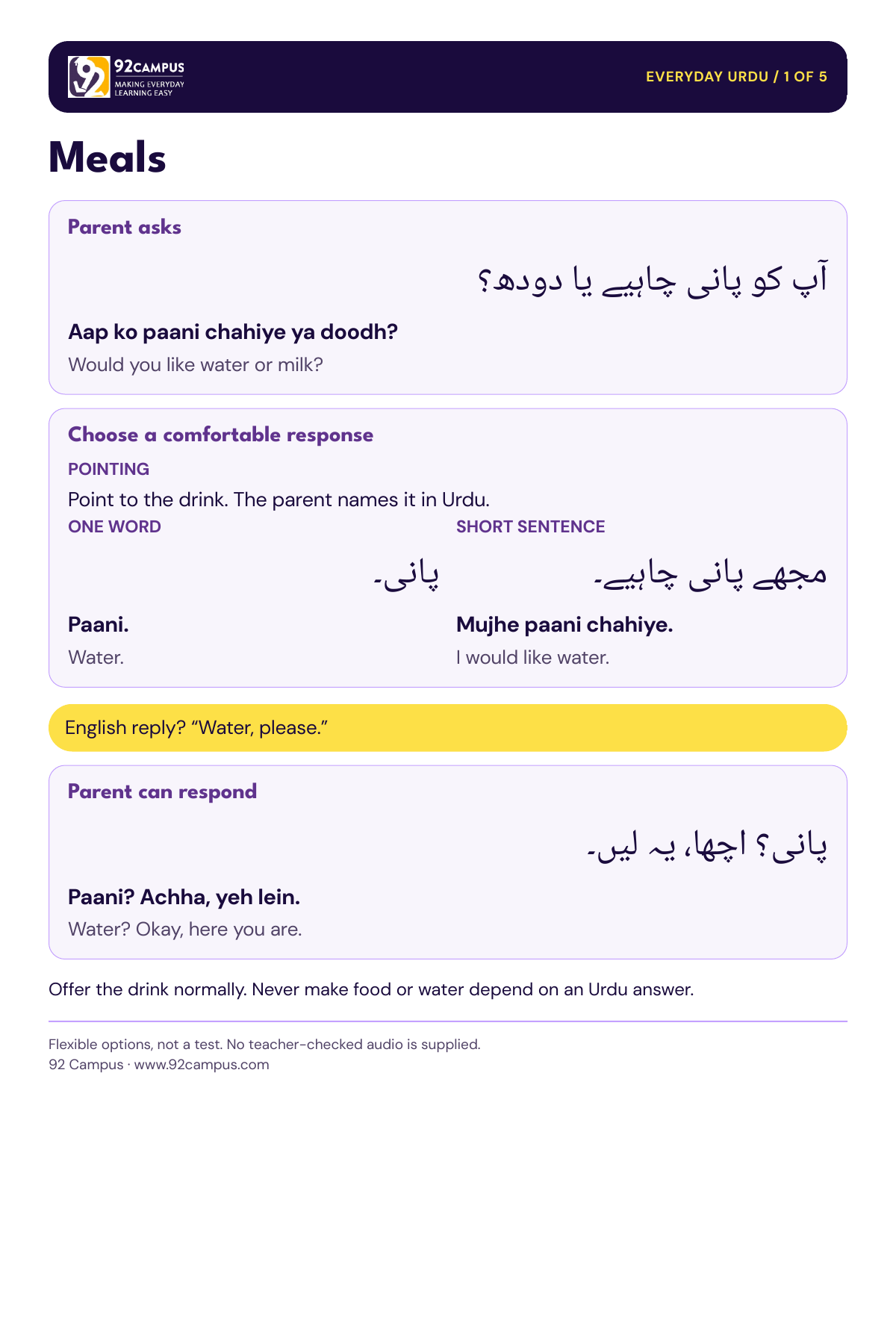
1. Meals
Parent asks
آپ کو پانی چاہیے یا دودھ؟
Aap ko paani chahiye ya doodh?
Would you like water or milk?
Pointing option: Point to the drink. The parent names it in Urdu.
Single-word option
پانی۔
Paani.
Water.
Short-sentence option
مجھے پانی چاہیے۔
Mujhe paani chahiye.
I would like water.
If your child replies in English: “Water, please.”
A supportive parent response
پانی؟ اچھا، یہ لیں۔
Paani? Achha, yeh lein.
Water? Okay, here you are.
Offer the drink normally. Never make food or water depend on an Urdu answer.
Open the meals conversation card
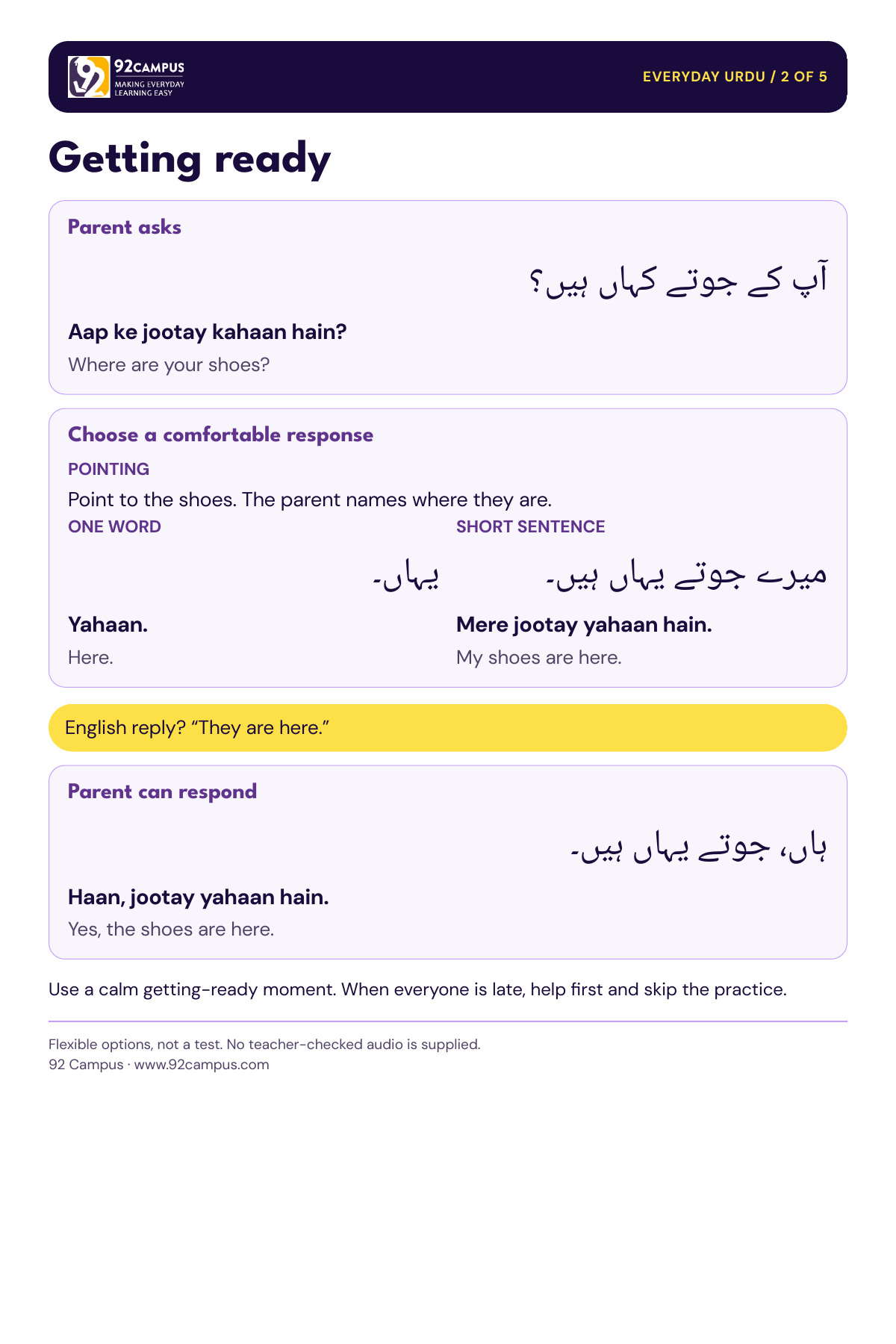
2. Getting ready
Parent asks
آپ کے جوتے کہاں ہیں؟
Aap ke jootay kahaan hain?
Where are your shoes?
Pointing option: Point to the shoes. The parent names where they are.
Single-word option
یہاں۔
Yahaan.
Here.
Short-sentence option
میرے جوتے یہاں ہیں۔
Mere jootay yahaan hain.
My shoes are here.
If your child replies in English: “They are here.”
A supportive parent response
ہاں، جوتے یہاں ہیں۔
Haan, jootay yahaan hain.
Yes, the shoes are here.
Use a calm getting-ready moment. When everyone is late, help first and skip the practice.
Open the getting ready conversation card
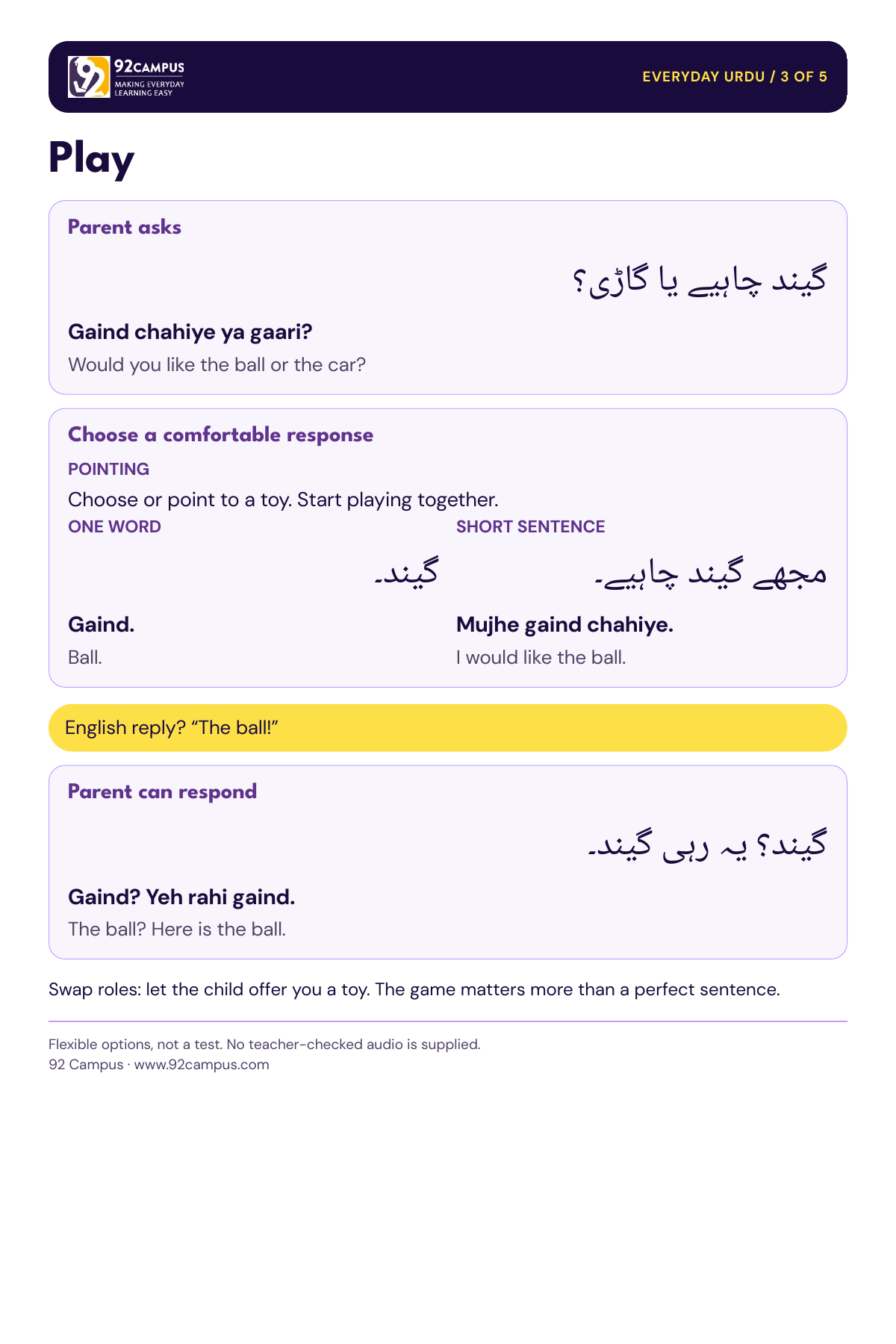
3. Play
Parent asks
گیند چاہیے یا گاڑی؟
Gaind chahiye ya gaari?
Would you like the ball or the car?
Pointing option: Choose or point to a toy. Start playing together.
Single-word option
گیند۔
Gaind.
Ball.
Short-sentence option
مجھے گیند چاہیے۔
Mujhe gaind chahiye.
I would like the ball.
If your child replies in English: “The ball!”
A supportive parent response
گیند؟ یہ رہی گیند۔
Gaind? Yeh rahi gaind.
The ball? Here is the ball.
Swap roles: let the child offer you a toy. The game matters more than a perfect sentence.
Open the play conversation card
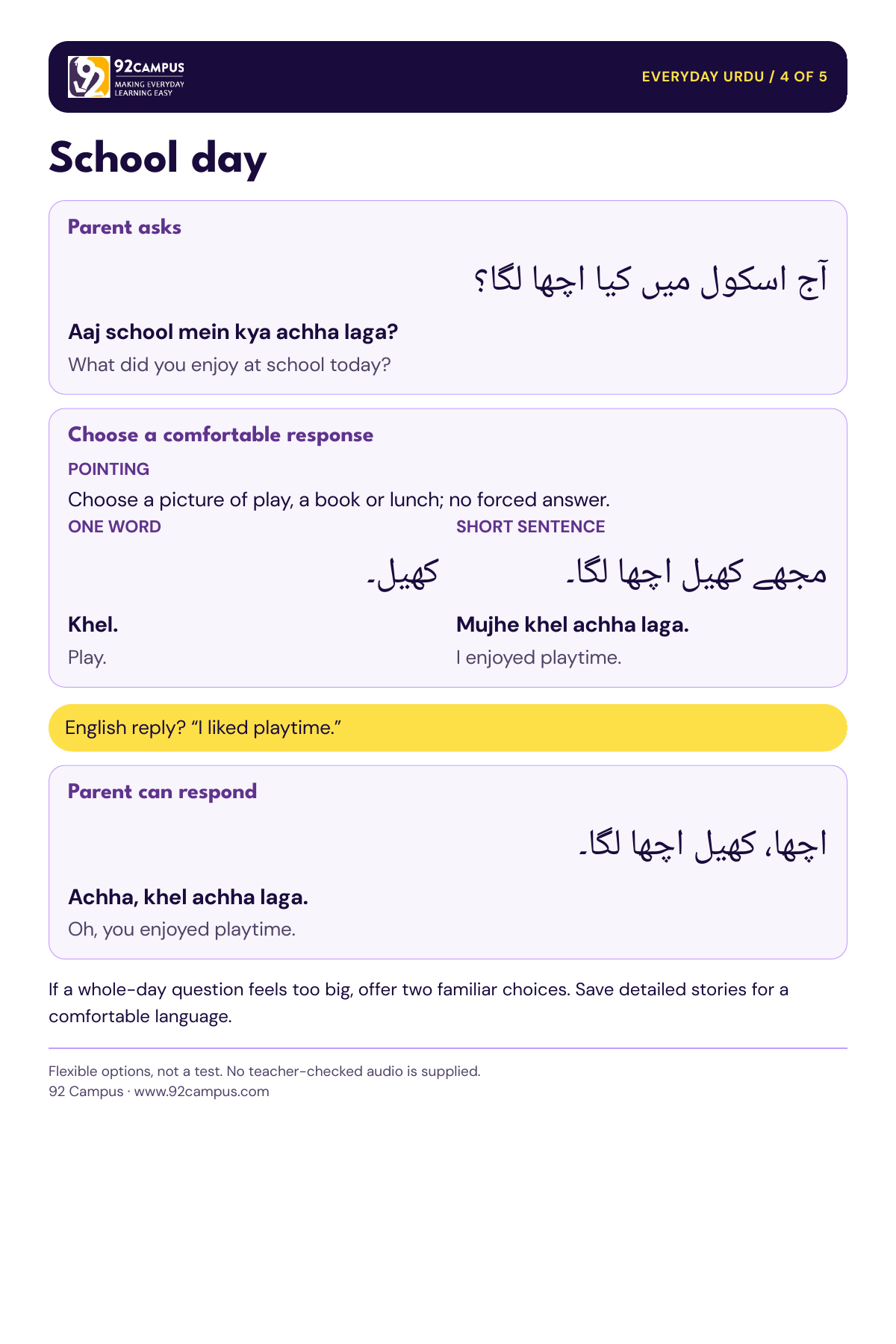
4. School day
Parent asks
آج اسکول میں کیا اچھا لگا؟
Aaj school mein kya achha laga?
What did you enjoy at school today?
Pointing option: Choose a picture of play, a book or lunch; no forced answer.
Single-word option
کھیل۔
Khel.
Play.
Short-sentence option
مجھے کھیل اچھا لگا۔
Mujhe khel achha laga.
I enjoyed playtime.
If your child replies in English: “I liked playtime.”
A supportive parent response
اچھا، کھیل اچھا لگا۔
Achha, khel achha laga.
Oh, you enjoyed playtime.
If a whole-day question feels too big, offer two familiar choices. Save detailed stories for a comfortable language.
Open the school day conversation card
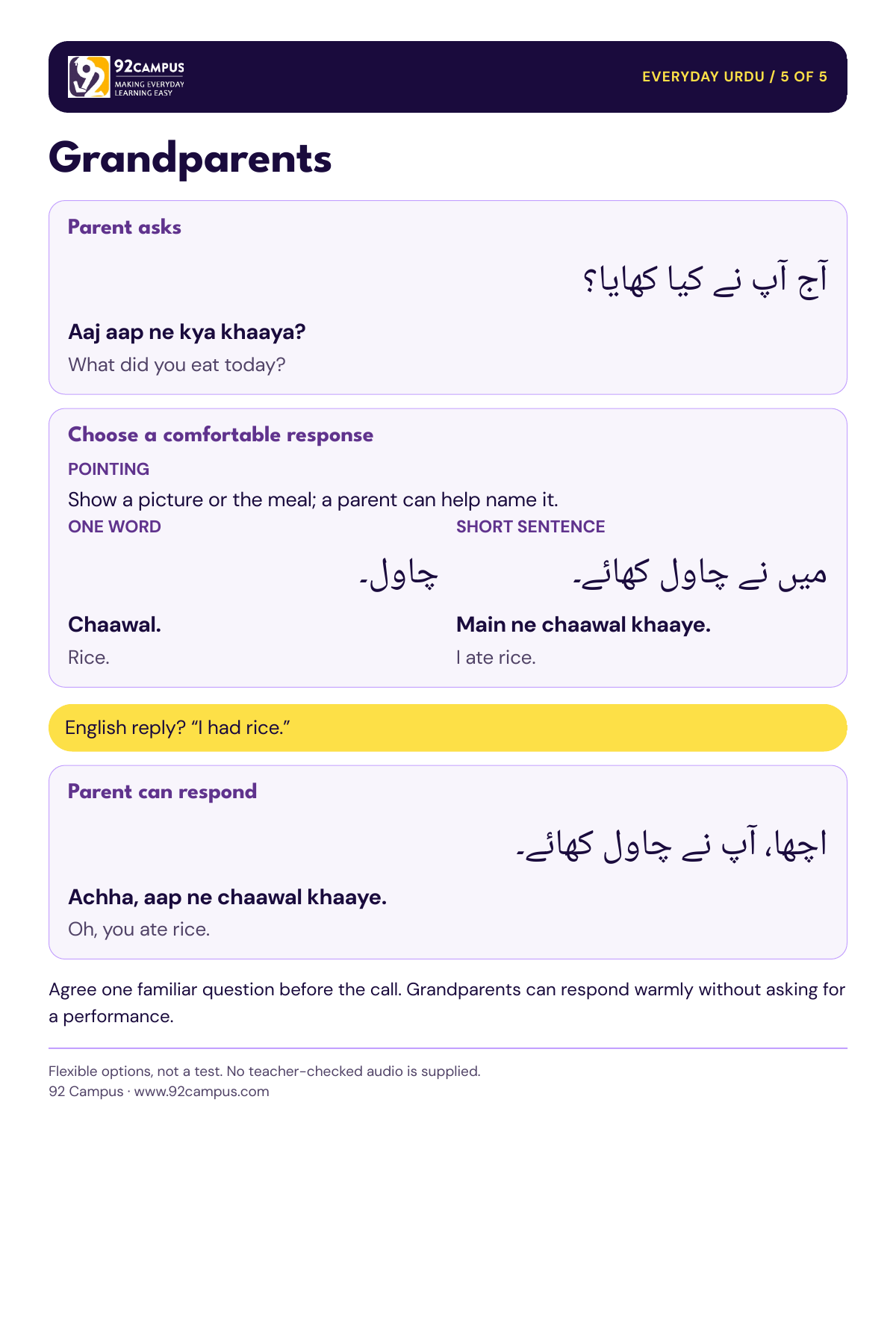
5. Grandparents
Parent asks
آج آپ نے کیا کھایا؟
Aaj aap ne kya khaaya?
What did you eat today?
Pointing option: Show a picture or the meal; a parent can help name it.
Single-word option
چاول۔
Chaawal.
Rice.
Short-sentence option
میں نے چاول کھائے۔
Main ne chaawal khaaye.
I ate rice.
If your child replies in English: “I had rice.”
A supportive parent response
اچھا، آپ نے چاول کھائے۔
Achha, aap ne chaawal khaaye.
Oh, you ate rice.
Agree one familiar question before the call. Grandparents can respond warmly without asking for a performance.
Open the grandparents conversation card
Practise the exchange through play
A role-play can begin with two toys, two pretend drinks or a small family photograph. You do not need a separate lesson setup.
During a toy-shop game, offer the ball and the car using the play card. Accept a point, name the toy and start playing. On another turn, offer the same short phrase. Let your child become the shopkeeper and ask you the question if they want to.
For an older child, choose a more useful goal: ordering a snack, explaining a game, sending a brief message or asking a relative a question. Let them help choose the topic. Do not require a twelve-year-old to use a younger child’s game if they find it uncomfortable.
Expand one word without turning it into correction
If your child says “Paani,” you can answer, “Mujhe paani chahiye? Achha”—modelling a possible fuller request before continuing. You can also simply say the fuller phrase once as an example, then respond to what was asked.
When a child mixes languages, keep listening to the meaning. ASHA’s guidance describes mixing words or grammar across languages as an expected part of multilingual use. A mixed answer is not, on its own, evidence of confusion. You can offer a natural Urdu version without interrupting every sentence. See the guidance on multilingual language use.
Choose a useful phrase to revisit rather than correcting every detail. If you are unsure about a word or sentence yourself, ask a confident speaker or tutor instead of presenting a guess as the only correct form.
Help relatives join the conversation
Before a call, agree one familiar question with a grandparent. Your child might show their lunch or a drawing while you help with a word. Ask relatives to allow a pause and respond to the message rather than saying, “You still cannot speak Urdu?”
A short connection is enough for that occasion. If the child wants to tell a longer story in English, help the family understand it; a relationship does not have to wait for a language target.
Keep a small practice log, not a fluency countdown
Record a few meaningful exchanges so you can see what to reuse. Separate understanding from the response used, and note the help provided. “Answered after hearing a model” is different from “Used the phrase independently.”
Illustrative entries, not an actual child’s progress| Situation | Understanding noticed | Response and support | Next opportunity |
|---|---|---|---|
| Meal | Chose the requested drink | English reply; parent named paani | Offer the same familiar choice |
| Play | Understood the two toy choices | Said gaind after a model | Repeat in play; no demand for a sentence |
| Family call | Needed the question simplified | Showed a meal photo; parent helped | Prepare one familiar question together |
Blank log fields: date or occasion; situation; understanding noticed; pointing/English/mixed Urdu/Urdu response; copied or independent; help provided; next comfortable opportunity. An English answer does not make the entry a failed session.
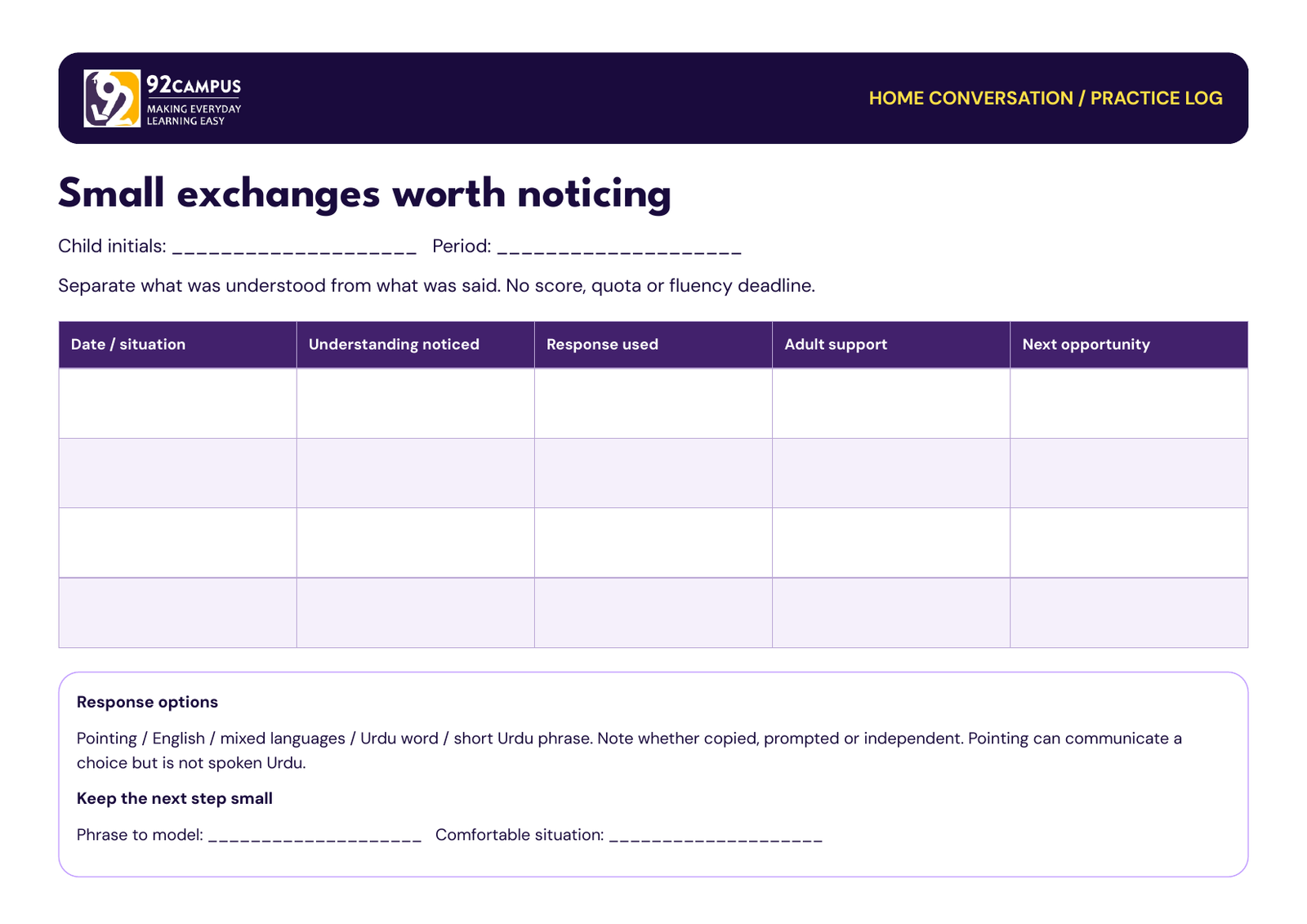
Open the blank Urdu practice log. You can also copy the fields into a notebook.
At the next review, ask whether the child is joining more comfortably, using a familiar word with less help or choosing a topic themselves. These are observations to discuss, not a promise that full Urdu sentences will arrive within a set number of weeks.
When Urdu lessons may offer a useful next step
Consider individual support when you would like clearer speaking goals, help modelling phrases or activities matched to what your child already understands. Explain the goal precisely: “They follow everyday Urdu, but mostly answer in English. We would like help with short family conversations.”
92 Campus’s Urdu Reading, Writing and Speaking course describes separate starting-point checks and role-play for everyday conversation. Discuss the balance you need rather than assuming that reading worksheets alone will address a speaking goal. Confirm the available tutor’s teaching-language support and suitable starting activities with the team.
You can explore the course options and learning resources without treating this guide as a course brochure.
When the concern is broader than replying in English
This article cannot assess a child’s language development. If you are concerned about their communication or understanding across the languages and settings they use, discuss your observations with a qualified speech-language professional. Replying in English alone is not a diagnosis. ASHA provides guidance on seeking support.
For your next conversation, choose one ordinary moment. Ask something useful, hear the answer and offer a little Urdu your child can use. The goal is a conversation they can join, not a performance they must pass.
Share your child’s understanding and speaking goals and discuss a suitable starting point in an Urdu trial. Tutor availability and the plan are confirmed with the team.
Join the conversation
Comments are reviewed before publication. Your name and approved comment will be public. Please leave out private learner or contact details.