
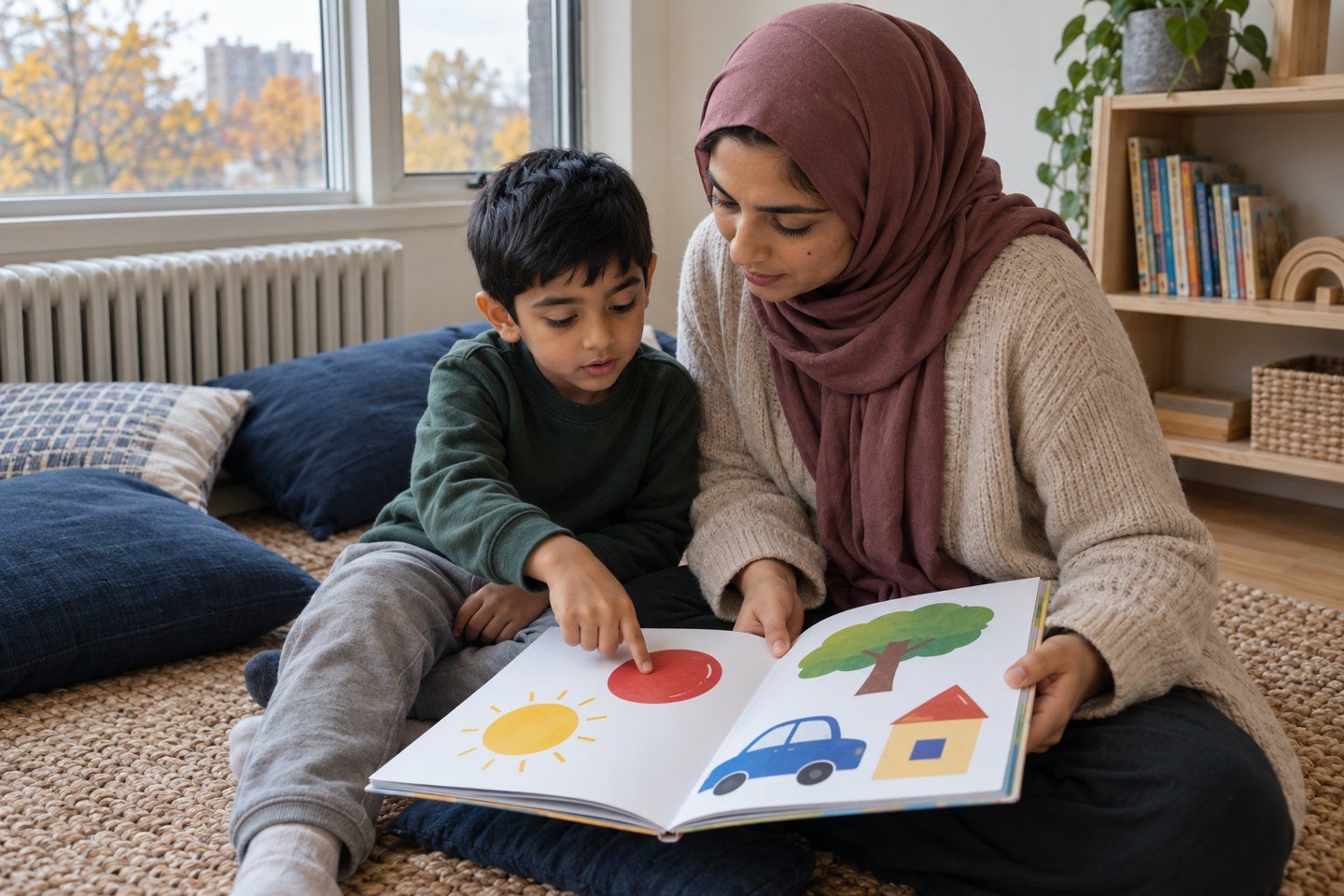
You open an Urdu–English storybook with your child. Both versions are on the page, and you suddenly have several decisions to make. Should you read everything twice? Translate each sentence? Ask your child to read the Urdu? What if they want to answer in English?
Begin with a smaller aim: share the story and give your child a comfortable way to join in. You can read aloud, notice a useful Urdu word and talk about a picture without making every page an independent reading test. Decide which goal matters for this reading, then adjust the support.
This guide is for Urdu-using families whose children are ready for picture-book discussion or early reading. The walkthrough is an original illustrative activity, not an extract from a published book or a teacher-reviewed lesson. Urdu language and teaching review of the activity remain pending.
Choose the purpose before choosing a language pattern
Understanding the story, recognising a written Urdu word and answering a question in Urdu are different tasks. A child can understand an event explained aloud without being able to decode the sentence. A child who points to the right picture has communicated a choice, but has not demonstrated independent Urdu reading.
- Story focus: you read, and the child follows the characters and events.
- Vocabulary focus: notice one or two words that matter in the scene.
- Reading focus: ask the child to try a short part they are ready to read, with help agreed with a tutor.
- Discussion focus: invite a choice, a brief answer or a retelling.
You do not have to achieve all four on every page. “Today we’ll enjoy the story and notice the word for ball” is a clearer plan than “Today you must speak and read Urdu throughout.”
Do we read both languages or translate every sentence?
There is no single pattern prescribed by this guide. Try one that fits the learner and book:
- Urdu first, English when needed: read a short Urdu section, look at the picture and use English to clarify a confusing event or term.
- Establish the story, then revisit Urdu: if the story is unfamiliar, use the language the child follows comfortably, then return to a manageable Urdu line or word.
- Different languages on different readings: enjoy one version now and another later, if the child wants to revisit the book.
These are editorial options, not a ranked set of proven methods. If sentence-by-sentence repetition makes the story difficult to follow, simplify the routine. If the child asks what a line means, use the printed translation or an explanation you can give accurately. Do not guess just to keep the exchange in Urdu.
For a reading goal, distinguish reading the printed Urdu from remembering its English partner. Covering or revealing a translation is a choice to agree with the tutor, not an automatic requirement for every shared-reading session.
What the Canadian research does—and does not—show
Ayesha Asif’s 2025 MA thesis at Wilfrid Laurier University examines Urdu–English language switching during shared reading with children aged 4–6 in Canada and Pakistan. The university’s public abstract describes 30 parent–child pairs in each location and interactions around three books. It reports language switching during reading and explanation.
This is directly relevant to the family activity, but it does not establish national prevalence, search demand or that the routine in this article produces a particular outcome. The full thesis is not yet publicly downloadable according to the repository, so the description here is limited to its abstract.
For your family, use a language choice as something to observe and adapt. “Did my child follow that event?” is a more practical immediate question than “Did we use the perfect balance of languages?”
An original two-sentence walkthrough
Illustrative mini-story: the lines below were written for this guide. They are not taken from a commercial book. Imagine a simple picture showing Ali with a red ball, followed by a picture of him giving it to Sara.
علی کو ایک سرخ گیند ملی۔
Roman Urdu: Ali ko aik surkh gaind mili.
English: Ali found a red ball.
اس نے گیند سارہ کو دے دی۔
Roman Urdu: Us ne gaind Sara ko de di.
English: He gave the ball to Sara.
Read the lines aloud yourself if your child is listening rather than decoding. Use the pictures to establish the event: Ali has the ball, then gives it to Sara. Roman Urdu is a parent identification aid here; it is not the same as learning to read Urdu script.
Notice one useful word
Choose گیند — gaind, “ball.” Point to the picture and, if appropriate, show the printed word. Say: “Here is the ball. This word is gaind.” Do not assume that pointing at the picture means the child recognises the written word.
Offer different ways to respond
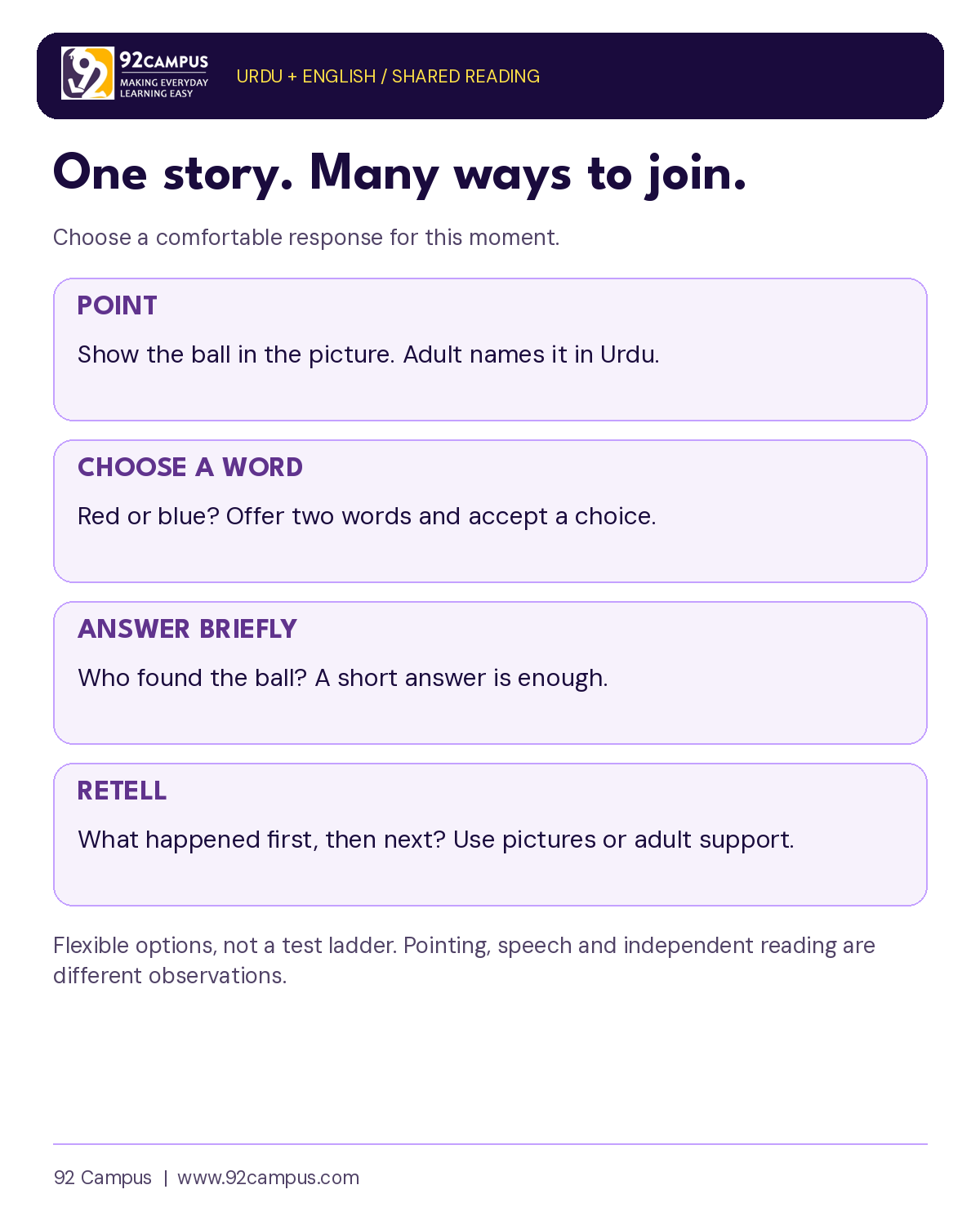
Use whichever response fits the child in that moment. These are options, not compulsory steps to finish in one session.
- Pointing: “Can you show me the ball?” Accept a point. Name it in Urdu yourself.
- Choosing a word: ask گیند سرخ ہے یا نیلی؟ — Gaind surkh hai ya neeli? — “Is the ball red or blue?” A possible one-word answer is سرخ — surkh, “red.”
- Answering briefly: ask گیند کس کو ملی؟ — Gaind kis ko mili? — “Who found the ball?” A possible answer is علی کو۔ — Ali ko. — “Ali.”
- Retelling: “Tell me what happened first and then.” A possible short Urdu retelling is علی کو گیند ملی۔ اس نے گیند سارہ کو دے دی۔ — Ali ko gaind mili. Us ne gaind Sara ko de di. — “Ali found the ball. He gave it to Sara.”
If your child says “red” in English, acknowledge the answer and offer the Urdu word: “Yes, surkh.” You can keep the conversation moving without requiring a repetition each time. Note separately that the child answered using English; do not record that as independent Urdu speech.
Ask a question that connects to the event
“Who has the ball after Ali gives it away?” Return to the second line or picture if the answer is unclear. If you ask “Why do you think he gave it to Sara?”, label the answer a guess about the character’s reason. The two sentences do not tell us his motive.
This distinction keeps discussion honest: what the story states, what the picture shows and what we imagine are not always the same. A tutor can help choose questions that fit a real book and the child’s understanding.
When should my child read independently?
Choose a small part that matches their current reading. The adult can read most of the story while the learner tries one known word or short line. Let them ask for help and clarify whether they are reading the text, repeating your model or recalling a familiar story.
If decoding takes all their attention, you can read the next part aloud and return to the story’s meaning. Bring a specific example to the tutor: “They recognised this word after a model, but needed help joining this sentence.” That is more useful than describing the entire book as easy or difficult.
Keep reading and conversation records separate. “Explained the event in English,” “chose an Urdu word after two options” and “read the Urdu line without a model” describe different things. None needs to erase the others.
Choose a book you can use accurately
Look for clear pictures, readable Urdu type, manageable text and both language versions you can follow. Preview the story for family suitability and unfamiliar vocabulary. Publisher levels are starting information, not guarantees that a particular child will find the book suitable.
A free place to explore is Storybooks Canada’s Urdu version of Two, written by Carole Bloch, illustrated by Richard MacIntosh and translated into Urdu by Samrina Sana. The page offers language switching, narration and Urdu–English download options. It is a separate published resource, not the source of the original mini-story above.
Use the resource on its own site and check its terms before reproducing it. No pages, illustrations or audio from that book are included in this package. The guide’s examples are suggestions for discussion, not an endorsement of every resource or a request to purchase a particular book.
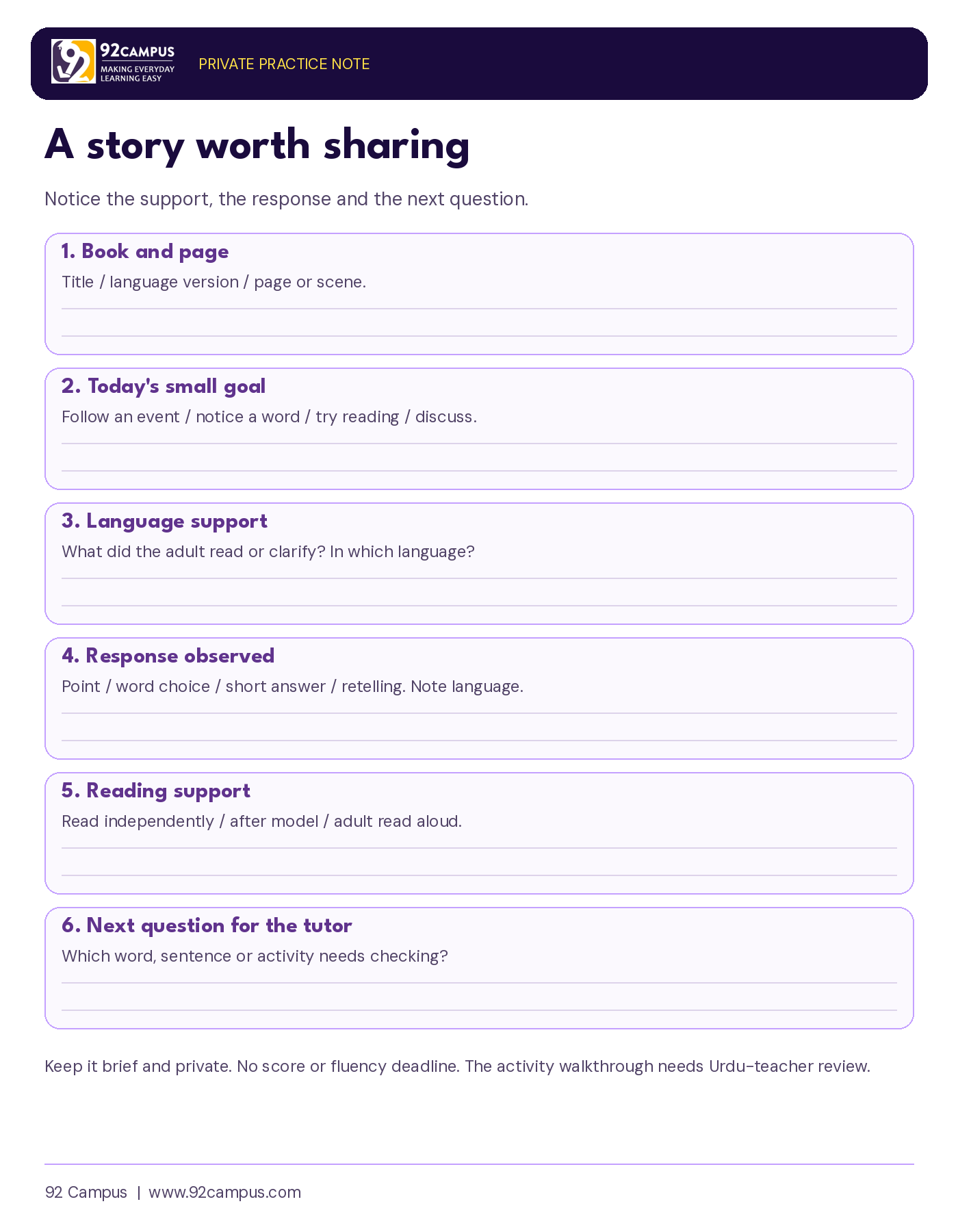
Keep a small reading note
Download the shared-reading note, or write five headings: book/page, goal, language support, response observed and next question. A short note is enough; do not turn story time into continuous scoring.
Illustrative entry: “Original ball mini-story. Goal: follow who receives the ball. Adult read Urdu and clarified the event in English. Child pointed to the ball and answered ‘Sara’ after hearing the second line. Next time: revisit gaind and ask the tutor which written word is suitable to practise.”
If your child wants the same book again, choose whether to revisit the story, a word or a different question. If they lose interest, finish at a natural stopping point and reconsider the selection. There is no required number of pages or guaranteed speaking deadline in this plan.
Turn the reading into a useful tutor conversation
92 Campus’s Urdu lessons offer a place to discuss reading and language goals. Share what the child can understand, say and read, along with a short book example. Ask the tutor to check the wording and choose an appropriate next task rather than assuming that every learner needs the same book or activity.
The academy’s course connection is assessment and suitable practice selection, not a promise that this editorial routine has been tested by its tutors. The walkthrough needs actual Urdu-teacher review before being described as teacher-approved.
Share your child’s Urdu reading and understanding goals to discuss suitable practice with a tutor.
Join the conversation
Comments are reviewed before publication. Your name and approved comment will be public. Please leave out private learner or contact details.