
You say, “Kal chhutti hogi,” and your child asks, “Was the day off yesterday?” They remember hearing kal in a story about something that already happened. Now the same word seems to point the other way.
That is a useful question to explore together. In these everyday time expressions, کل (kal) can mean yesterday or tomorrow. Instead of asking your child to guess from that word alone, give them a complete sentence and a clear reference point: today.
This guide offers a three-day activity, paired examples and blank and filled discussion notes for families learning Urdu alongside English. The practice ideas are editorial suggestions; they are not a diagnostic test or a fixed grammar curriculum.
The word stays the same; the sentence supplies clues
Rekhta Dictionary’s entry for kal includes both tomorrow and yesterday. Michigan State University’s Basic Urdu chapter on tense and aspect illustrates how Urdu verb forms express time, including past and future sentences with kal.
For a child, the useful first question is not “What does kal always mean?” It is “Are we talking about something before today, or something after today?” The verb and the surrounding conversation help. You do not need to introduce every tense name to begin.
A standalone message such as “kal?” may be unclear without the conversation around it. Asking the speaker to clarify is a sensible response. There is no need to teach a rule that every use must be understandable from one word or one ending.
Make today the middle of a three-day strip
Take three paper cards. Label them in English “Yesterday”, “Today” and “Tomorrow”, and add آج (aaj) to the middle card. Put them in that order for this activity. This is a time-order diagram using English labels, not a lesson about the direction of Urdu writing.
Add a date or a familiar event to today’s card so your child knows where the explanation begins. Then say: “Yesterday is the day before this. Tomorrow is the day after this.” If those English ideas are not yet clear, explore them with familiar events before adding Urdu sentences.
The side cards can both show kal, but keep their English meanings visible during the demonstration. Seeing the same word in two places is the point. Covering labels can be a later listening option, not a requirement.
Use a matched pair about a day off
These are illustrative language examples. Choose them only when a day off is familiar to your child; do not use the future sentence to announce an actual school closure.
Looking back
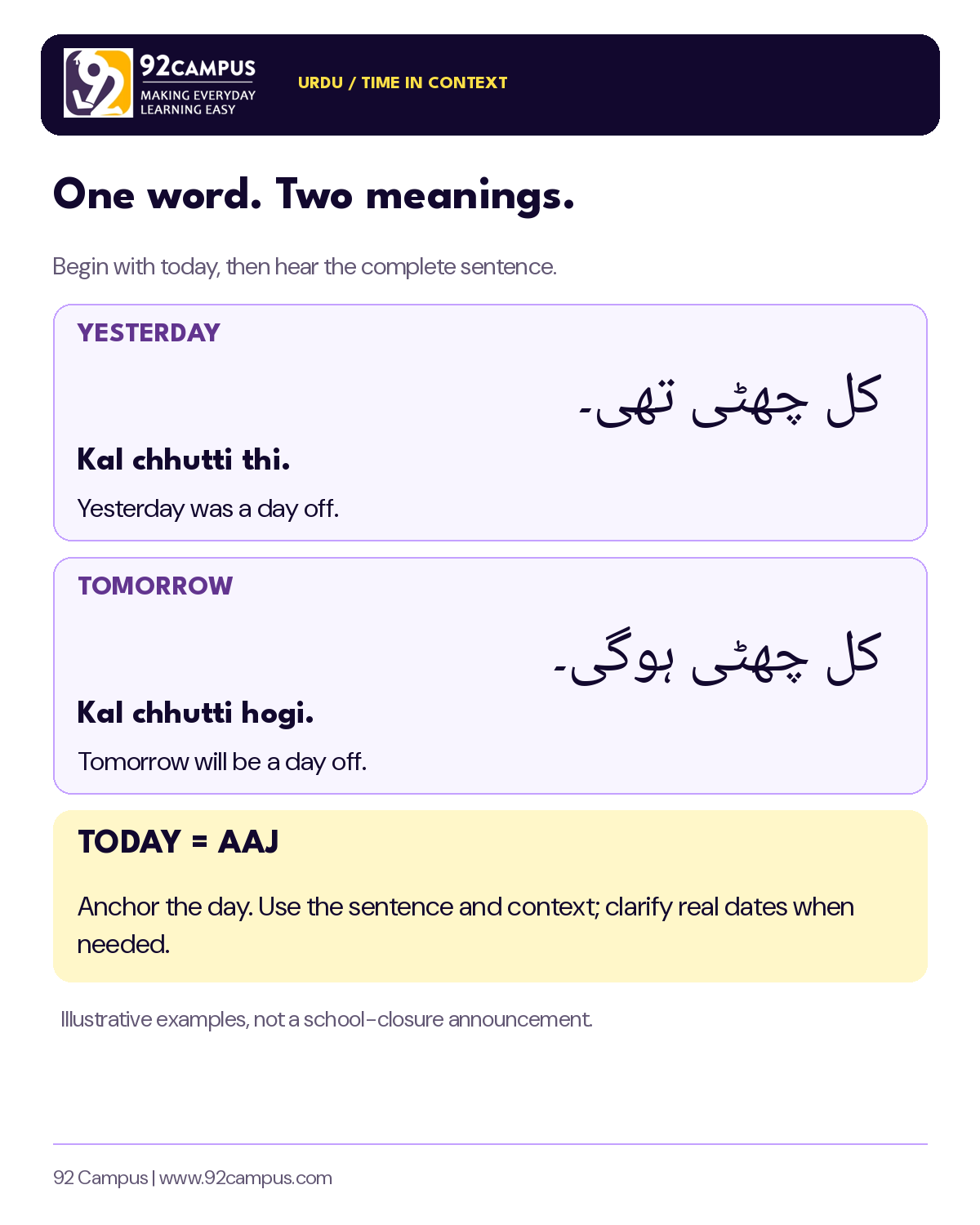
کل چھٹی تھی۔
Kal chhutti thi. — Yesterday was a day off.
Place a paper token on “Yesterday”. Explain the whole meaning, then draw attention to thi in this sentence. The child may point, select the card or say “yesterday”. All are ways to join this meaning activity; only a spoken Urdu response is Urdu speaking practice.
Looking ahead
کل چھٹی ہوگی۔
Kal chhutti hogi. — Tomorrow will be a day off.
Move the token to “Tomorrow”. Compare the complete sentences: kal remains, while thi and hogi give different time information. Let the child hear the pair again if useful.
Keep the English meaning and Roman Urdu beside the script for the adult. Roman spelling is an approximate aid, not a substitute for hearing natural speech. Ask a tutor to model a phrase you cannot confidently say yourself.
Change the event while keeping the question clear
Once the first pair is familiar, another optional pair is:
- کل میچ تھا۔ Kal match tha. — The match was yesterday.
- کل میچ ہوگا۔ Kal match hoga. — The match will be tomorrow.
The event word has changed, and so have the matching verb forms. Do not tell a child that thi and hogi are the only possible clues in Urdu. Model the whole phrase rather than making them construct it from a memorised ending.
For a listening turn, say one complete sentence without pointing at the answer card. Change the order instead of always saying yesterday first. Note whether the child chose before a repeat, after a repeat, or after an English explanation. These are observations about this turn, not proof that every future conversation will be understood.
Three parent responses that keep the conversation useful
“But you said kal meant yesterday!”
Parent: “It did in that sentence. This sentence is about tomorrow. Let’s hear the whole sentence and put it next to today.” You are adding context rather than treating the child’s earlier learning as wrong.
The child points to the wrong card
Parent: “Let’s listen together: kal chhutti hogi. That means tomorrow will be a day off.” Show the matching card. If they move the token after your explanation, call it supported practice. There is no need to repeat the same question until the answer looks independent.
The message really is ambiguous
Parent: “We need to check which day the person means.” In an actual appointment message, confirm the weekday and date rather than relying on a guessed translation. The activity teaches a language distinction; it does not confirm lesson bookings.
What changes when tomorrow becomes today?
Return to the strip on another day if it fits naturally. Update the middle card first. Yesterday and tomorrow now refer to different dates because the reference point has changed.
For example, in a made-up situation where today is Wednesday, yesterday is Tuesday and tomorrow is Thursday. When today is Thursday, Wednesday becomes yesterday. Use the actual day names on your own cards, and keep the earlier sentence attached to the day on which it was said if you are discussing a message.
There is no need to add all seven Urdu day names at the same time. Keep this activity about the direction of time and the complete sentence. A calendar list and a language-in-context task serve different purposes.
Keep a blank note and a filled example
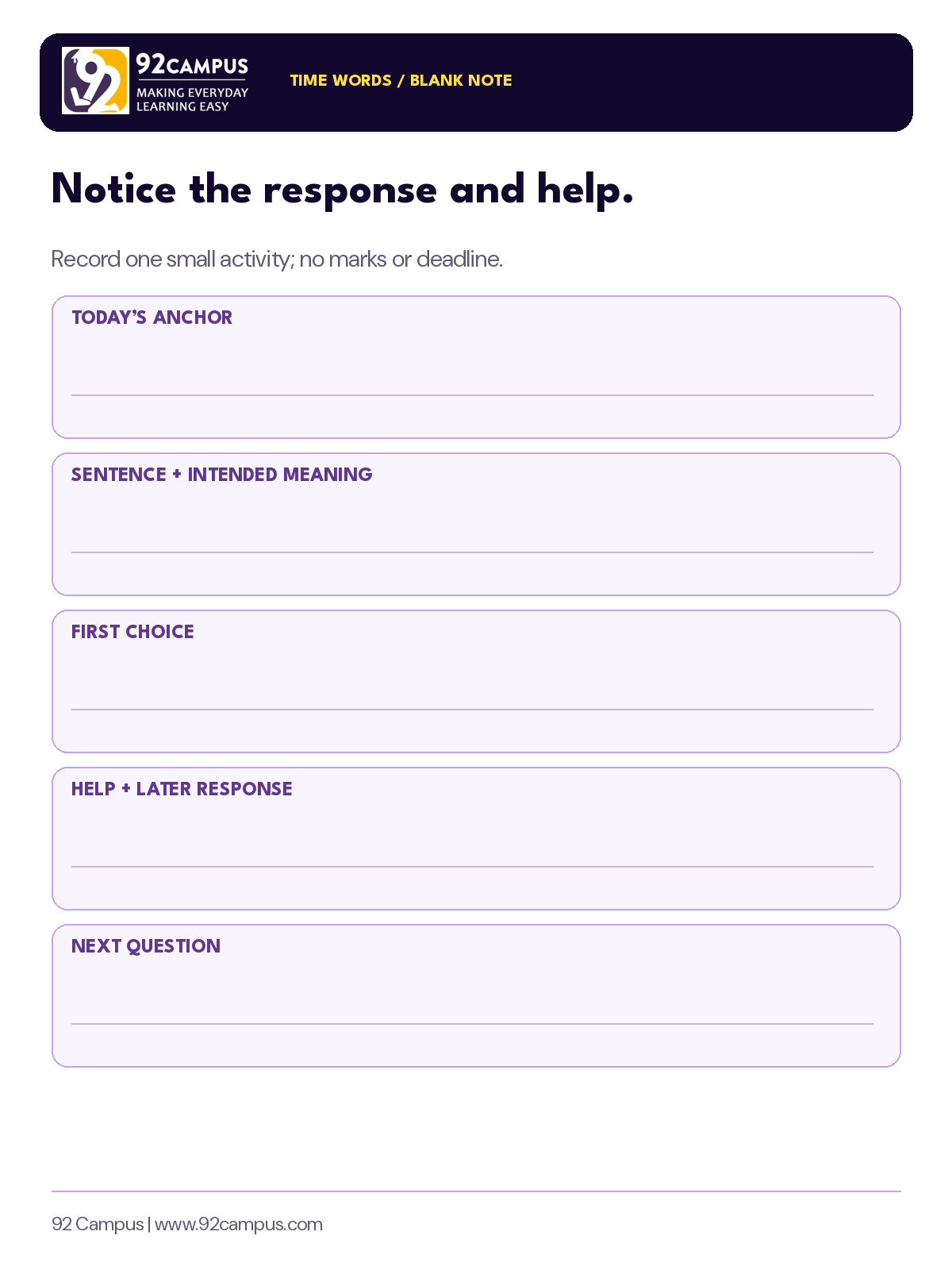
Use five fields: today’s anchor; exact sentence; first choice or explanation; help given; next question. Keep the sentence and its intended meaning in the note so a tutor can see what the child actually heard.
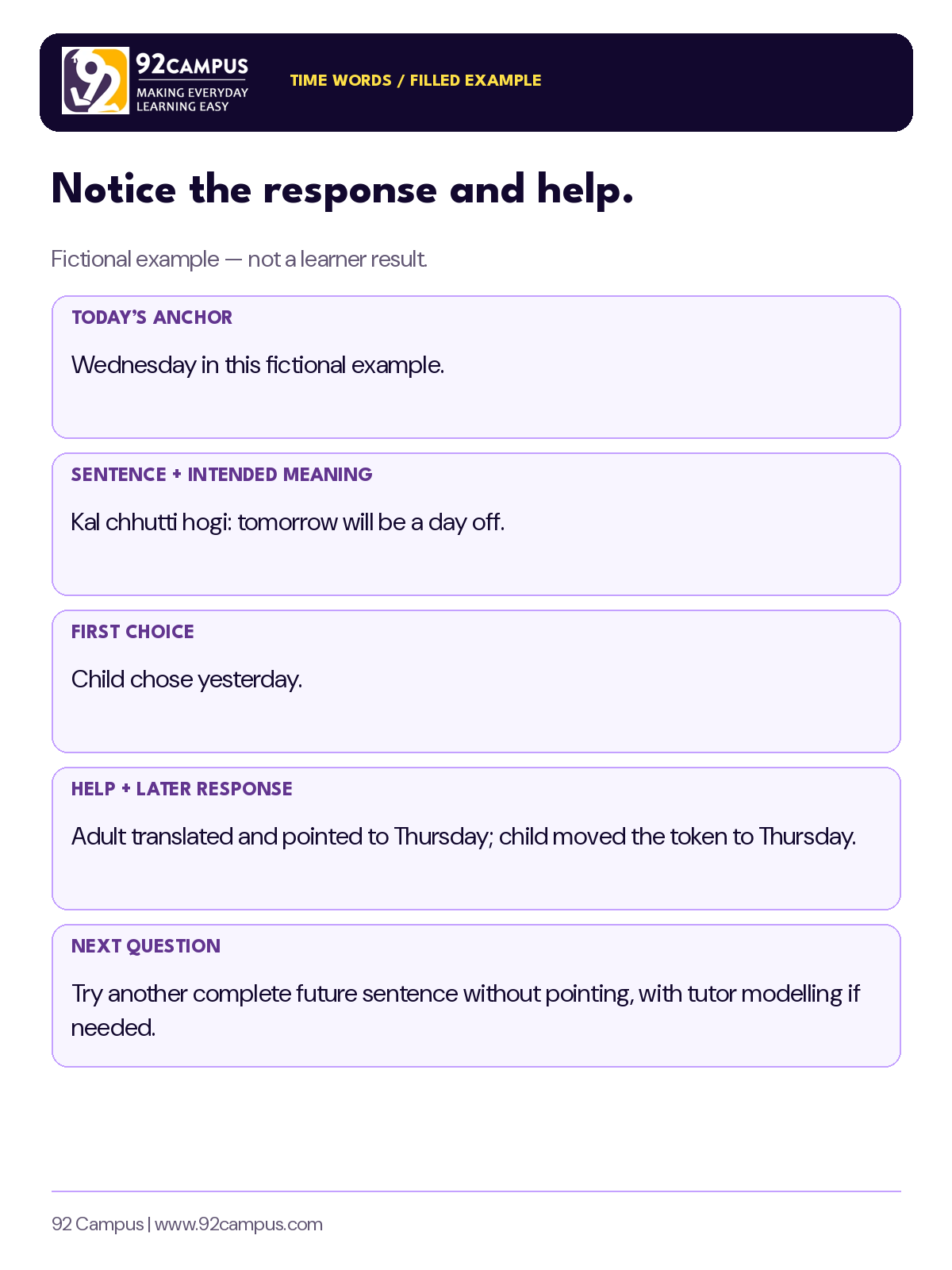
Filled illustrative example: Today’s anchor: Wednesday. Sentence: Kal chhutti hogi, intended as tomorrow. First choice: yesterday. Help: adult translated the sentence and pointed to Thursday. Response afterwards: child moved the token to Thursday. Next question: try another complete future sentence without the pointing cue, with tutor modelling if needed.
This fictional record shows understanding after support. It does not claim the child independently interpreted kal, or that a particular number of sessions will make the skill permanent.
Take one exact sentence to the tutor
Rather than reporting “My child doesn’t understand Urdu time words”, share the sentence, what happened and what help made it clear. That gives the tutor a specific starting question: does the learner need familiar vocabulary, a clearer timeline or more examples of a sentence pattern?
If your child understands the sentence but answers in English, the Urdu speaking-confidence guide discusses ways to keep the exchange going. If you meet time expressions in a story, the shared-reading guide can help you discuss events without translating every line.
92 Campus Urdu lessons include listening and conversation alongside reading and writing. Share an example your child found confusing and discuss a suitable starting activity. A trial request is confirmed after the team checks tutor availability and agrees the local time.
Join the conversation
Comments are reviewed before publication. Your name and approved comment will be public. Please leave out private learner or contact details.