

Your child reads a familiar Urdu exercise with zabar, zer and pesh, then opens a storybook and starts trying different pronunciations. You may wonder whether the earlier progress was real—or whether you should put vowel marks on every page.
The earlier learning still matters. The new text is asking your child to read with fewer written pronunciation cues. A useful next step is to notice what changes: recognising the letters, supplying a missing vowel, knowing the spoken word or understanding the sentence. Those observations give a tutor something specific to work with.
This guide is for parents whose children already read simple marked words or sentences. It offers a small comparison and an observation sheet, rather than a universal sequence for removing marks.
What changes when Urdu vowel marks are omitted?
Zabar, zer and pesh are short-vowel signs placed above or below letters. Ordinary Urdu print often leaves these cues unwritten. Gregory M. Bruce’s University of Texas script resource explains both the signs and the ambiguity their omission can create. Familiar vocabulary and knowledge of word patterns can help a reader supply information the print does not spell out.
“Without vowel marks” does not mean “without any vowels.” Letters such as alif, wao and ye still contribute information to the spelling. Nor does it mean removing the dots that distinguish letters. Keep the spelling intact; a teacher-prepared comparison should change only the intended pronunciation cues.
A familiar spoken word may be easier to recognise in unmarked print than a word the child has never heard. Sentence meaning can also help distinguish possible readings. However, context is something to check alongside the written letters, not permission to substitute any word that fits the picture.
Look at three questions separately
1. Does my child know the word when hearing it?
Say the word naturally without showing its spelling. Ask for a meaning, an example or a simple choice. If the child does not know it orally, explain it before expecting independent reading. Pronouncing a new word correctly after a model does not necessarily mean understanding it.
For example, a child may recognise the spoken word for “book” but not the word for “lesson.” Needing help with the second word is useful vocabulary information, even if the child also needs a vowel cue.
2. What difference does a written cue make?
Compare the same word with and without a selected short-vowel sign, keeping its letters, size and typeface the same. Notice whether the child can identify the letters and whether the cue changes the attempt. If both forms are difficult, ask the tutor to check the reading task more broadly.
If your child reads a word after you supply it aloud, record “after an oral model.” If a vowel mark helps, record that instead. These are different kinds of support; neither should be written down as fully independent reading.
3. Can my child explain the sentence?
After a manageable line, ask a question about its actual meaning. An English explanation, a brief Urdu answer or a suitable gesture can help you see what was understood. Record the response language separately if Urdu speaking is another goal.
The guide to understanding Urdu but replying in English discusses listening and speaking. Here, the separate question is what the learner can recognise and understand in print. A confident conversation does not, by itself, establish independent reading.
An original marked and unmarked comparison
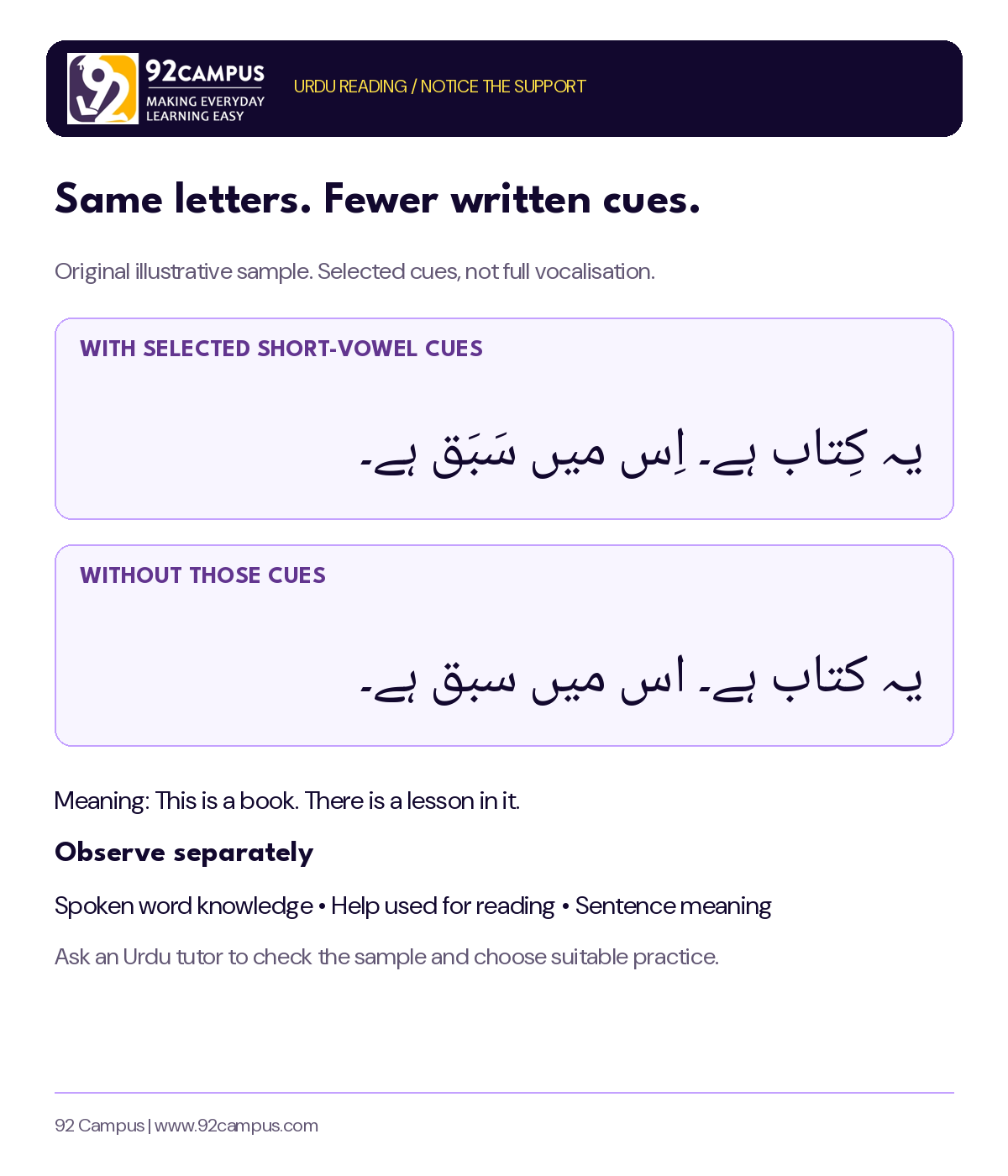
Illustrative editorial sample: these two sentences have selected short-vowel cues in the first version. They are not fully vocalised, a standardised test or a teacher-approved lesson. Ask an Urdu tutor to check the sample and its suitability before using it as a pronunciation model.
With selected short-vowel cues
یہ کِتاب ہے۔ اِس میں سَبَق ہے۔
Without those short-vowel cues
یہ کتاب ہے۔ اس میں سبق ہے۔
Meaning: “This is a book. There is a lesson in it.” The letters and meaning are unchanged; the first version adds selected pronunciation information. The cue in کِتاب supports the initial short vowel. In سَبَق, the selected marks indicate short vowels within the word.
Try one useful comparison, with the tutor’s guidance
- Check the spoken vocabulary. Does your child understand the words for book and lesson when you say them? Explain an unfamiliar word without turning that moment into a reading score.
- Choose a starting version. If your child is comfortable, invite an attempt at the unmarked line to see what help is needed. If it is frustrating, start with the supported version. Record which came first.
- Offer specific support. At a difficult word, show the corresponding marked form or ask the tutor for a spoken model. Avoid supplying the whole sentence before the child has a chance to look.
- Return to the sentence. Ask, “What is in the book?” Accept an answer that shows the meaning, then note whether prompting was needed.
- Discuss the next task. The tutor might choose another sentence containing the same word, more spoken vocabulary work or further letter-and-vowel practice. The observation should inform that choice.
Rereading immediately after seeing the marked form or hearing a model is supported practice. It does not establish that the child would read a new unmarked passage independently. Keep that distinction in the record.
When a pronunciation is uncertain, check rather than guess
Some unmarked spellings can have more than one reading. A short excerpt may not supply enough information by itself. If you are unsure, ask a tutor to check the word in its sentence rather than presenting your own guess as the only correct pronunciation.
A supportive exchange might be: Child: “I’m not sure what this says.” Parent: “Let’s look at the letters first. Do you know this word when you hear it? We can check the vowel with your tutor.”
If the child chooses a different word that fits the story, say: “That idea fits the picture. Now let’s check whether these are the letters for that word.” This keeps meaning and attention to the print connected.
Should I add marks to every word?
You do not need to decide on a whole-book rule. Bring a short example to the tutor and ask which support is useful for the present task. Options to discuss include adding a cue to one target word, reading a supported version first, modelling an unfamiliar word aloud or choosing a simpler sentence.
Do not erase marks or remove help according to a fixed age, page count or weekly deadline. Equally, do not assume a successful marked reading automatically transfers to ordinary story print. Try a suitable next example and observe what the child actually does.
When comparing two forms, avoid changing the vocabulary, font and amount of text at the same time. If several things change, describe them rather than attributing every difficulty to the missing vowel marks.
Story enjoyment can continue while reading is still developing. You can read most of the book aloud and invite a small, suitable reading turn. The Urdu–English shared-reading guide offers ways to keep discussion and independent reading as separate goals.
Use a brief observation sheet
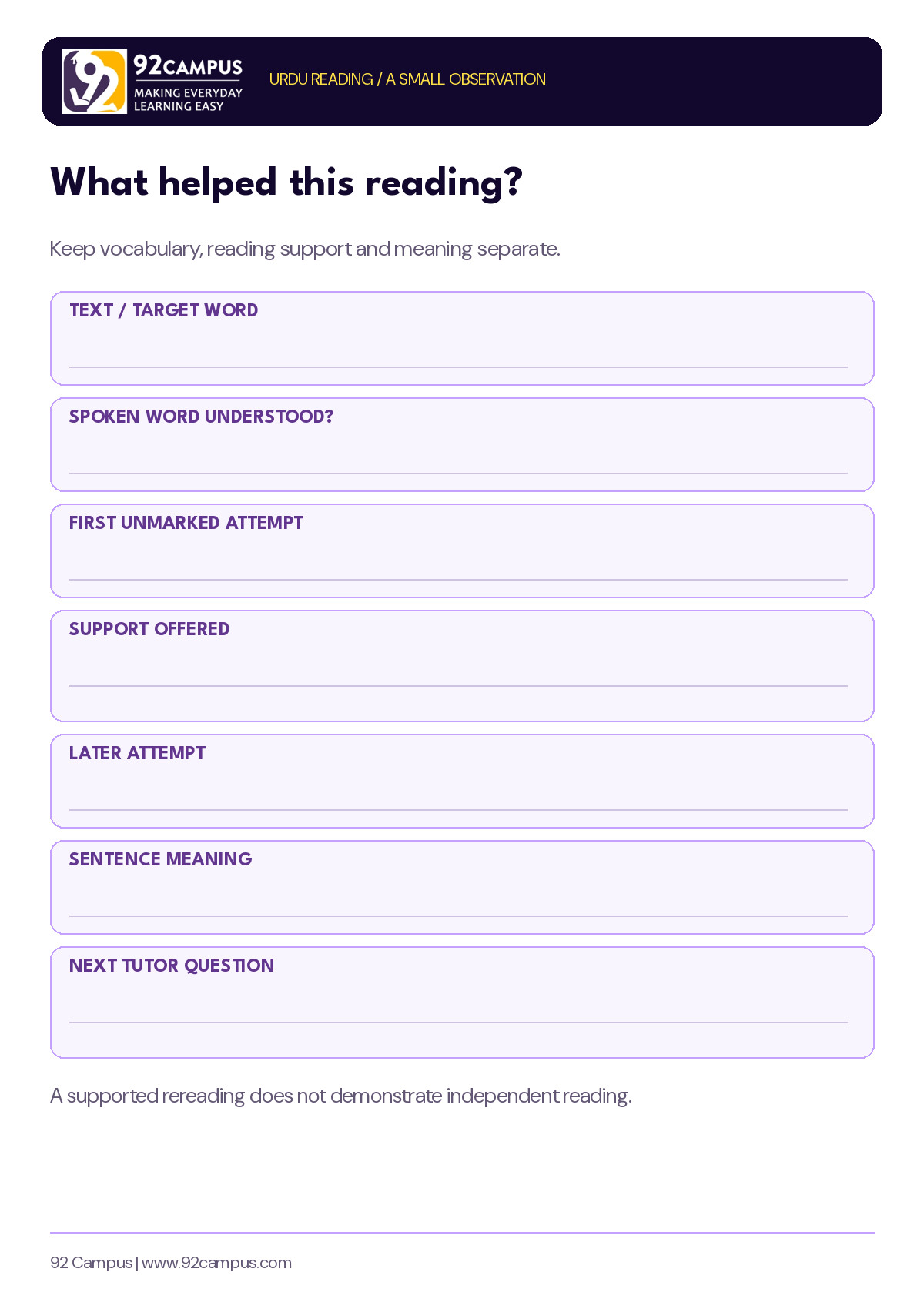
Save or print the blank sheet, or copy its headings onto paper: text and target word; spoken-word understanding; first unmarked attempt; support offered; later attempt; sentence meaning; next tutor question. Describe one short event. This is a learning note, not a diagnostic assessment.
Filled illustrative example: target word: “lesson” in the original sample; spoken understanding: needed an explanation; first unmarked attempt: paused and asked; support: meaning explained, marked form shown and spoken model given; later attempt: read the line after support; sentence meaning: answered “a lesson”; next question: “Which familiar-word sentence should we try next, and which cues should remain?”
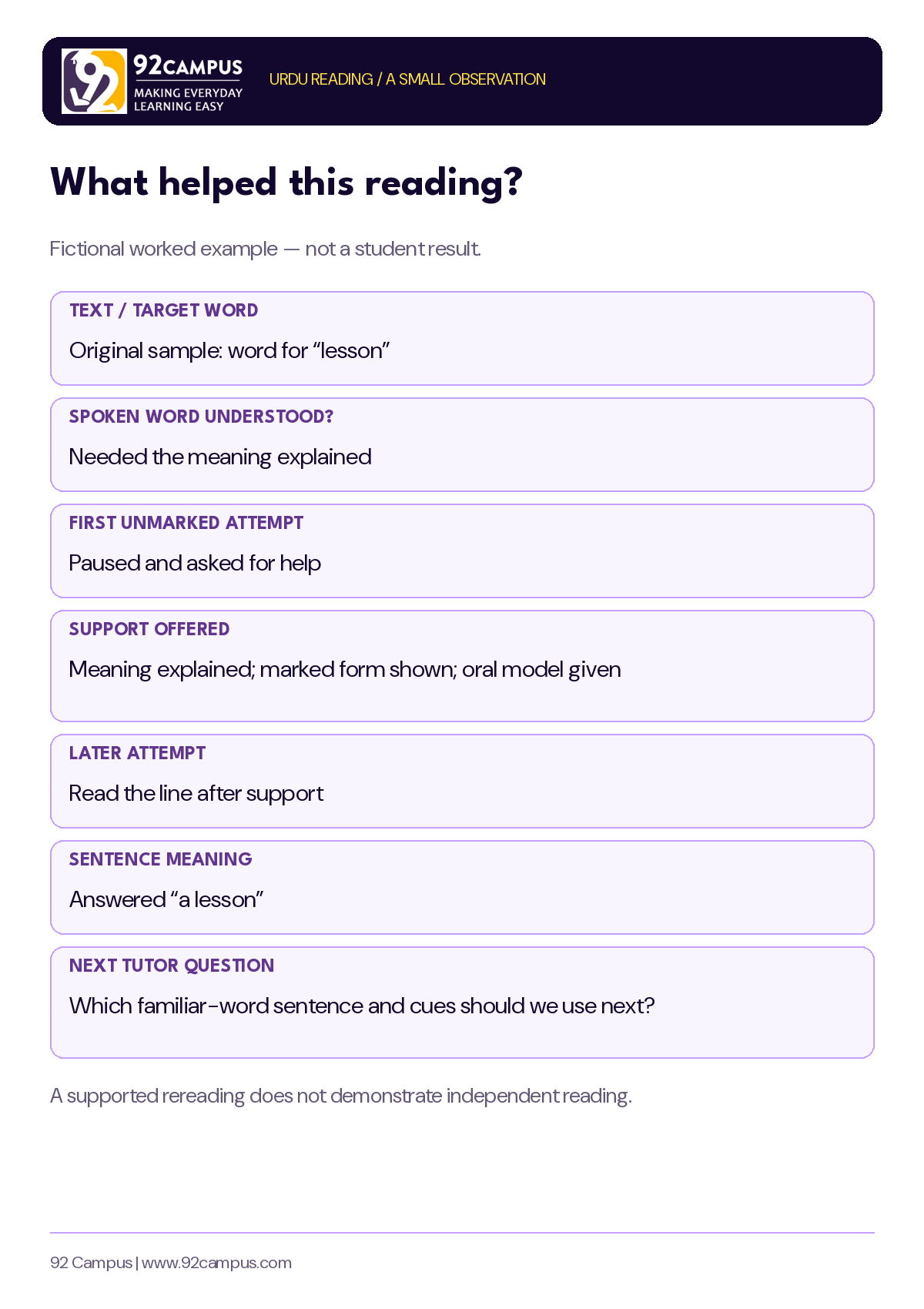
The example deliberately avoids a conclusion such as “the marks solved the problem.” Meaning was explained and a model was given as well. Tell the tutor exactly what happened so the next activity can be chosen more carefully.
What does research tell us?
A 2023 Linguistic Forum study reports that children in its Urdu-textbook reading study found marked text easier. Its abstract describes experimental and control groups with pre- and post-tests. That supports taking written vowel cues seriously; it does not establish a universal home-teaching sequence, diagnose an individual child or validate this article’s worksheet.
The practical suggestions here are editorial activities for discussion with a teacher. They are not a treatment programme or a promise of fluency within a set period.
Bring the actual text to the next lesson
Show the tutor a short passage your child can read with marks and one that causes difficulty without them. Explain whether the vocabulary was familiar, which help you supplied and what the child understood. Ask the tutor to model the target word and select an appropriate next reading task.
92 Campus Urdu lessons include reading everyday words and short level-appropriate sentences, with a starting-point assessment. Share a short example of what your child can currently read and ask which Urdu reading task would suit their next lesson. Confirm the relevant tutor support and teaching language with the team; a trial appointment is confirmed after availability is checked.
Join the conversation
Comments are reviewed before publication. Your name and approved comment will be public. Please leave out private learner or contact details.