
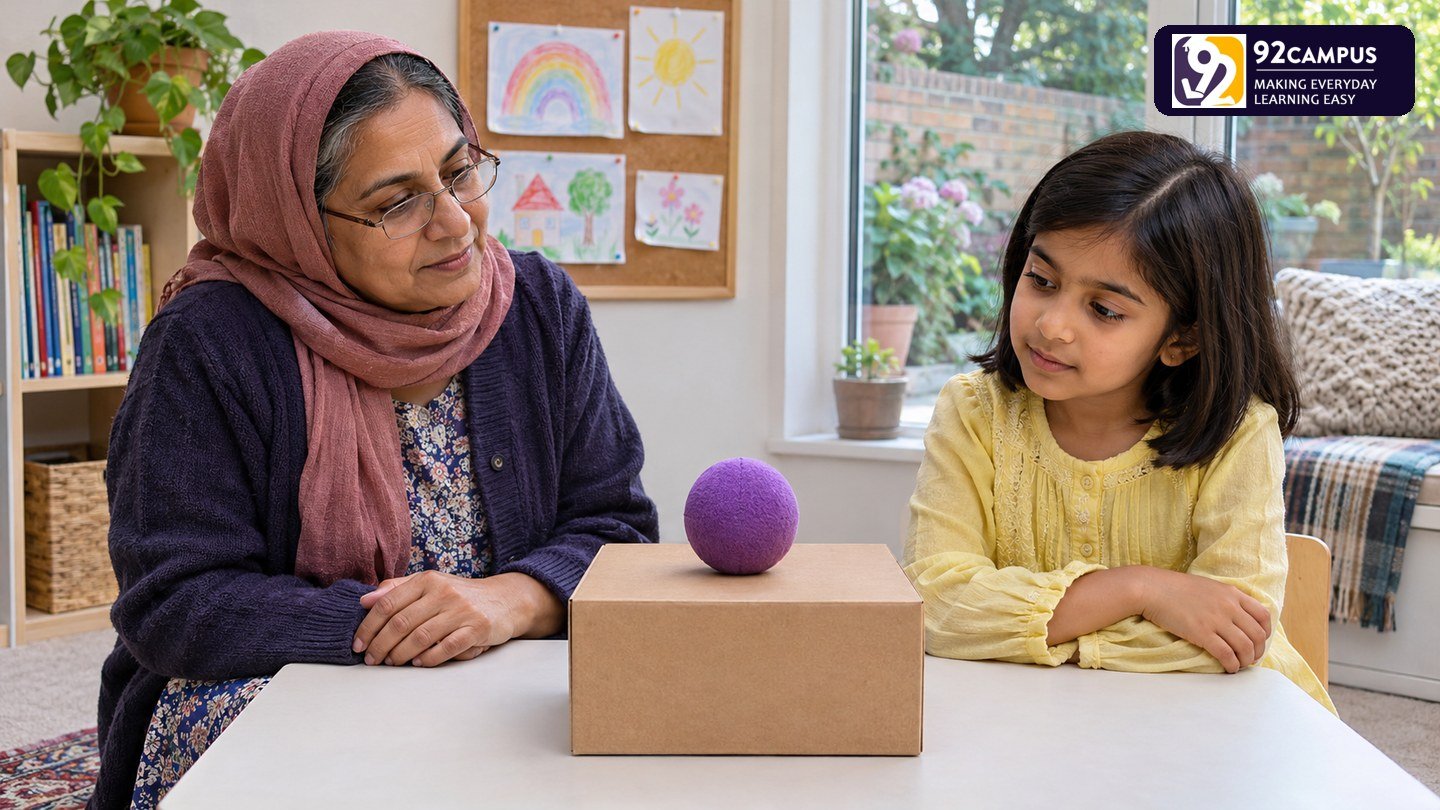
Your child knows the Urdu names for a ball and a box. You ask them to put the ball in the box, but it lands on top. When you demonstrate, they copy perfectly. Did they understand the location word, or follow your hands?
You can explore that question through a small home game. Keep the objects familiar, make the position easy to see, and notice what help accompanied the response. Repeating a word, copying a movement, choosing a picture from spoken Urdu, and describing a position are different things to record.
This guide introduces three Urdu location words with original diagrams, command cards and blank and filled observation sheets. All sample responses are illustrative. These are learning activities, not a speech assessment or developmental test.
The three location phrases to start with
Families often search for “Urdu prepositions for kids”. In Urdu grammar, these words are usually called postpositions because they follow the noun. Michigan State University’s Basic Urdu postpositions chapter explains this order and gives simple and compound examples.
In — میںmein — for this activity, the ball is inside the box. On — پرpar — for this activity, the ball rests on the box’s top surface. Under — کے نیچےke neechay — the ball is below the box.Use the complete phrase ڈبے کے نیچے (dabbay ke neechay, under the box) when modelling this relationship. You do not need to teach grammatical terminology before playing.
A note for adults: the naming form ڈبہ (dabbah, box) becomes ڈبے (dabbay) in these phrases. The MSU chapter on the oblique case explains noun-form changes before postpositions. Model the whole phrase rather than asking a beginner to memorise the rule.
Set up an easy-to-see demonstration
Choose one familiar ball and a light, empty box with a flat lid. A soft ball that stays in place is useful. First check that your child recognises the object names گیند (gaind, ball) and ڈبہ (dabbah, box).
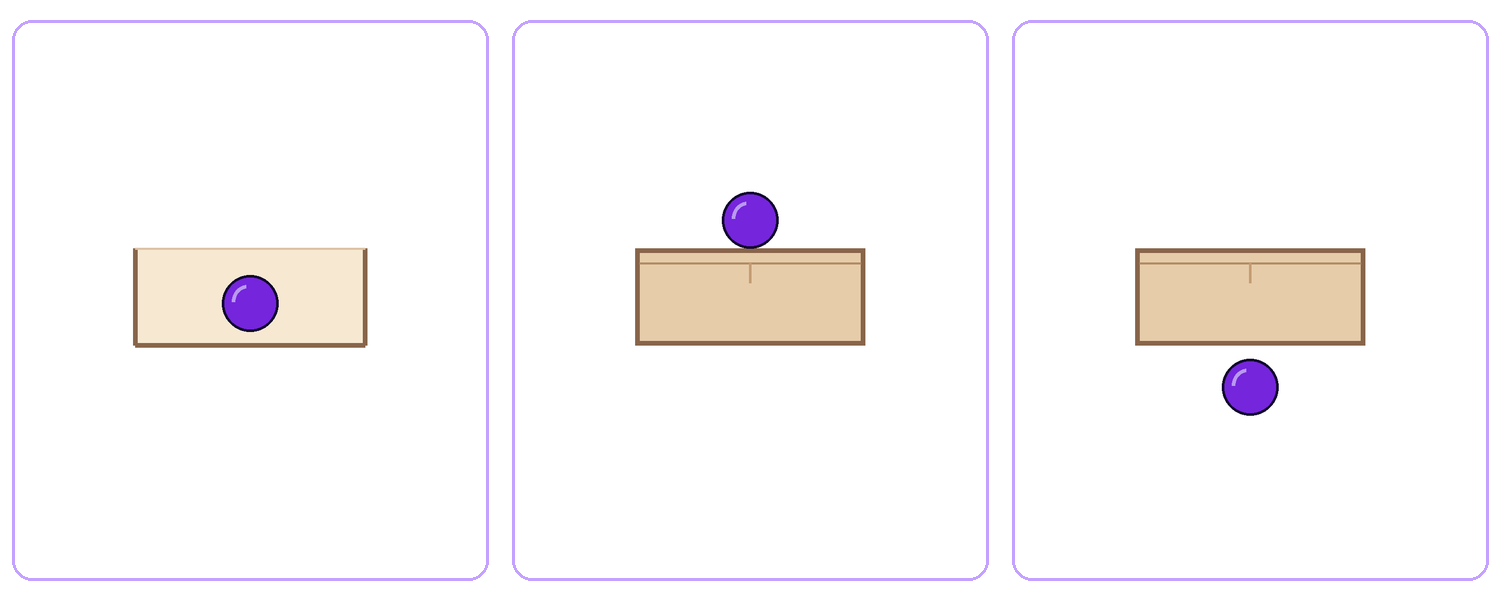
Show one position at a time. For in, open the box so the ball can be seen inside. For on, close the lid and rest the ball on it. For under, an adult can hold the empty box steadily above the ball. The diagrams simplify the view to make the relationship visible.
These changes make a demonstration clearer, but they can also supply clues. Opening the lid or lifting the box immediately before an answer may help your child without them relying on the location word. Record that help. Use the unlabelled picture activity below when you want to try listening without those movements.
The command examples use رکھو (rakho, put/place), a familiar direct form. Urdu also has other forms for different relationships and levels of politeness, as the MSU imperative chapter explains. Ask your tutor to confirm the wording your household will use consistently.
Three Urdu command cards: hear, see, then try
The English meanings and Roman Urdu below help the adult prepare. Roman spellings are approximate pronunciation aids, not checked audio. In a listening turn, keep the written answer out of the child’s view and avoid giving an English translation before the response.
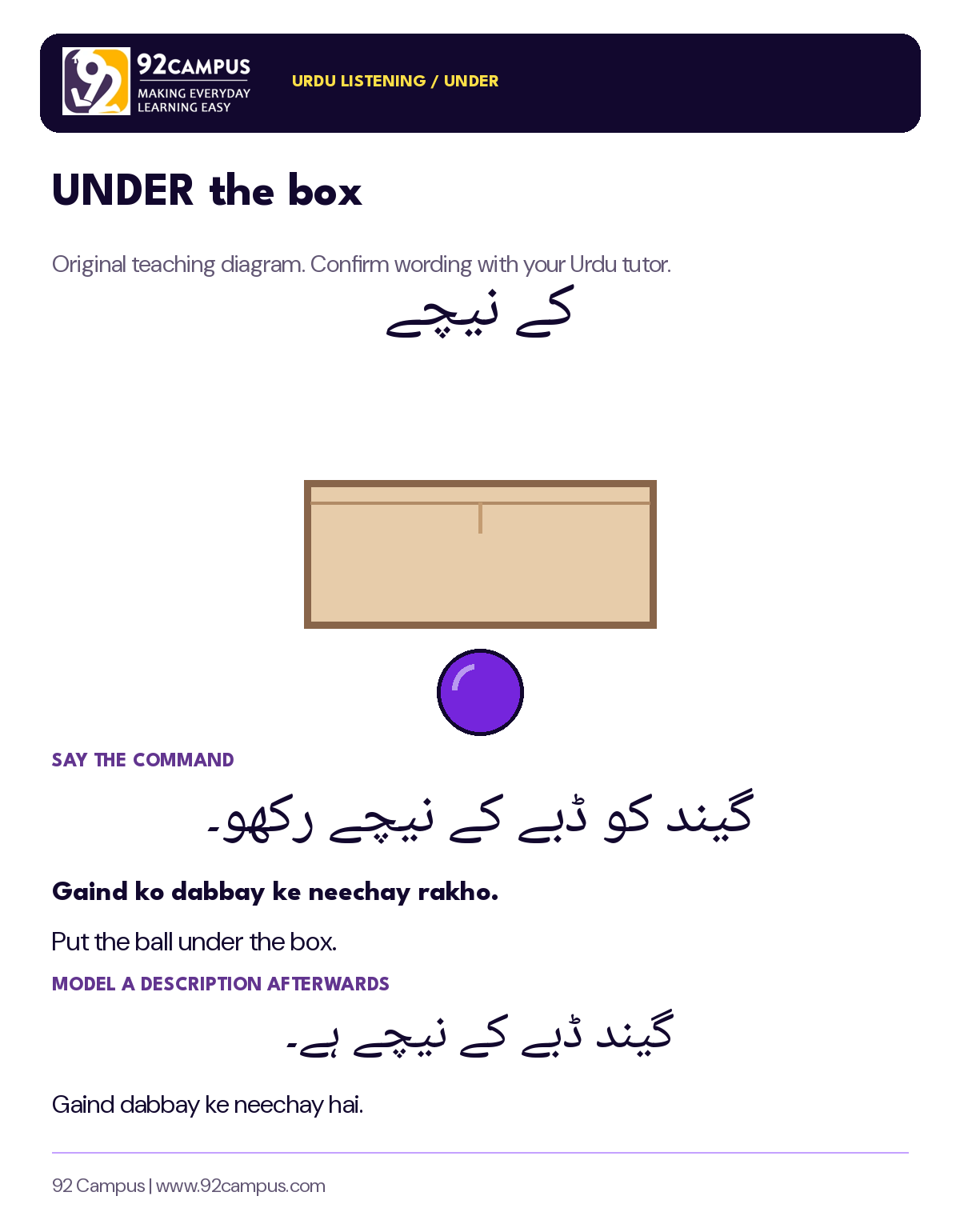
1. In the box — ڈبے میں
Command:
گیند کو ڈبے میں رکھو۔
Roman Urdu: Gaind ko dabbay mein rakho.
English: Put the ball in the box.
Description to model afterwards:
گیند ڈبے میں ہے۔
Gaind dabbay mein hai. — The ball is in the box.
Show the ball going into the box while saying the command naturally. Invite a turn. If your child places it inside immediately after watching you, write “copied after demonstration”. That is useful supported practice; it does not yet show what they would do from the words alone.
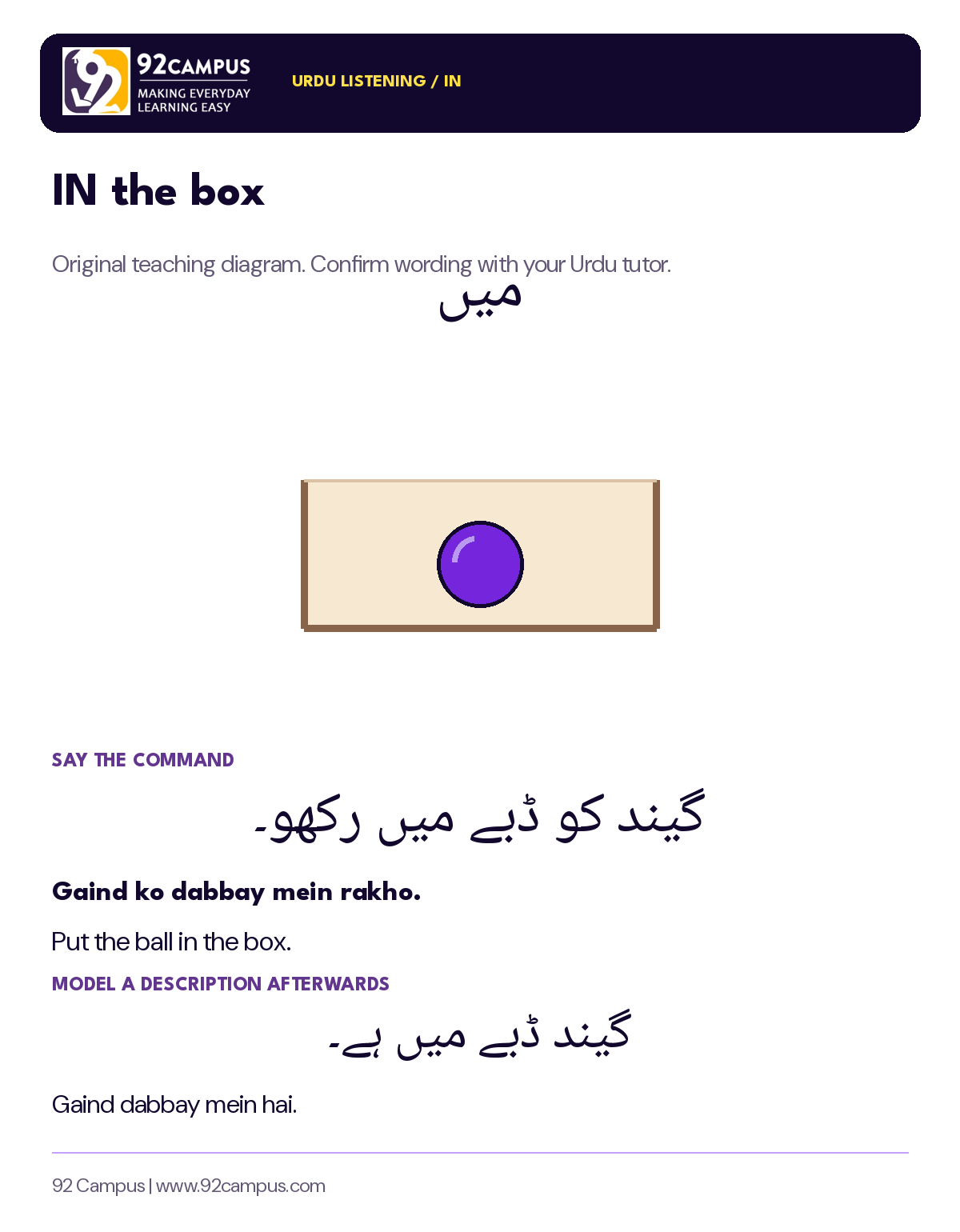
2. On the box — ڈبے پر
Command:
گیند کو ڈبے پر رکھو۔
Roman Urdu: Gaind ko dabbay par rakho.
English: Put the ball on the box.
Description to model afterwards:
گیند ڈبے پر ہے۔
Gaind dabbay par hai. — The ball is on the box.
Make contact with the top surface clear. Avoid a picture where the ball appears to hover above it. If you point to the lid and the child then places the ball correctly, record the pointing cue as well as the final placement.
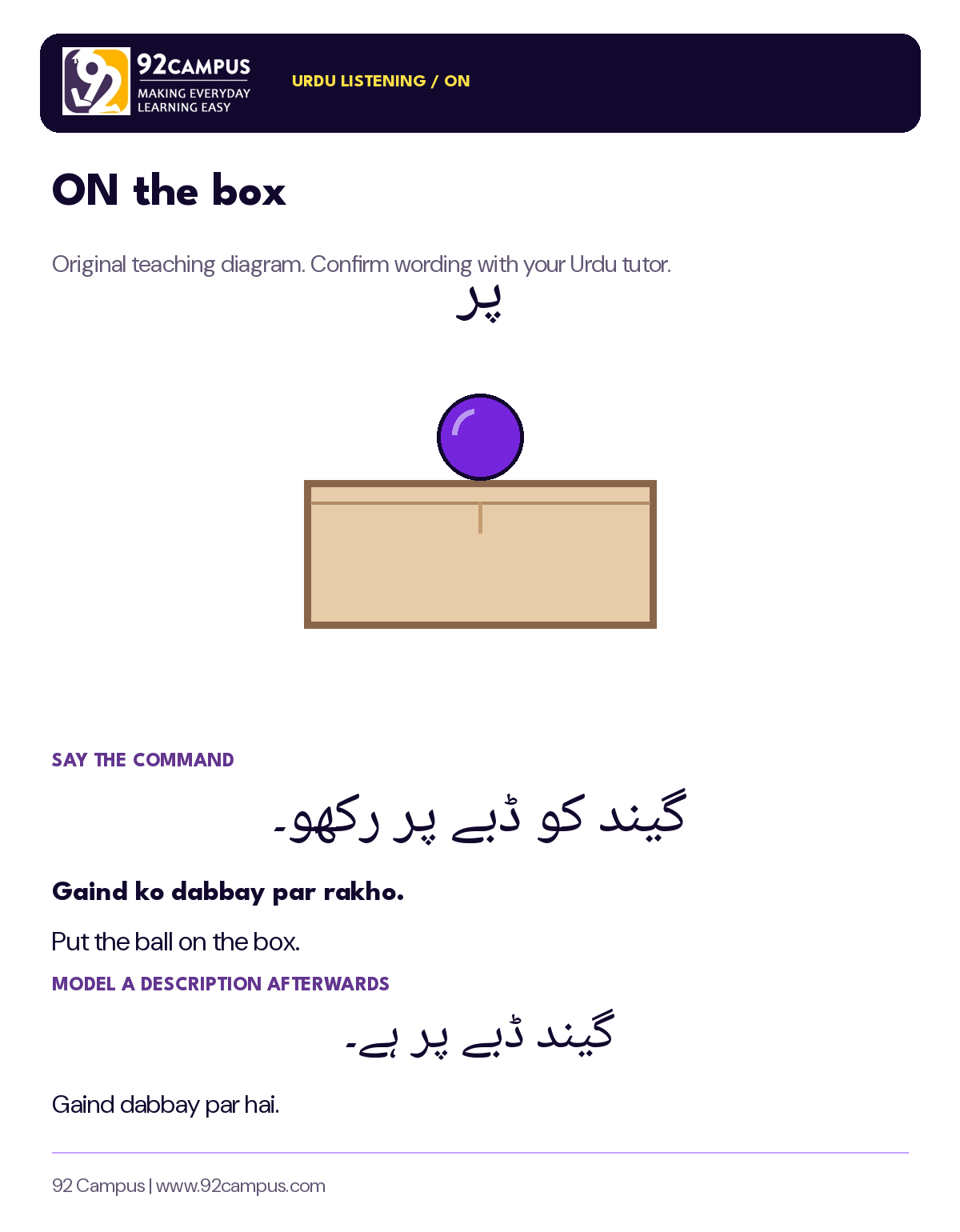
3. Under the box — ڈبے کے نیچے
Command:
گیند کو ڈبے کے نیچے رکھو۔
Roman Urdu: Gaind ko dabbay ke neechay rakho.
English: Put the ball under the box.
Description to model afterwards:
گیند ڈبے کے نیچے ہے۔
Gaind dabbay ke neechay hai. — The ball is under the box.
Keep the ball visible below the box while the adult holds the empty box up. If the lifting movement makes the intended position obvious, call this a demonstration or supported placement. A clear teaching example and a less-cued listening turn serve different purposes.
Separate the listening task from the speaking task
Try listening with unlabelled picture tiles
Save and print the unlabelled picture strip, cut the three tiles apart, and shuffle them. If printing is inconvenient, draw the same three simple positions on separate pieces of paper. Make sure the pictures themselves are understandable before using them for listening practice.
For example, say:
گیند ڈبے پر ہے۔
Gaind dabbay par hai. — The ball is on the box.
Invite your child to choose the matching picture. Keep your hands and gaze neutral. Record whether they chose before a repeat, after a repeat, or after you pointed or translated. Shuffle again before another turn instead of keeping “in, on, under” in a predictable order.
A matching choice without an adult model is a listening observation for that sentence and those pictures. It is not proof that every location word is understood, or that the child can now describe a real object independently.
Invite a description in a separate turn
Arrange a position, then ask:
گیند کہاں ہے؟
Gaind kahan hai? — Where is the ball?
Give the child time to answer before modelling the sentence. A brief پر (par) can communicate “on” in context. A full sentence can be a later modelling opportunity; do not make sentence length the only thing you notice.
If the child says “on the box” in English, respond to the meaning and offer the Urdu model afterwards. Record the original English response separately from any Urdu repetition. The guide for a child who understands Urdu but replies in English explores supportive response options in more detail.
A filled example: one word, three different observations
The following family record is fictional. It focuses on par, using familiar objects, and does not represent a timed lesson or a mastery target.
- Adult model: The parent points to the on-picture and says Gaind dabbay par hai. The child repeats “par”. Record: repeated the word after an adult model; no separate listening choice was observed.
- Listening choice: The parent shuffles the unlabelled tiles and says the same sentence without pointing. After hearing it a second time, the child selects the on-picture. Record: matched this spoken sentence to a picture after one repetition, without a pointing cue.
- Description: With the real ball on the box, the parent asks Gaind kahan hai? The child says “on the box” in English. Record: described the relationship in English; an independently produced Urdu description was not observed.
The parent then offers the Urdu sentence as a model. If the child repeats it, that is supported speaking practice. Keep it separate from their first answer. A useful tutor question is: “Should we keep practising par with these objects, or change the task?”
Blank and filled observation sheets
Use a few notes rather than marks out of ten. Record what happened, including useful support, and stop if the activity is no longer comfortable or useful. The sheet is not a diagnostic or standardised language measure.
Blank record
Target phrase and familiar objects____________________ Task and exact words the adult used____________________ Model, pointing, translation or repetition given____________________ Child’s first placement, choice or exact words____________________ What this response shows for this task____________________ Question or next task to discuss with the tutor____________________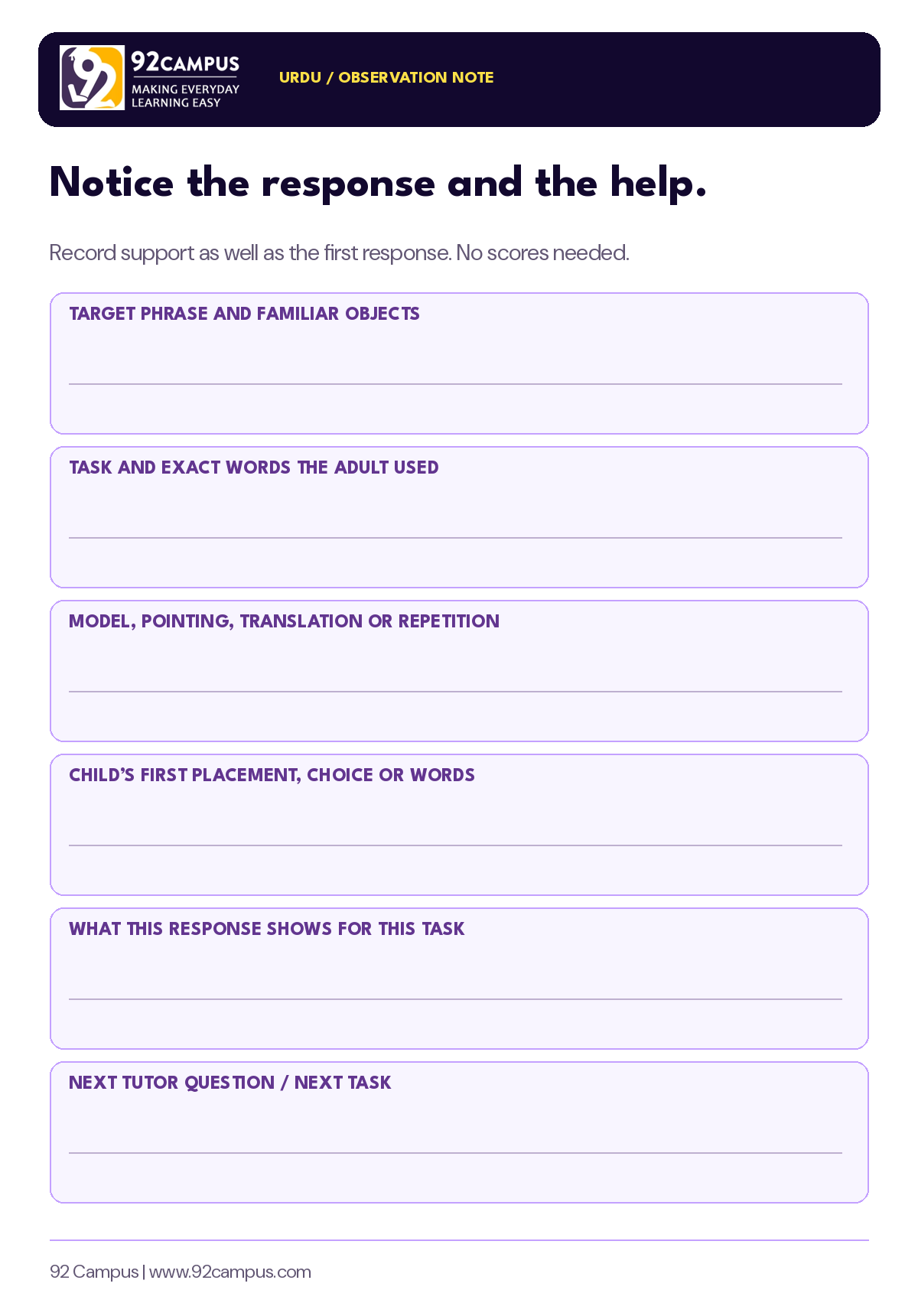
Filled record
Target and objectsPar / on; familiar ball and box. Adult modelPointed to on-picture and said “Gaind dabbay par hai.” Child repeated “par”. Listening choiceShuffled tiles; same sentence repeated once, no pointing. Child chose on-picture. First descriptionAsked “Gaind kahan hai?” Child answered “on the box” in English. ObservationA supported repeat, a picture match after repetition, and an English description are separate observations. Next tutor questionKeep practising par with these objects, or change the task?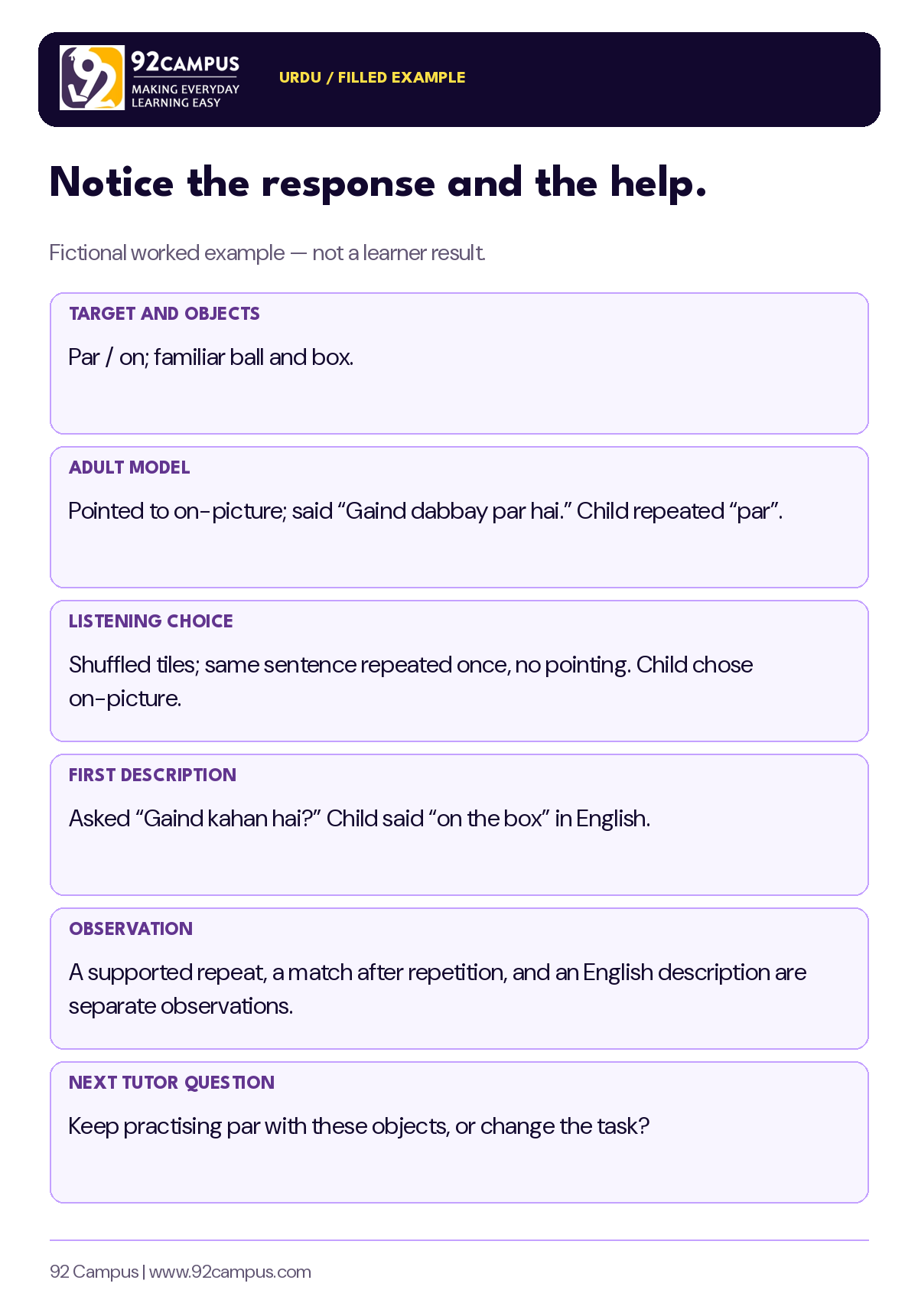
When the response is unclear, make the next task simpler
If your child does not recognise gaind, dabbah, or rakho, establish those meanings before attributing the difficulty to a location word. If picture choice is unfamiliar, demonstrate how choosing a matching picture works and record that modelling.
Rather than repeating the command louder, return to a clear example. “Let’s look together” can lead into another demonstration. When trying again, note any help that remains: the open lid, an adult glance, a familiar sequence, or an English translation.
Once a familiar example feels manageable, ask the tutor whether to vary the position order, change a familiar object, or invite a short description. Change one useful feature at a time so your notes remain understandable. A later response with a new object is another observation, not a guaranteed transfer from the first game.
In a storybook, you can also notice where a character or object is, but picture discussion adds its own vocabulary and context. The Urdu–English shared-reading guide helps you choose a separate story-understanding goal.
Discuss a suitable Urdu listening and speaking starting point
92 Campus’s Urdu Reading, Writing and Speaking lessons allow families to discuss a learner’s current understanding and goals. Share a brief example: the words your child recognises, the sentence you used, their first response, and any model or cue that helped.
Ask the Urdu tutor to check the commands, natural household wording and pronunciation, and to confirm whether this task suits the child’s next lesson. Choose a relevant listening or speaking goal instead of assuming both will develop together on a fixed timetable.
Start with what your child can currently understand and say: ask 92 Campus about a suitable Urdu listening and speaking starting point. The team checks availability and confirms the tutor and local time after a trial request.
Join the conversation
Comments are reviewed before publication. Your name and approved comment will be public. Please leave out private learner or contact details.