
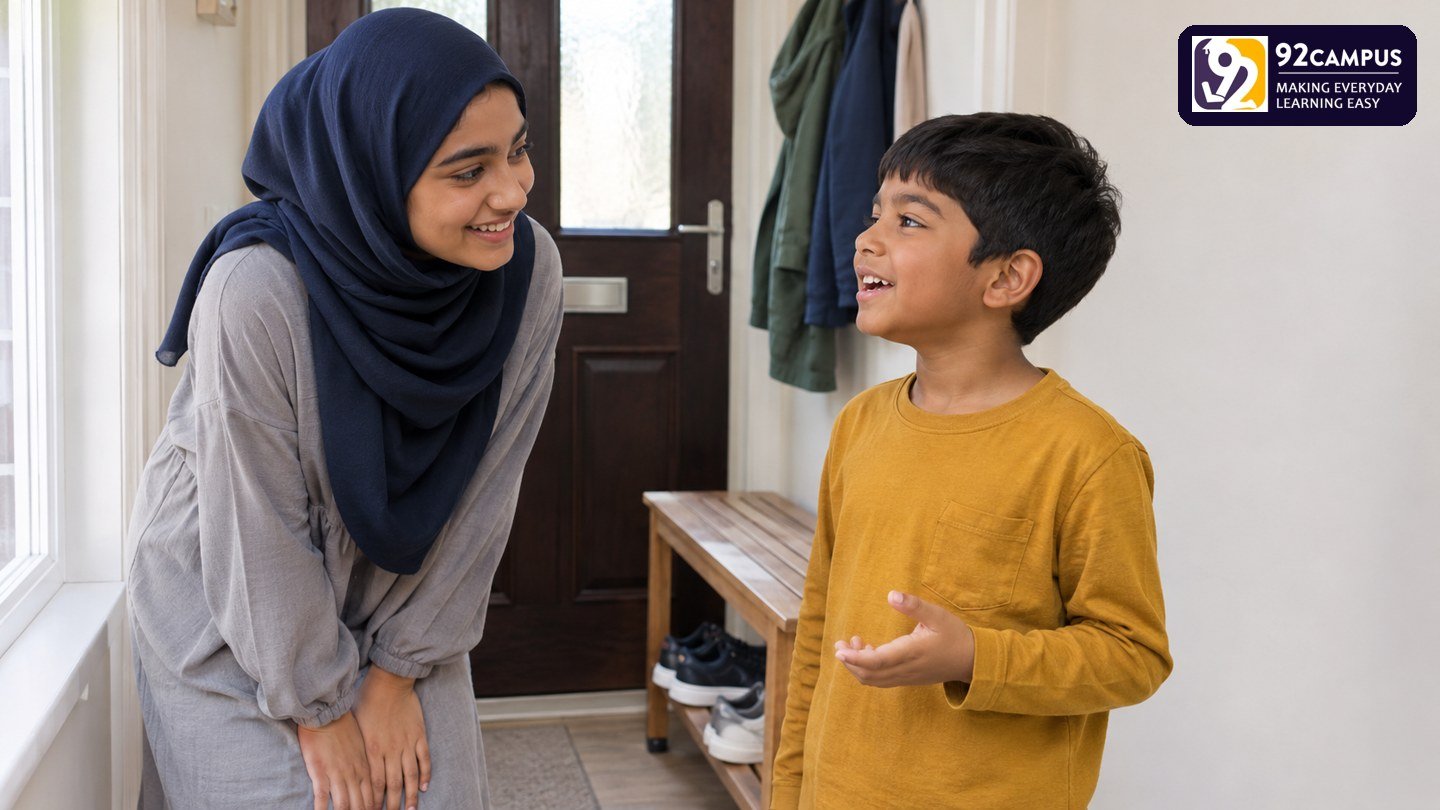
A relative says, “Assalamu alaikum,” and your child says exactly the same words back. You prompt, “What do we say?” They look at you, unsure which words you want.
You want your child to feel the warmth of the greeting, not just get through a question in front of everyone. Start with a clear distinction: one person offers the greeting; the other returns it. Show both turns, explain their meaning and practise with someone familiar.
This guide focuses on helping a child learn that exchange. The family conversations and practice ideas are editorial examples, not accounts of actual students or a fixed teaching programme.
What do we say, and what does it mean?
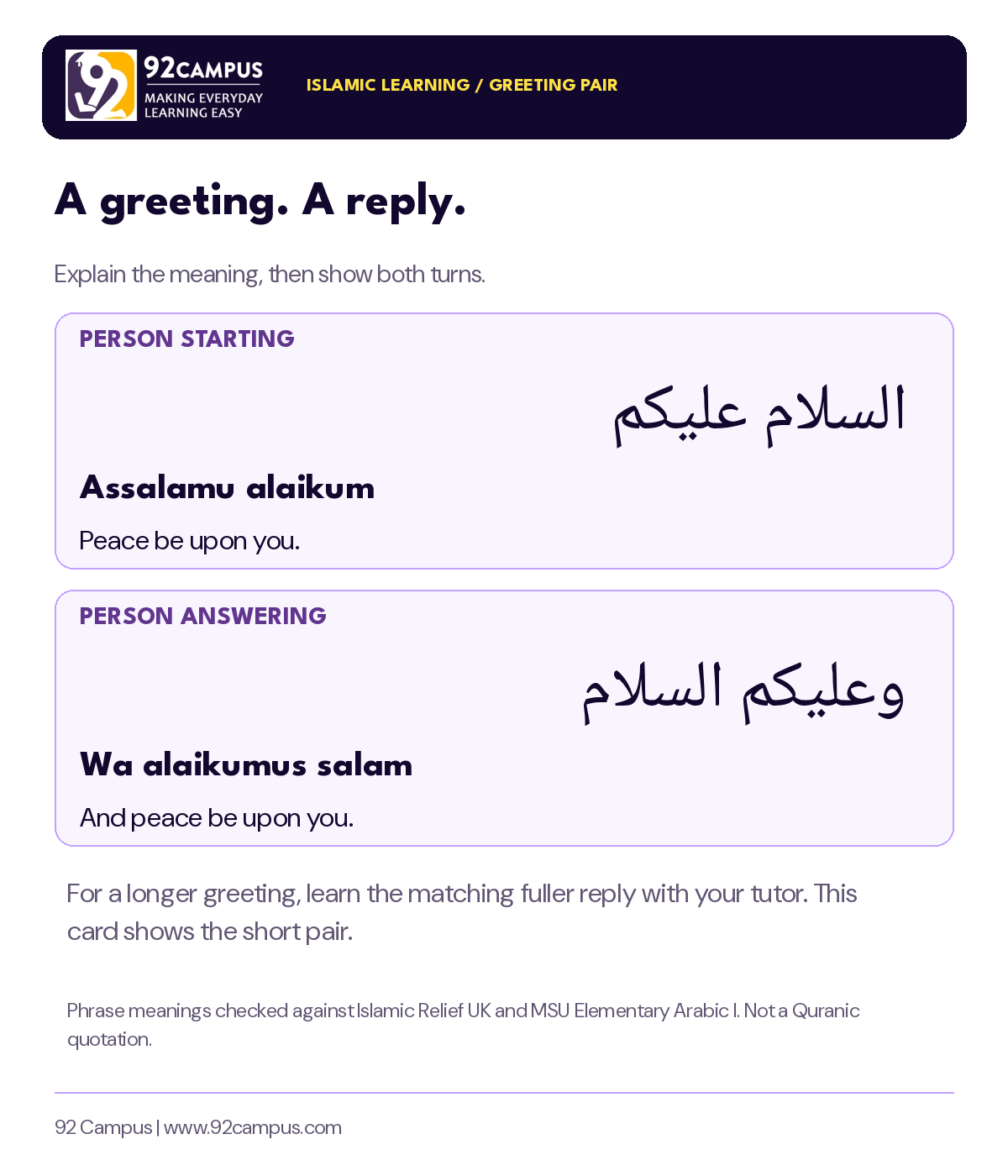
Islamic Relief UK’s guide to everyday Islamic phrases identifies Assalamu alaikum as a greeting of peace and Wa alaikumus salam as its response. Teach the two phrases together so the child can hear the difference between starting and answering.
The greeting
السلام عليكم
Assalamu alaikum — “Peace be upon you.”
The reply
وعليكم السلام
Wa alaikumus salam — “And peace be upon you.”
You may see As-salamu alaykum or Wa alaykum as-salam in English writing. These are ways of representing the Arabic phrases, not different greetings for the child to memorise. The sample dialogue in Michigan State University’s Elementary Arabic I also pairs these greeting and reply phrases. Written spellings are pronunciation aids; ask the tutor to model sounds you are unsure of.
For a simple meaning explanation, say: “I am wishing you peace, and you are returning that good wish.” This is a child-friendly explanation of the exchange, not an additional translation of a Quranic verse.
Connect the reply with the Quran’s teaching
Surah an-Nisa 4:86, in Irfan ul Quran, teaches responding to a greeting with one that is better or returning it in a like manner. This is a paraphrase of the relevant instruction, not a quotation of the full translation.
The practical connection for this activity is straightforward: the person greeting us is addressing us, and we return their greeting. A parent can say, “These words are for the person who has spoken to you.”
Keep the religious teaching separate from the teaching technique. A turn card or a family role-play is a suggested way to explain the exchange; it is not a religious requirement. This article does not decide individual questions about accountability, particular social situations or rulings on greeting different people.
Show the two turns before asking for a reply
Choose a calm moment with two familiar family members if possible. One says Assalamu alaikum; the other answers Wa alaikumus salam. Let the child hear a complete exchange before inviting them to take either part.
Name the roles in ordinary language: “That was the greeting. That was the reply.” If you are practising alone with your child, you can say both parts and explain when you are switching roles.
Then offer a clear invitation: “I’ll start. You can use the answering words.” Say the greeting and give the child time to respond. You do not need a stopwatch or a required number of repetitions.
If they need the reply modelled, say it naturally and let them join if they wish. A repeated phrase after your model is useful supported practice. It is different from choosing the reply after hearing only the greeting.
When your child repeats the greeting instead
Here is a complete illustrative conversation. It is a teaching example, not a record of a real child.
- Parent: “Assalamu alaikum.”
- Child: “Assalamu alaikum.”
- Parent: “You remembered the words I said. I started the greeting. Your answering words are ‘Wa alaikumus salam’.”
- Parent: Models the reply once, then explains: “That means you are returning the wish of peace.”
- Child: Repeats “Wa alaikumus salam” with the parent.
- Parent: “We said the reply together. Now you can start, and I’ll answer you.”
This response identifies the part to teach without calling the child rude or turning the moment into an argument. Switching roles lets them hear the reply again while taking the part they already recognise.
On another comfortable occasion, offer the greeting without supplying the answer first. Notice what actually happens. If a reminder is still useful, give it. A single unaided reply does not establish that every greeting will now be answered independently.
What if the person uses a longer greeting?
Families also use the fuller greeting Assalamu alaikum wa rahmatullahi wa barakatuh, wishing peace, Allah’s mercy and His blessings. The Slough Islamic Trust’s explanation of Assalamu Alaikum describes this fuller wording.
Keep the returning words available too:
وعليكم السلام ورحمة الله وبركاته
Wa alaikumus salam wa rahmatullahi wa barakatuh — “And peace be upon you, and Allah’s mercy and His blessings.”
Connect this with the Quran’s instruction to return a greeting in a like or better manner. Do not teach the short reply as the complete answer to every longer greeting. Let a knowledgeable tutor demonstrate the longer exchange and help the child hear where each phrase ends.
During an actual greeting, an adult can model the reply alongside a learner. Keep questions about the religious duty in a particular case for a qualified teacher or scholar; the practice example is not an individual ruling.
Three everyday moments to practise
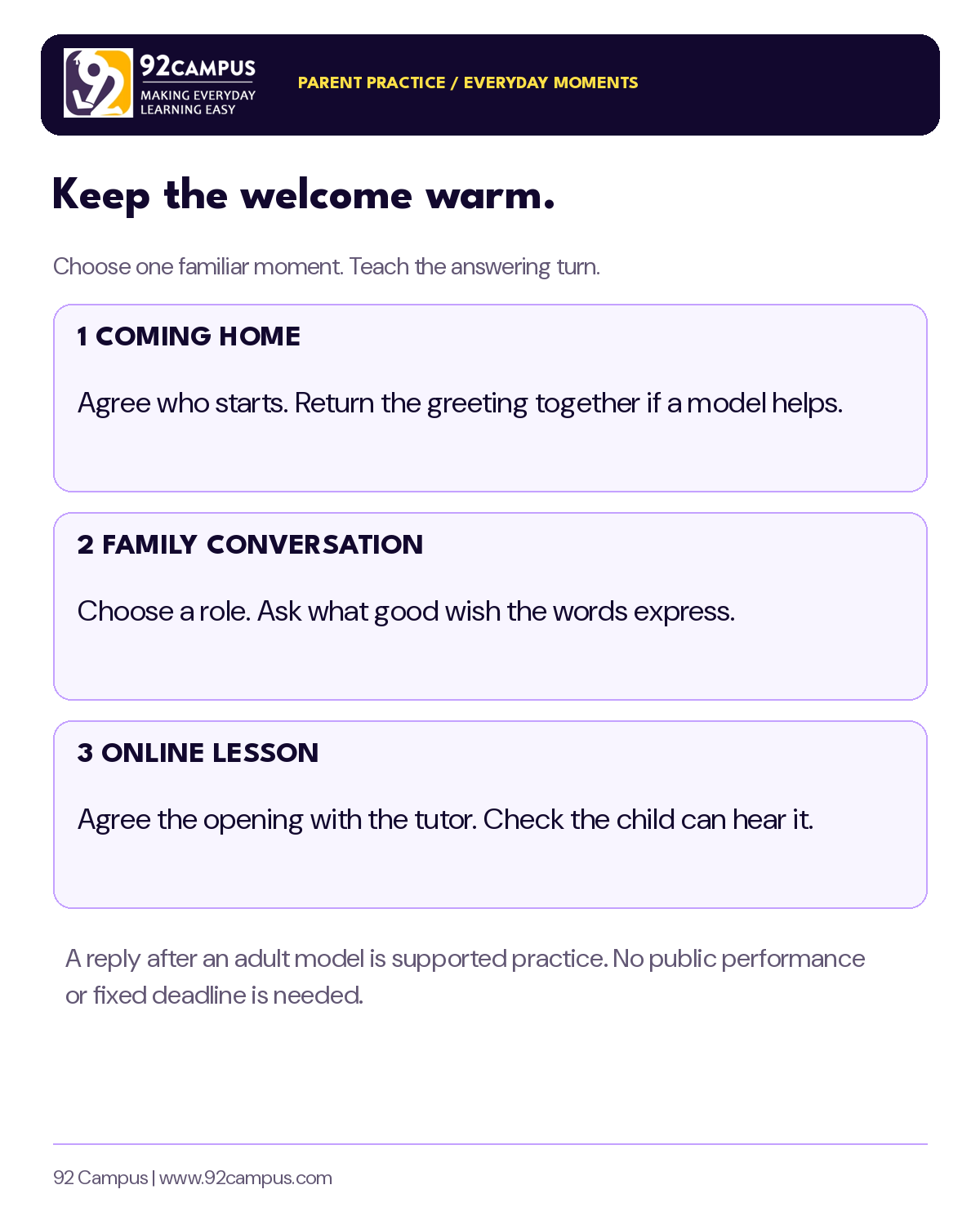
1. When a familiar person comes home
Beforehand, tell the child who will start: “When your sister comes in, she can greet us, and we’ll answer.” Invite the family member to use the wording you have practised.
If the child falls silent, return the greeting yourself and continue welcoming the person. Later, you can practise the reply together. Avoid making the doorway a place where the whole family waits for a performance.
2. During a relaxed family conversation
Let your child choose whether to start or answer. Use the pair card if they want a reminder. After the exchange, ask, “What good wish did we give each other?” An answer in the child’s familiar language can show how they understood the meaning; it is not Arabic reading practice.
If they say “hello”, add the specific meaning gently: “Yes, it is a greeting. These words wish peace for the other person.” You can explain the meaning without asking them to repeat a memorised definition.
3. At the start of an online lesson
Tell the tutor in advance if your child is learning which phrase answers salam. Agree whether the tutor will start and whether a parent will model the reply if needed.
Check that the child can actually hear the greeting before treating silence as a learning difficulty. If sound is missing, use the parent audio-check guide to separate a device problem from the greeting task.
If your child knows the reply but does not say it in the moment
Ask a specific question afterwards: “Did you know which words to use, or would a reminder have helped?” You can also notice whether they heard the greeting, recognised who was speaking and had a clear chance to answer. These are questions about that interaction, not a diagnosis.
Try not to turn “Show everyone how well you can say it” into the next task. A private exchange with someone familiar may be a more suitable practice choice for that day. Do not make hugging, handshaking or looking directly into someone’s eyes conditions of this activity.
If pronunciation needs attention, let a knowledgeable tutor listen and model the phrase. Do not invent mouth-position instructions or mark an English transliteration as proof of correct Arabic pronunciation.
Bring one clear example to the tutor
A useful message is: “My child can start with Assalamu alaikum, but repeats it when someone greets them. We modelled the reply and said it together. Could you help them practise the answering turn and explain its meaning?”
That message describes what was tried and where help was useful. You are asking for a suitable next step, rather than reporting that your child has “bad manners”.
For broader group activities, the 92 Campus classroom-values guide includes greeting and listening practice. This article focuses on the specific words and meaning of the salam reply.
92 Campus Islamic Studies lessons connect foundational learning and manners with everyday situations. Share what your child can already say and discuss a suitable starting activity. If you request a trial, the team checks availability and confirms the tutor and local time before the appointment.
Join the conversation
Comments are reviewed before publication. Your name and approved comment will be public. Please leave out private learner or contact details.