

“Why is Ramadan earlier this time?” Your child recognises the month, but the dates on the family calendar seem to keep changing. They may wonder whether someone moved Ramadan, or whether it has stopped being the ninth month.
Start by naming the two calendars: “Ramadan belongs to the Islamic calendar. The dates on this school calendar belong to the Gregorian calendar.” Then show what stays the same and what changes. You do not need a long astronomy lesson to begin.
This guide offers a short explanation, a hands-on comparison and blank and filled learning notes. The activity and conversations are editorial teaching suggestions. The sample dates are deliberately made up for counting practice; they are not Ramadan dates or a fasting timetable.
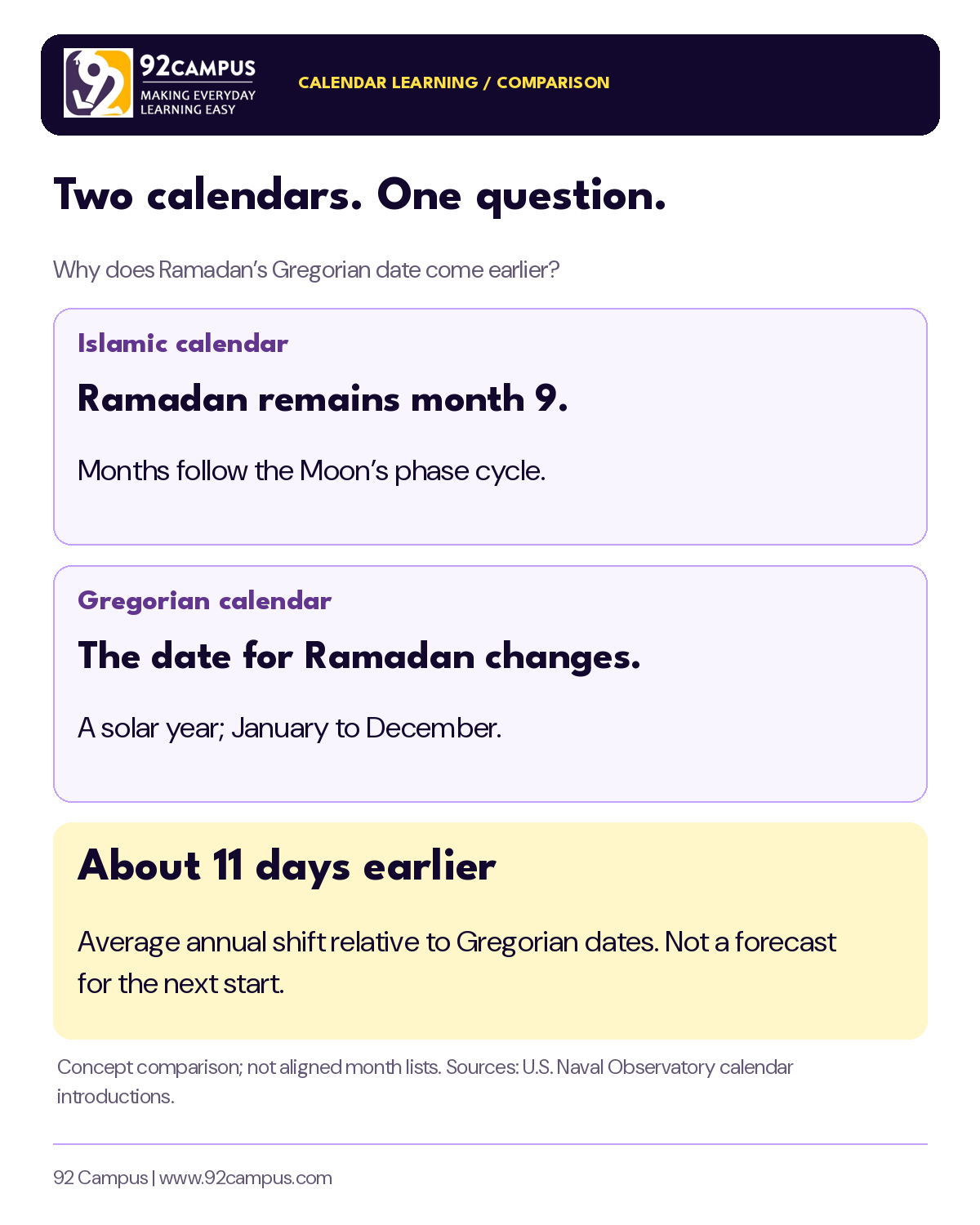
Ramadan stays the ninth Islamic month
Ramadan is always the ninth month of the Islamic, or Hijri, calendar, as the British Council’s child-facing introduction explains. It follows Sha’ban and comes before Shawwal. Its position does not change when its Gregorian date changes. The U.S. Naval Observatory’s Islamic-calendar introduction lists the months in order.
September is the ninth Gregorian month, but that does not make September and Ramadan a permanent pair. They are ninth in different calendars. A useful parent response is: “Both lists have a ninth month, but the years do not take the same amount of time.”
If your child already knows January and December, use those as familiar examples. You can introduce Muharram as the beginning of the Islamic year without requiring them to recite every month name before discussing Ramadan.
Why the Gregorian date comes earlier
The Gregorian calendar is a solar calendar: its year relates to the Earth’s journey around the Sun. Islamic months follow the Moon’s phase cycle. These are different ways of organising time, as the Observatory’s introduction to calendars explains.
Twelve lunar months finish sooner than a Gregorian year. The Observatory describes the average difference as about eleven days, so the Islamic months shift earlier relative to Gregorian dates. “Earlier” here means earlier on the Gregorian calendar, not that Ramadan changes its place in the Islamic year.
For an older child, use rounded numbers: about 354 days for twelve lunar cycles compared with 365 days in a non-leap Gregorian year. The Royal Observatory Greenwich explanation of lunar cycles gives this comparison and notes that a Gregorian year can have 365 or 366 days.
Subtracting 354 from 365 gives 11. This is a useful simplified explanation, not a rule for calculating your community’s next start date. Keep the word about when explaining the annual shift.
A brief Quran connection
In Surah al-Baqarah 2:189, in Irfan ul Quran, the new moons are described as signs of time for people and Hajj. This sentence is a paraphrase of the relevant part, not a quoted translation of the whole verse.
You might say, “Our calendar learning helps us notice how time is marked.” The family activity below is a teaching suggestion, not a religious requirement or a ruling about which calendar announcement to follow.
Try the two-calendar activity
Have a Gregorian calendar or a hand-drawn May date list, two small pieces of paper and a pencil ready. Use the comparison card as your Islamic-calendar reminder. No printed resource is essential; you can copy the labels onto paper.
1. Name the calendars before comparing numbers
Write “Islamic calendar: Ramadan = month 9” on one paper. On the other, write “Gregorian calendar: January to December.” Ask your child which calendar contains Ramadan and which contains May.
If the names are unfamiliar, show the answer and say it together. Record that you modelled it rather than treating the repeat as an independent explanation.
2. Keep Ramadan’s position fixed
Leave the Ramadan card in place. Explain: “This stays the ninth Islamic month. We are going to explore what an earlier date looks like on the other calendar.” Avoid moving Ramadan to eighth place in a month list to demonstrate the shift.
3. Count backwards on a made-up example
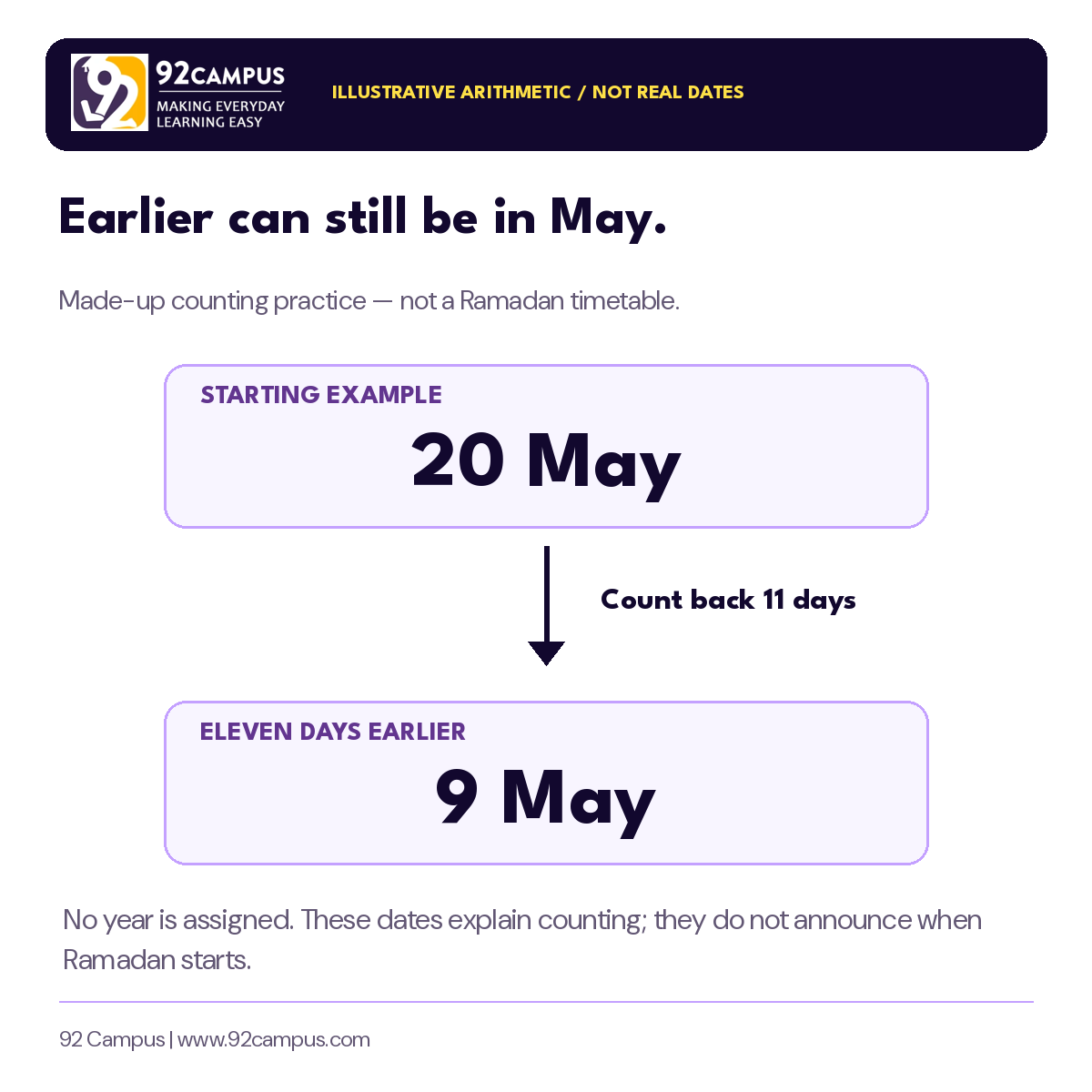
Illustrative dates only: use 20 May as a starting point and count back eleven days to 9 May. Neither is presented as a real Ramadan start date, and no actual year is assigned.
For counting, one day before 20 May is 19 May; continue until the eleventh step reaches 9 May. If counting distracts from the idea, point out the two dates yourself and focus on which comes earlier.
Ask, “Did the day number change? Did the Gregorian month have to change too?” In this example the date is earlier, but both dates are still in May. A changing date does not always mean a different Gregorian month.
4. Ask for the reason, then offer a model
Invite an explanation: “Why does Ramadan’s date on this calendar tend to come earlier?” A short answer such as “The lunar year is shorter” communicates the central idea. If needed, model: “Twelve lunar months finish sooner, while Ramadan stays month nine.”
For a child who is not ready to explain verbally, offer two choices: “Did Ramadan become a different Islamic month, or are we comparing calendars with different year lengths?” Note whether they chose after help. There is no score or deadline to complete.
What to say when the calendars get mixed up
These short interactions are illustrative, not accounts of actual students.
“So Ramadan is the eighth month now?”
Parent: “Ramadan is still ninth in the Islamic calendar. Its date is earlier on the Gregorian calendar. Let’s point to the calendar we mean before using a month number.”
“Ninth month means September.”
Parent: “September is ninth in the January-to-December list. Ramadan is ninth in the Islamic list. A position in one list does not give it the same dates as the other.”
“If we subtract eleven, do we know the next Ramadan date?”
Parent: “That helped us understand the approximate shift. It was not a date announcement. We’ll check the calendar and confirmation our family follows.”
The distinction matters because a helpful model can become misleading if a child treats it as an exact forecasting rule. Keep “why the date shifts” separate from “which date has been announced”.
The annual shift and different community dates are separate questions
Your child may also notice that a friend’s family starts on a different day. This is not the same question as why Ramadan moves earlier from year to year.
The Royal Observatory’s crescent-Moon guide explains that Islamic months have 29 or 30 days, that crescent visibility varies by location, and that communities can follow different calendar methods or announcements. An astronomical new Moon and the first visible crescent are not the same thing.
A measured response is: “Our families may follow different announcements. Let’s ask a knowledgeable person to explain the approach our family follows.” Do not use a worksheet to judge another family’s practice or ask a child to settle a religious disagreement.
When marking a real family calendar, write the source and whether a date is expected or confirmed by that source. Check what an announcement means before treating it as a settled plan. The learning exercise does not determine fasting or festival dates.
Use a blank and filled learning note
These fields help you notice the idea your child can explain and the question to bring back to a tutor. Copy them onto paper or save the sheets. They are discussion aids, not a standardised assessment.
Blank note
Month and positionWhich calendar contains Ramadan, and where does it come? Made-up counting exampleWhat earlier date did we find? Label it illustrative. Child’s explanation and help givenWhat did the child say? Did an adult model or offer choices? What the example cannot tell usDoes it confirm a real start date? Question or check to follow upWhat source or tutor question do we need?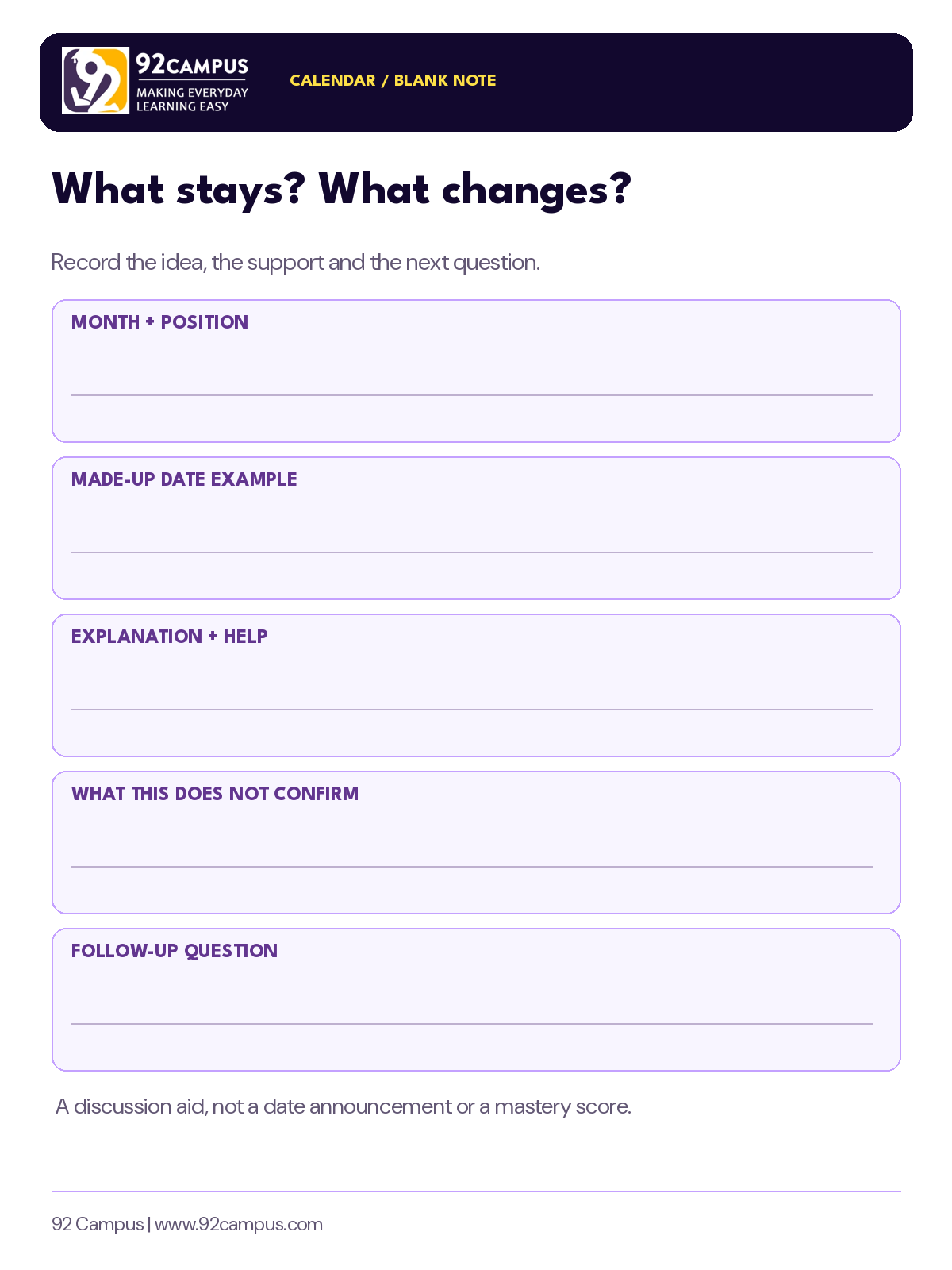
Filled illustrative note
Month and positionRamadan is month nine in the Islamic calendar. Made-up counting example20 May to 9 May: eleven days earlier; both still in May. Not real Ramadan dates. Explanation and helpChild said “because it is shorter” after an adult explained that twelve lunar months finish sooner. LimitThis does not confirm our community’s next start date. Follow-upAsk which announcement our family follows and how expected and confirmed dates are labelled.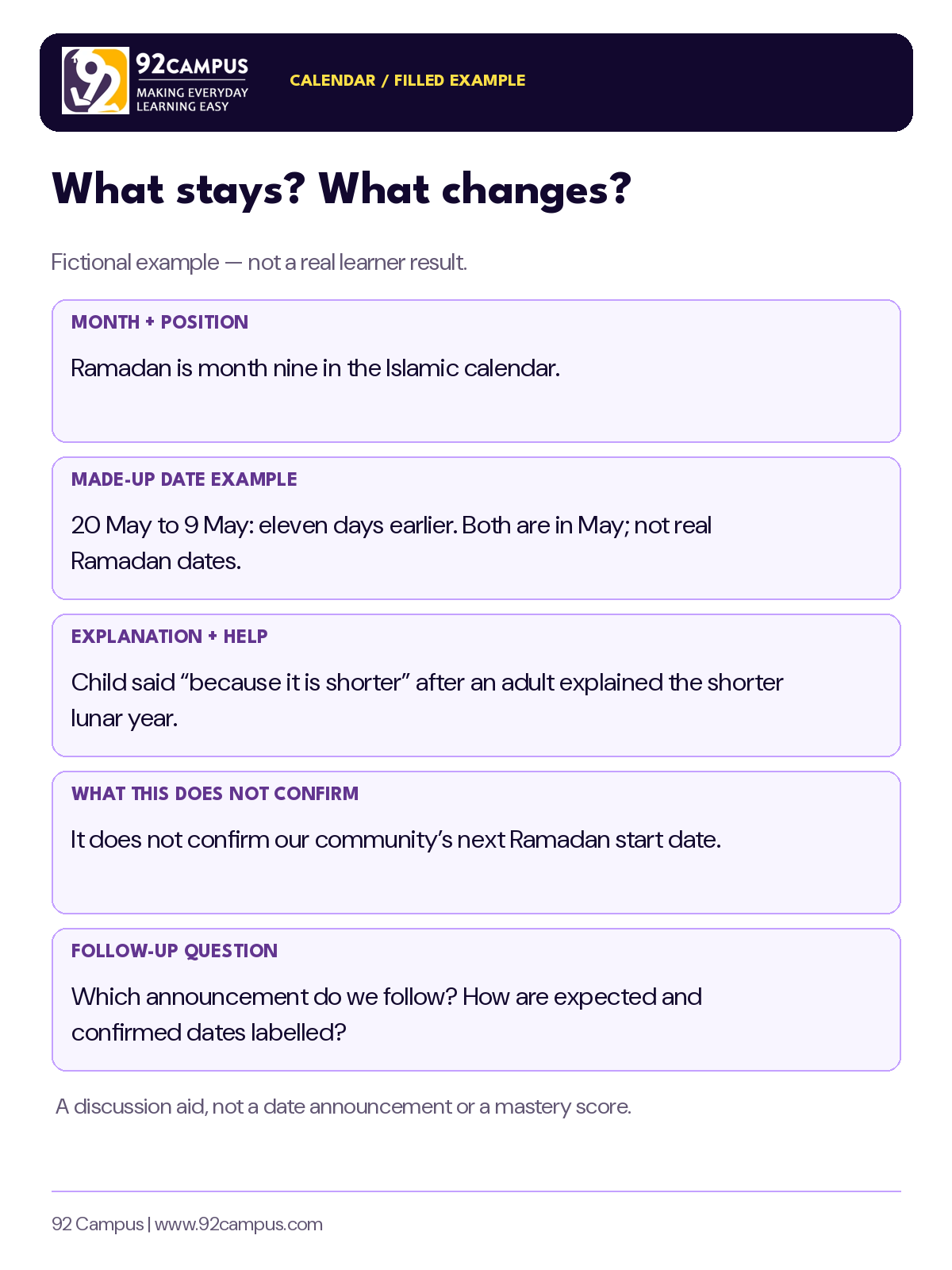
Bring one clear question to the next lesson
Ask your child what still feels puzzling. It may be the two calendar names, the shorter lunar year, or the difference between a predicted date and an announcement. Choose that question rather than adding all twelve month names and a detailed history at once.
If your child wants to explore the beginning of the Islamic year, the 92 Campus Muharram guide introduces that month in its historical context. That is a separate discussion from this calendar comparison. The learning resources page offers other home-learning materials.
92 Campus Islamic Studies lessons introduce foundational beliefs, worship, manners, duas and selected Seerah topics through individual discussion. Tell the team what your child already understands and ask whether a calendar-learning question would suit their next activity.
Share your child’s current understanding and discuss a suitable Islamic Studies starting point. The team checks tutor availability and confirms the local time after the request.
Join the conversation
Comments are reviewed before publication. Your name and approved comment will be public. Please leave out private learner or contact details.