
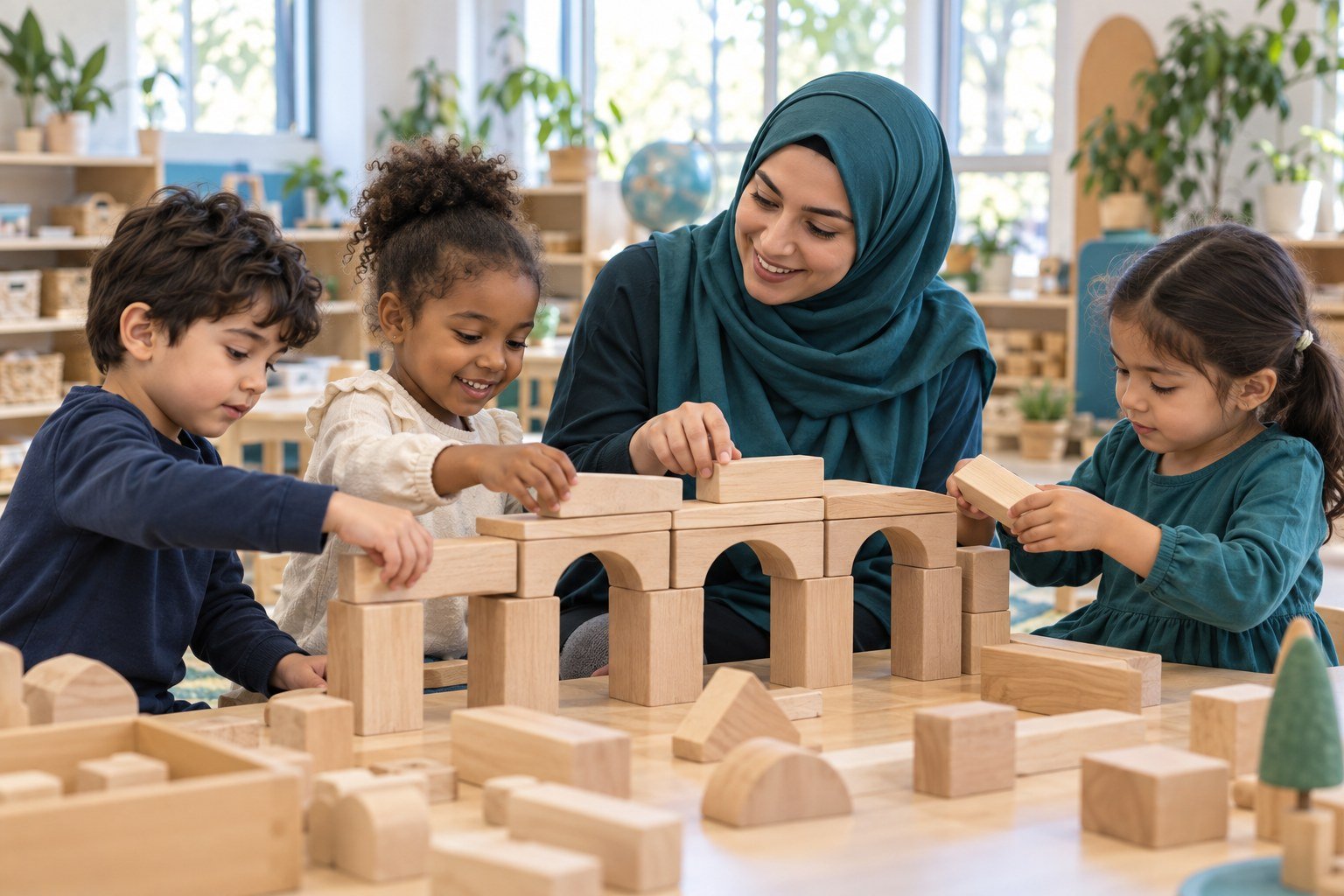
Two children reach for the same red block. One pulls it closer; the other shouts. Across the room, a quieter child wants to join a game but does not know what to say. These small moments can become some of the most useful lessons of the school day.
Children may know that sharing is good without knowing how to ask for a turn. They may recognise the word kindness but need help noticing when someone feels left out. Islamic classroom activities give children opportunities to practise those skills through play, conversation, and everyday choices.
This guide is designed for ages four to seven in Islamic schools, weekend programmes, and small learning groups. Parents can adapt the activities for siblings or playdates. The aim is meaningful practice, not perfect behaviour after one lesson.
Why playful practice matters
NAEYC’s developmentally appropriate practice guidance identifies play as important for language, peer relationships, and social competence. Its social and emotional teaching guidance also describes modelling, coaching, and specific feedback. Together, these support an approach in which adults demonstrate a skill and help children use it during real interactions.
The Harvard Center on the Developing Child explains that playful activities offer practice in attention, working memory, and self-control. The activities below are classroom suggestions informed by those broad principles, not a tested programme with guaranteed results.
Islamic values become visible in everyday actions
Quran 5:2 includes the instruction to cooperate in goodness and righteousness. Sahih Muslim 2593 teaches that Allah loves gentleness. These provide a foundation for discussing helpful actions and gentle treatment.
A teacher might connect cooperation with building together or gentleness with returning a toy carefully. Those are educational applications, not claims that these particular games are prescribed in Islam. Describe honesty, patience, gratitude, and responsibility in simple language, and demonstrate them yourself.
Set up the session before children begin
Choose one social skill per session. Prepare materials in advance and work with pairs or groups of three or four where possible. For a larger class, repeat stations with suitable adult supervision rather than gathering everyone around one resource.
Start with a demonstration, give children time to play, and finish with one reflection question. All timings below are illustrative planning estimates; shorten or extend them for your group. Ages four to five may need pictures and single-step directions; ages six to seven can manage more planning and explanation.
Accept gestures, home-language responses, or communication aids. Do not require eye contact, public speaking, touch, or a particular facial expression. Offer an observation role before participation. Use large, age-appropriate materials and follow school supervision, food, and safeguarding procedures.
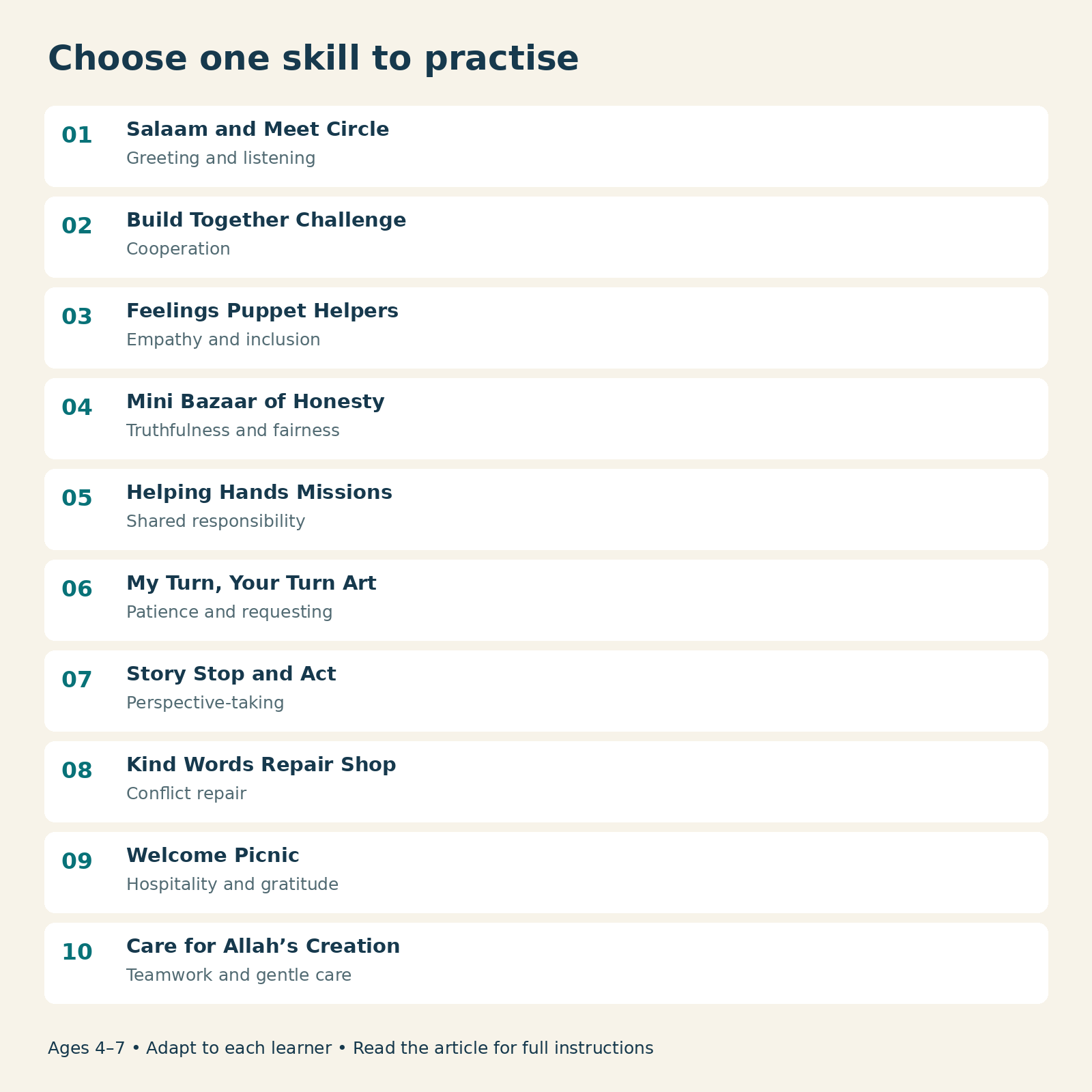
10 Islamic classroom activities teachers can use
1. Salaam and Meet Circle
Focus: greeting and listening. Prepare: a soft ball and picture prompts showing favourite foods, animals, or games. Time: 10–12 minutes.
- Model greeting a colleague or puppet: “Assalamu alaikum. What game do you enjoy?” Demonstrate listening and responding.
- Pass the ball to a child who chooses a partner. The child greets them and asks one question using a prompt.
- The partner replies, then becomes the next greeter. Ensure everyone receives an invitation without requiring them to speak.
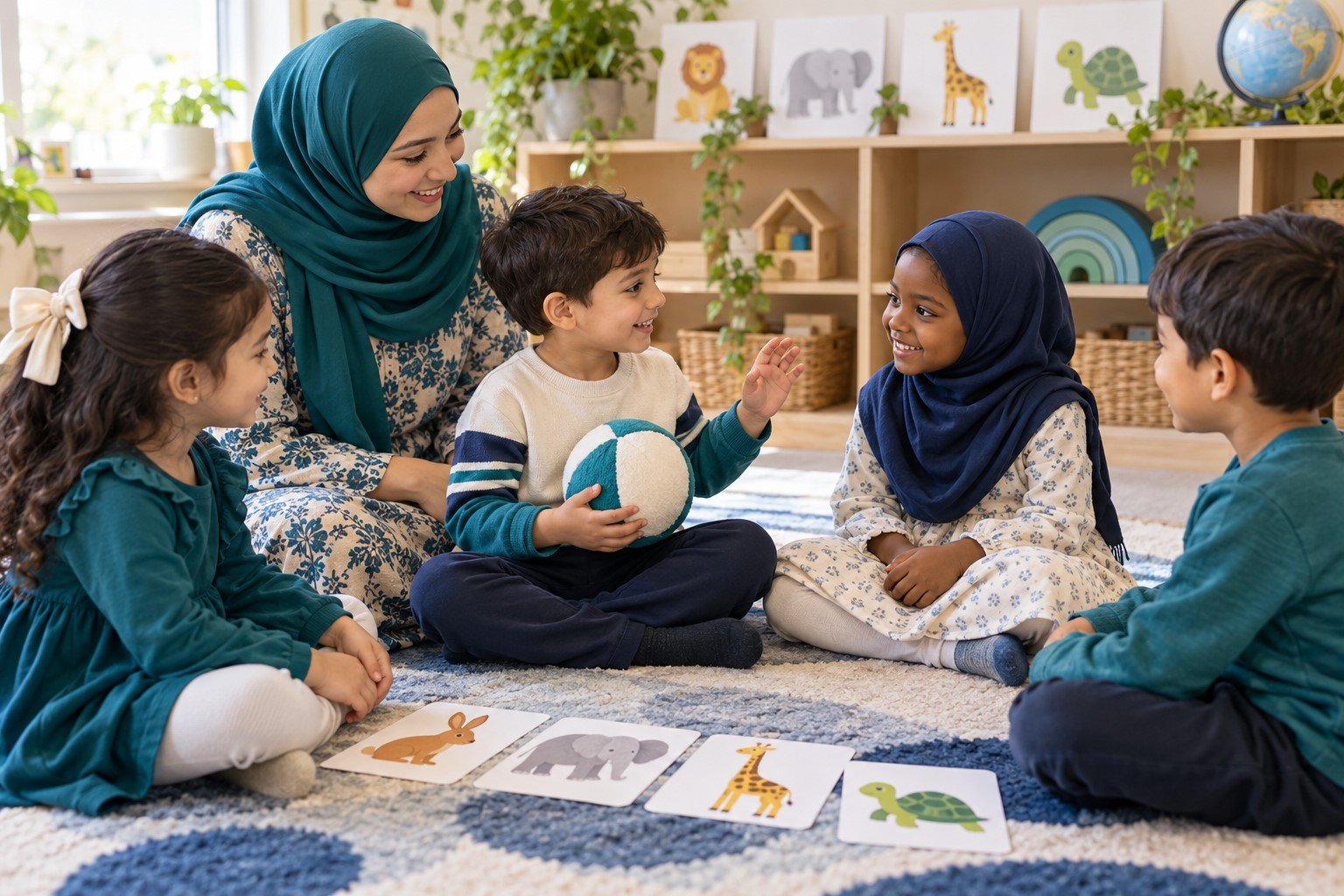
Teacher language: “Let’s give Maryam time to answer.” For ages four to five, accept a greeting and pointing; ages six to seven can ask a follow-up question. If one child dominates, offer a helper role after their turn.
Reflect and notice: “What did you learn about someone?” Look for a child acknowledging a peer or waiting for an answer. Connect the greeting with making others feel welcome.
2. Build Together Challenge
Focus: cooperation. Prepare: large blocks, a toy vehicle, and a clear building area. Time: 15–20 minutes.
- Give each group a shared problem: “Can you build a bridge this vehicle can travel across?”
- Invite children to suggest ideas. Offer rotating roles such as builder, materials helper, and tester.
- Let them build, test, and change the design. Rotate roles so nobody controls the materials throughout.
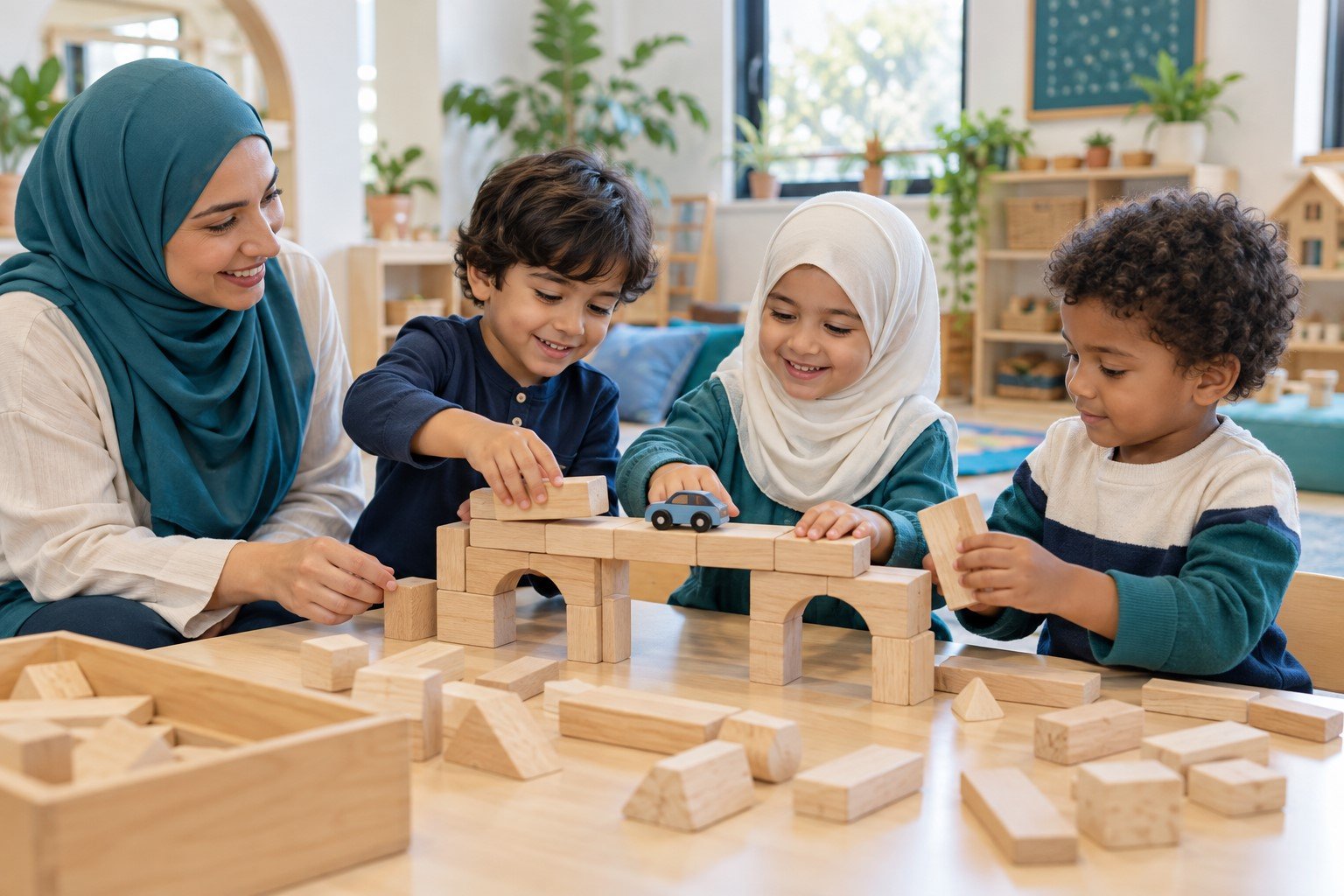
Teacher language: “You have two ideas. How could you try both?” Younger children can build a simple road in pairs; older children can sketch a plan and explain a change. If a structure falls, help children name their disappointment before restarting.
Reflect and notice: “What could you do together that was harder alone?” Notice requests, offered materials, and shared decisions. Link this to cooperating in good work rather than rewarding the tallest structure.
3. Feelings Puppet Helpers
Focus: empathy and inclusion. Prepare: two puppets and simple emotion cards. Time: 12–15 minutes.
- Act out a puppet watching others play without joining. Ask, “How might this puppet feel?” Accept more than one possibility.
- Invite children to suggest what the puppet could say and how the others could respond.
- Replay the scene with an invitation: “Would you like to help us build?” Let children control the puppets.
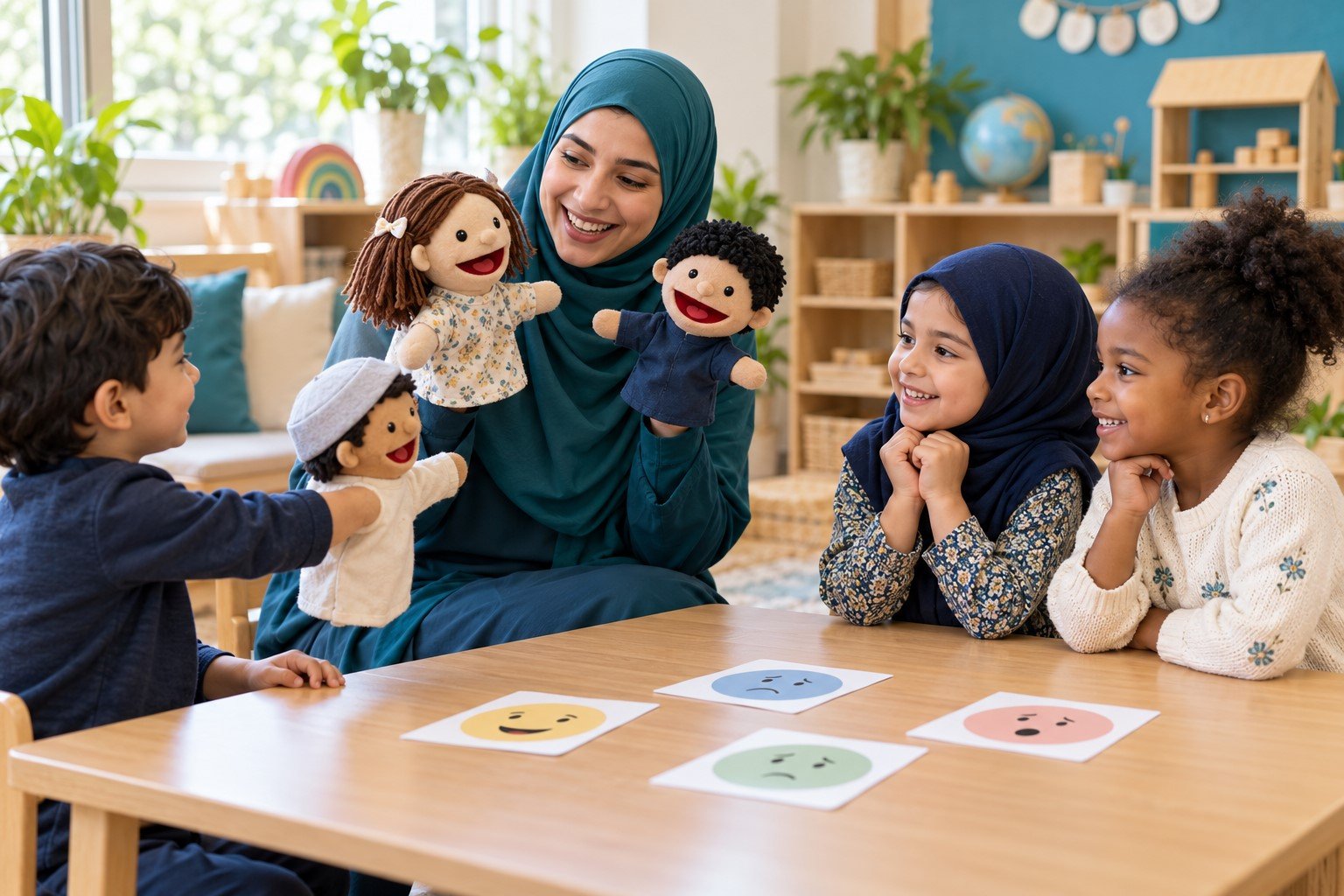
Teacher language: “We can ask how someone feels instead of guessing.” Younger children can choose a picture; older children can practise checking: “Would you like company?” If a child declines play, model respecting that choice.
Reflect and notice: “How could we make joining easier?” Look for invitations and checking another child’s wishes. Explain mercy through considerate action, not through demanding that everyone feel happy.
4. Mini Bazaar of Honesty
Focus: truthful communication and fairness. Prepare: pretend food, baskets, and large counters. Time: 15–20 minutes.
- Create a shop with one counter exchanged for one item. Demonstrate customer and shopkeeper roles.
- Announce a pretend mistake: “Sometimes our shop gives an extra apple. Let’s practise what to do.”
- Give an extra item in the role-play. Model returning it, then rotate roles so children can practise.
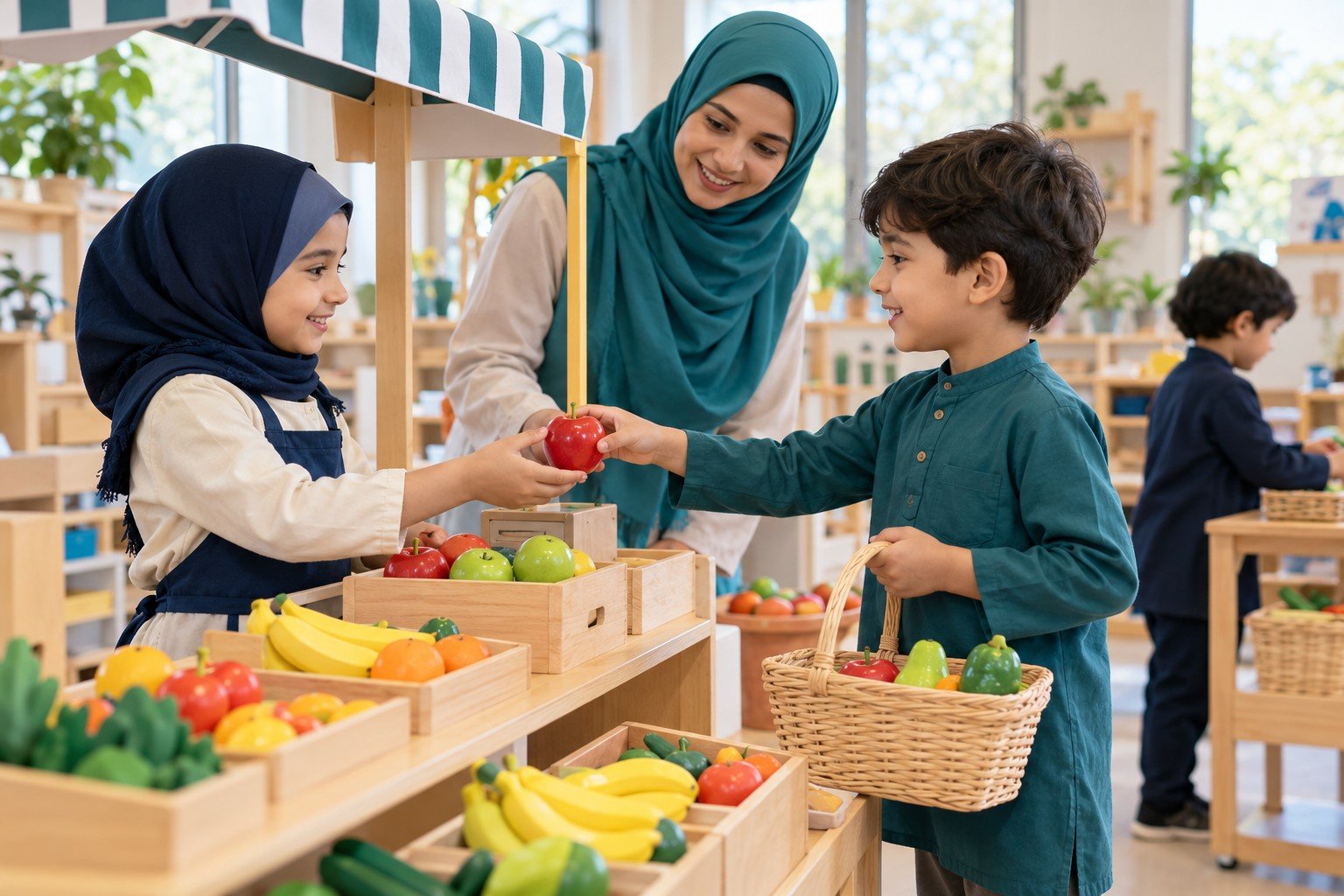
Teacher language: “I received two, but I asked for one.” Use simple item exchanges for younger children; older children can check an illustrated order list. This is rehearsal, not a secret test of character. Correct counting mistakes calmly.
Reflect and notice: “How did we put the mistake right?” Notice honest reporting and polite corrections. Connect honesty with making things fair, without labelling a child dishonest.
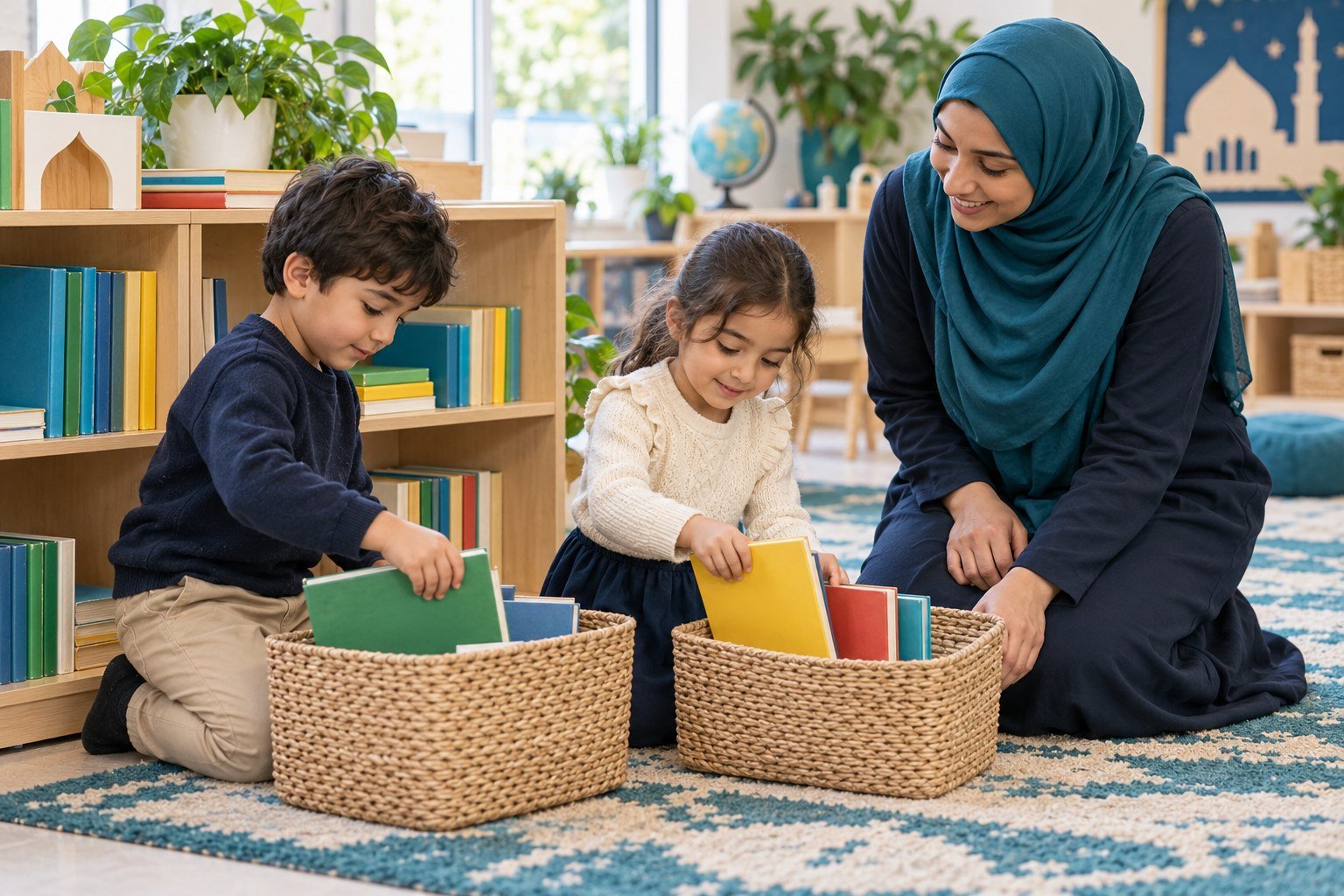
5. Helping Hands Missions
Focus: shared responsibility. Prepare: picture task cards and safe classroom materials. Time: 10–15 minutes.
- Offer pairs a choice: arrange books, distribute drawing paper, or organise large pencils.
- Ask each pair to decide who will do which part. Demonstrate asking before helping someone.
- Let them complete the mission and check together whether anything remains.
Teacher language: “Would you like help carrying those?” Give younger children one short job; older children can plan two connected steps and exchange roles. Keep tasks accessible and supervised; children should not handle cleaning chemicals or unsafe equipment.
Reflect and notice: “How did your job help our classroom?” Notice asking, coordinating, and finishing together. Present service as everyone’s contribution, not as punishment or work assigned by gender.
6. My Turn, Your Turn Art
Focus: patience and requesting. Prepare: large paper, several crayons, and one shared stamp or roller. Time: 12–15 minutes.
- Invite a small group to create one picture. Explain that the special tool will move around the group.
- Model: “May I use it after you?” Agree on a short turn, such as one stamped shape.
- Support passing the tool while children continue drawing with available materials.
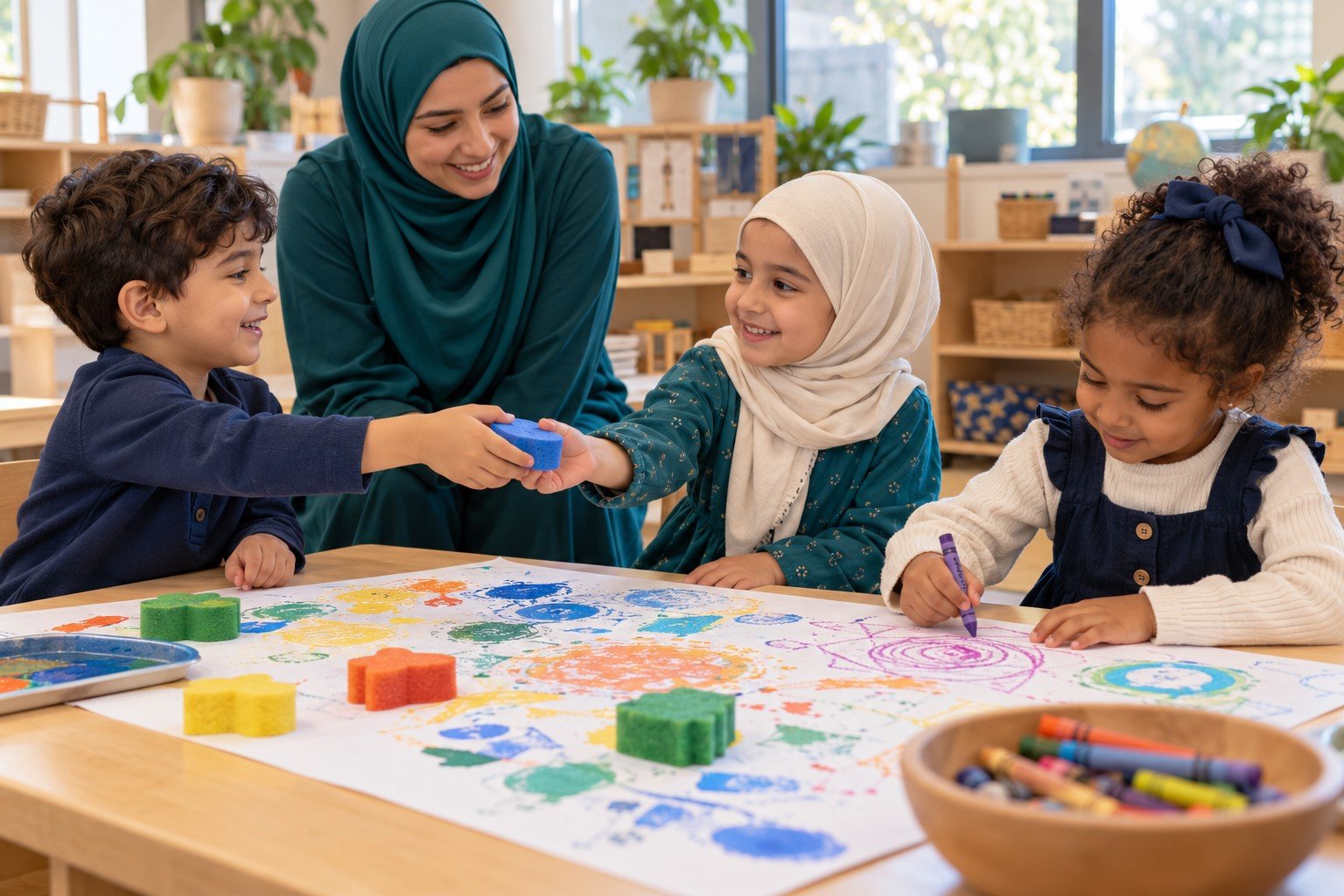
Teacher language: “You’re waiting. You can draw while your turn comes.” Younger children can work in pairs; older children can agree on the order themselves. Avoid long queues or removing a personal comfort object to teach sharing.
Reflect and notice: “What helped you wait?” Look for requesting and passing with decreasing adult support. Describe patience as something children practise with help, not silent endurance of distress.
7. Story Stop and Act
Focus: perspective-taking and responsibility. Prepare: a short invented story, a pencil, and a toy. Time: 15–20 minutes.
- Tell a clearly fictional classroom story: a child finds someone’s pencil or accidentally breaks a toy.
- Stop before the decision. Ask, “What could happen next? Who needs help?”
- Act out two possible responses, then let children practise reporting the problem and helping repair it.
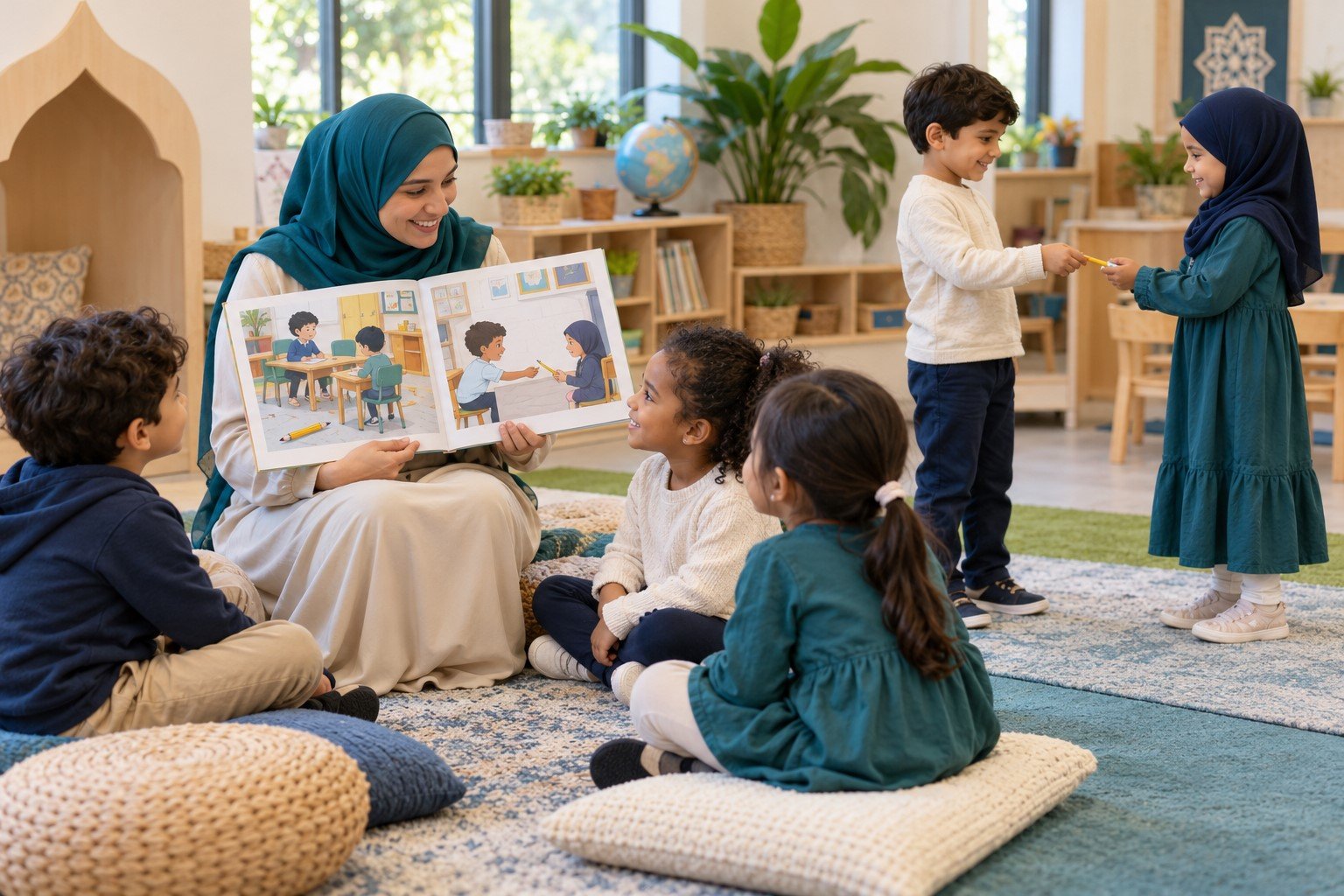
Teacher language: “An accident happened. What can we do now?” Younger children can choose between two actions; older children can explain likely consequences. Never present an invented tale as a Quranic or prophetic account, or use it to expose a real child’s mistake.
Reflect and notice: “What made that response fair?” Look for admitting a mistake, returning property, or seeking help.
8. Kind Words Repair Shop
Focus: resolving everyday disagreements. Prepare: puppets and three picture prompts: pause, explain, repair. Time: 12–15 minutes.
- Demonstrate a puppet taking another puppet’s drawing materials. Pause and help both settle.
- Model: “I was using that. Please ask first.” Then: “I can give it back.”
- Practise with invented scenarios and swap roles. Offer possible repairs: return, rebuild, replace, or ask an adult.
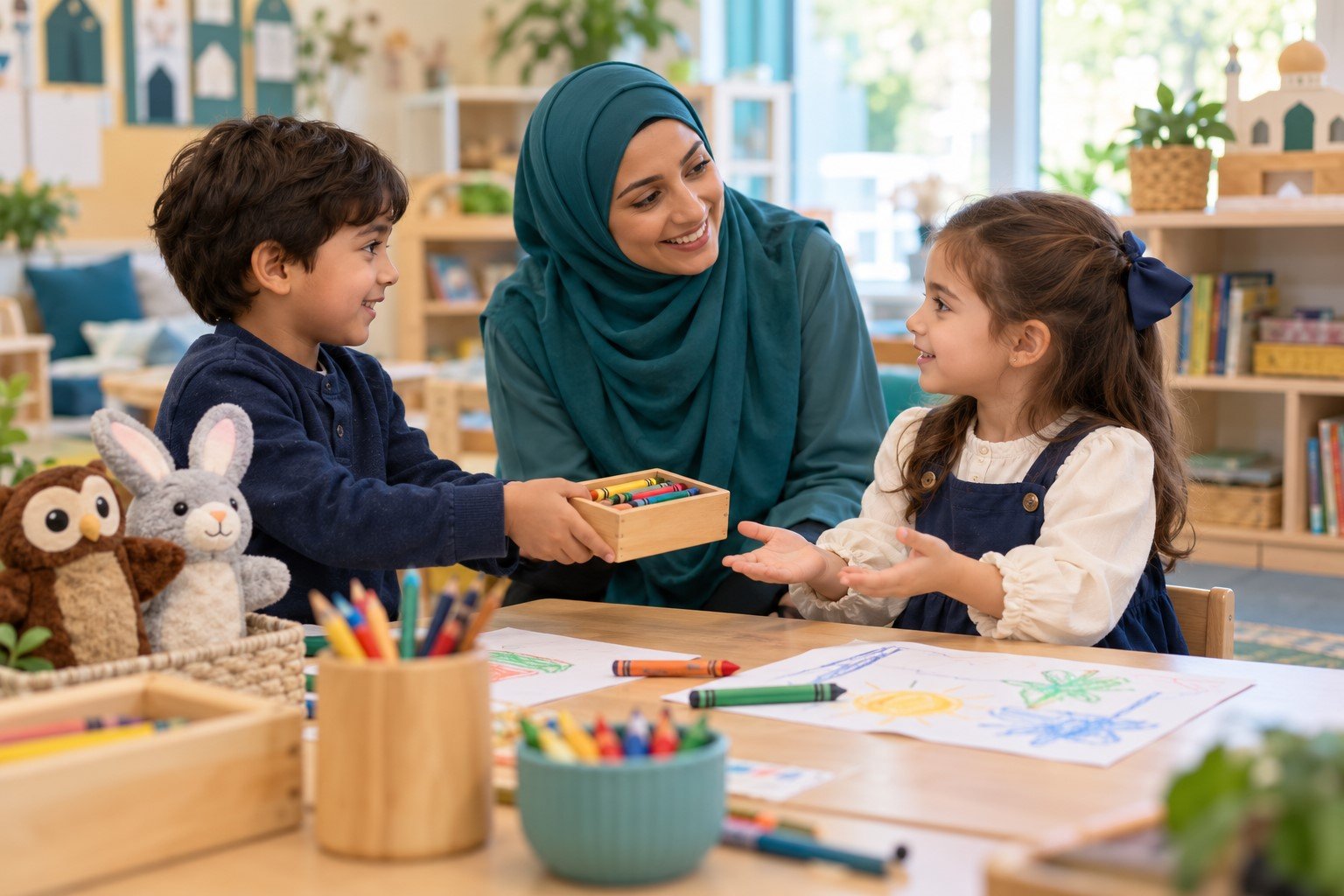
Teacher language: “We can be upset and still keep people safe.” Younger children can practise “Stop, please”; older children can suggest a workable agreement. Do not force hugs, apologies, or immediate forgiveness. Stop real harm and provide support before discussing solutions.
Reflect and notice: “What helped make things better?” Notice a clear request or practical repair. Connect gentle speech with meaningful action.
9. Welcome Picnic
Focus: hospitality and gratitude. Prepare: pretend food, plates, and a picnic cloth. Real snacks are optional only under school food and allergy procedures. Time: 15–20 minutes.
- Give a small group enough pretend items to arrange a place for everyone.
- Practise offering, accepting, and declining: “Would you like some?” “Yes, please” or “No, thank you.”
- Rotate host roles and ask the group to check whether anyone has been overlooked.
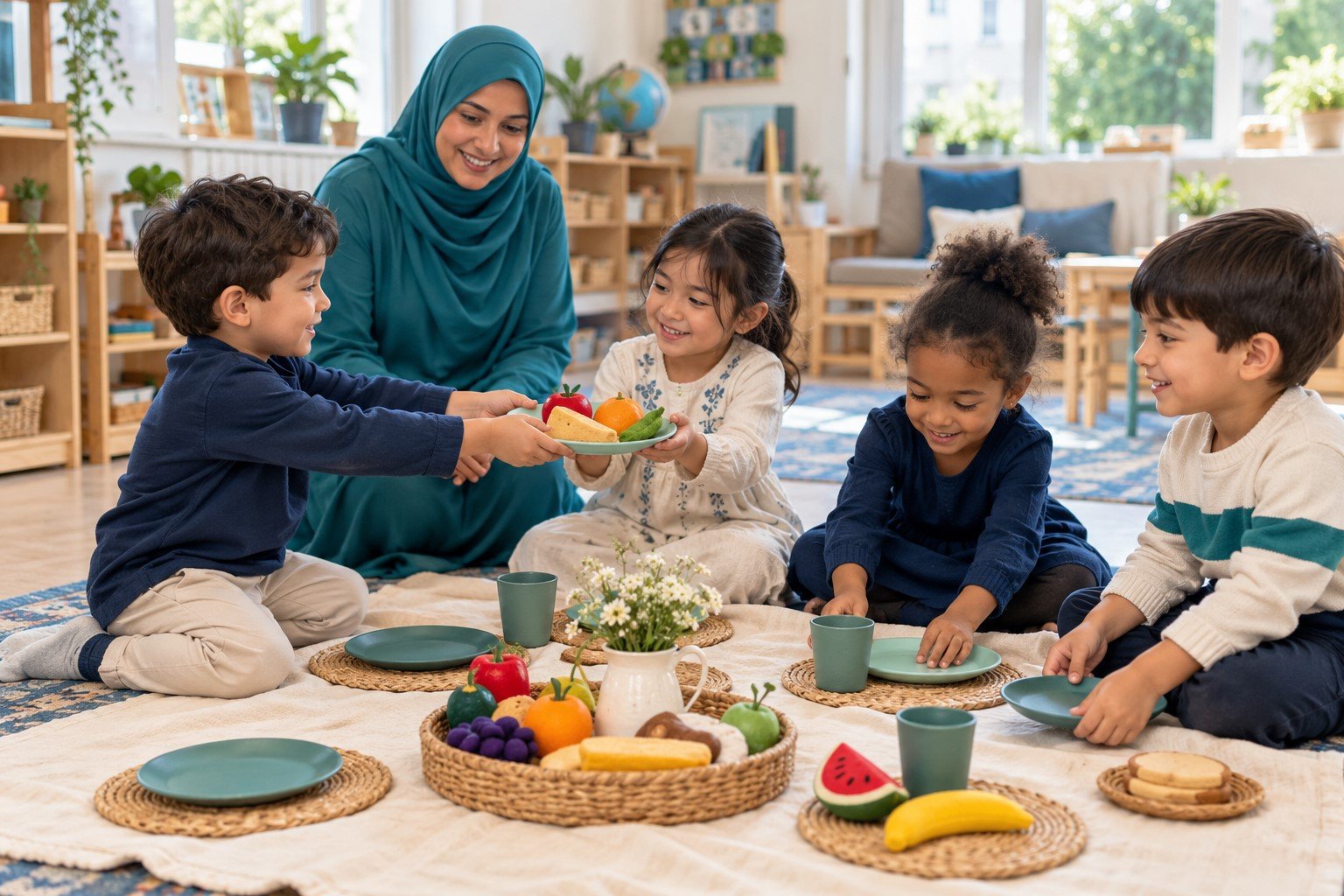
Teacher language: “We offer kindly, and we respect no.” Younger children can match plates to places; older children can plan quantities. Do not require children to surrender their own food or taste something unfamiliar.
Reflect and notice: “How did we help our guests feel welcome?” Notice polite offers and accepted refusals. Discuss thanking Allah for provision and thanking those who help.
10. Care for Allah’s Creation
Focus: teamwork and gentle care. Prepare: a school-approved non-toxic plant, a small watering container, and picture role cards. Time: 15 minutes initially, then brief check-ins.
- Ask what the plant needs. Explain a suitable watering routine for that particular plant.
- Assign rotating roles: checking soil with guidance, watering when needed, and reporting observations.
- Have children compare what they notice and decide, with adult help, whether care is needed today.
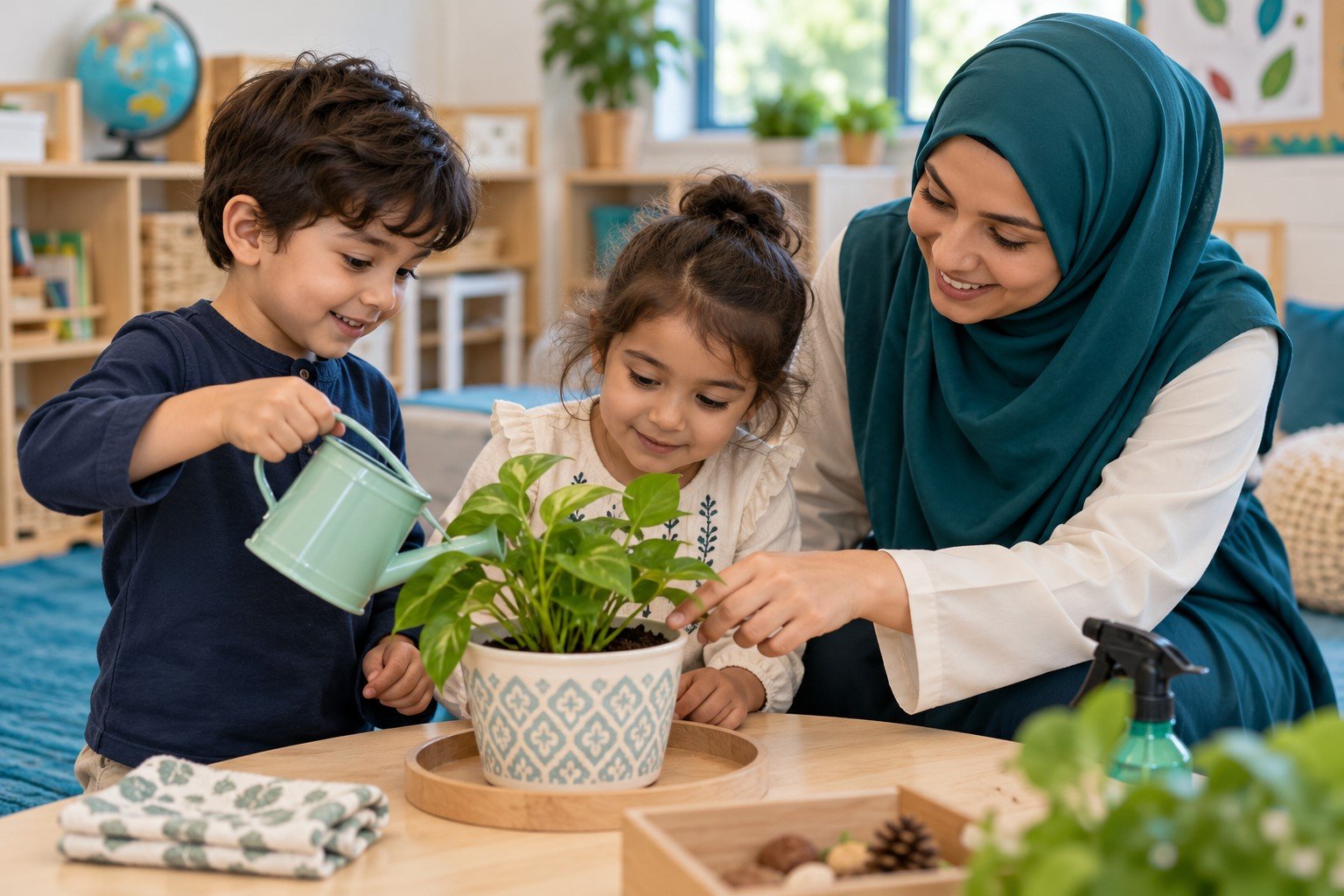
Teacher language: “Caring can mean checking before adding more water.” Younger children can help one step at a time; older children can keep a picture record. Follow hygiene procedures after handling soil. If the plant struggles, investigate rather than blaming children.
Reflect and notice: “How did we care gently?” Look for following an agreed role and consulting a partner.
Plan repetition and notice small changes
Start with two activities and repeat them with small variations. An illustrative week could include greeting practice on Monday, block cooperation on Wednesday, and a repair puppet scene on Friday, with familiar phrases used daily. It is a planning example, not a research-based timetable.
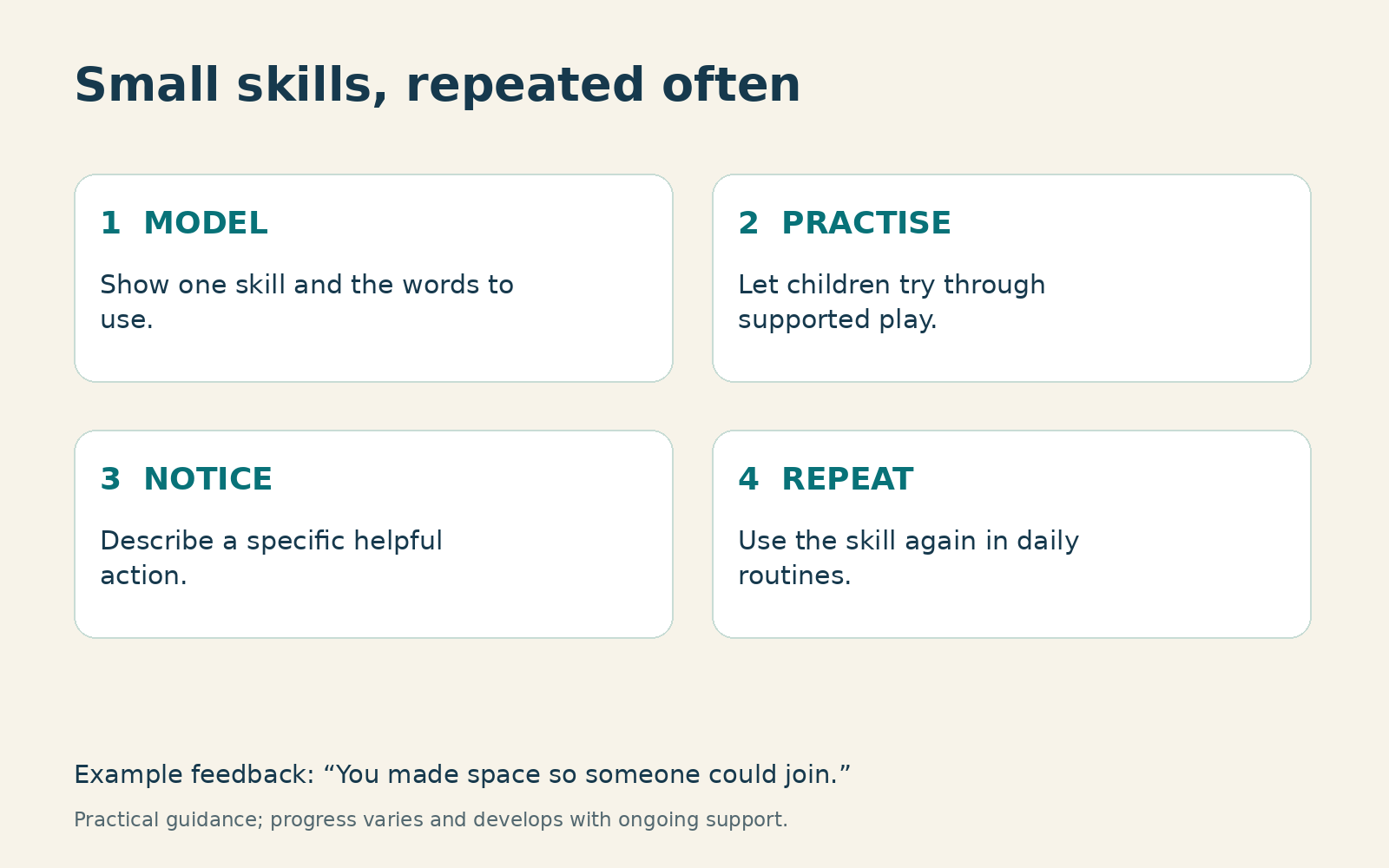
Keep a private note of the date, opportunity, action, and support needed: for example, “Asked for the roller after one verbal prompt.” Compare a child’s progress with their own earlier attempts. Quiet participation and communication aids count; fluent speech is not the only sign of learning.
Replace “You’re the best child” with “You made space so someone could join.” Send parents one phrase to practise at home, without names or comparisons. If a child continues struggling, review task difficulty, communication needs, and environmental demands with caregivers and school support staff.
Connect classroom practice with Islamic learning at home
Quran education has value in a child’s relationship with Allah and understanding of Islam. Alongside recitation, age-appropriate discussion can help families connect religious learning with everyday conduct. Reading ability and social skills need their own practice; neither automatically guarantees the other.
92 Campus Islamic Studies classes introduce beliefs, worship, manners, duas, and selected seerah topics through one-to-one online teaching. Parents can share a current goal—such as asking politely or telling the truth—and ask how suitable examples could be included.
After a lesson about kindness, try a two-minute puppet scene at home. Individual lessons can support understanding and language, while classroom play, siblings, and playdates provide opportunities to practise with peers. These group activities are suggestions for teachers, not a promise that 92 Campus delivers a group social-skills programme.
To make learning sustainable, first discuss the child’s readiness and goals, then review current class plans and confirm fees, lesson length, and scheduling. Share your city and time zone when requesting lessons from the USA, UK, Canada, or Australia.
Begin with one skill tomorrow
Choose one activity, prepare a few materials, and model the words you want children to try. Notice the small moment when a child asks, helps, waits, or puts something right. Repeat that opportunity patiently.
For support connecting faith with everyday learning, parents can request a free trial with 92 Campus and discuss their child’s age and goals. The team confirms a suitable lesson after checking tutor availability.
Sources
- NAEYC: Principles of Child Development and Learning.
- NAEYC: Promoting Young Children’s Social and Emotional Health.
- Harvard Center on the Developing Child: Brain-Building Through Play.
- Quran 5:2; Sahih Muslim 2593.
- 92 Campus: Islamic Studies, pricing, and trial requests. Checked 15 October 2026, Pakistan time.
Join the conversation
Ask a question or share your learning experience. Comments are reviewed before publication. Your name and approved comment will be public.