
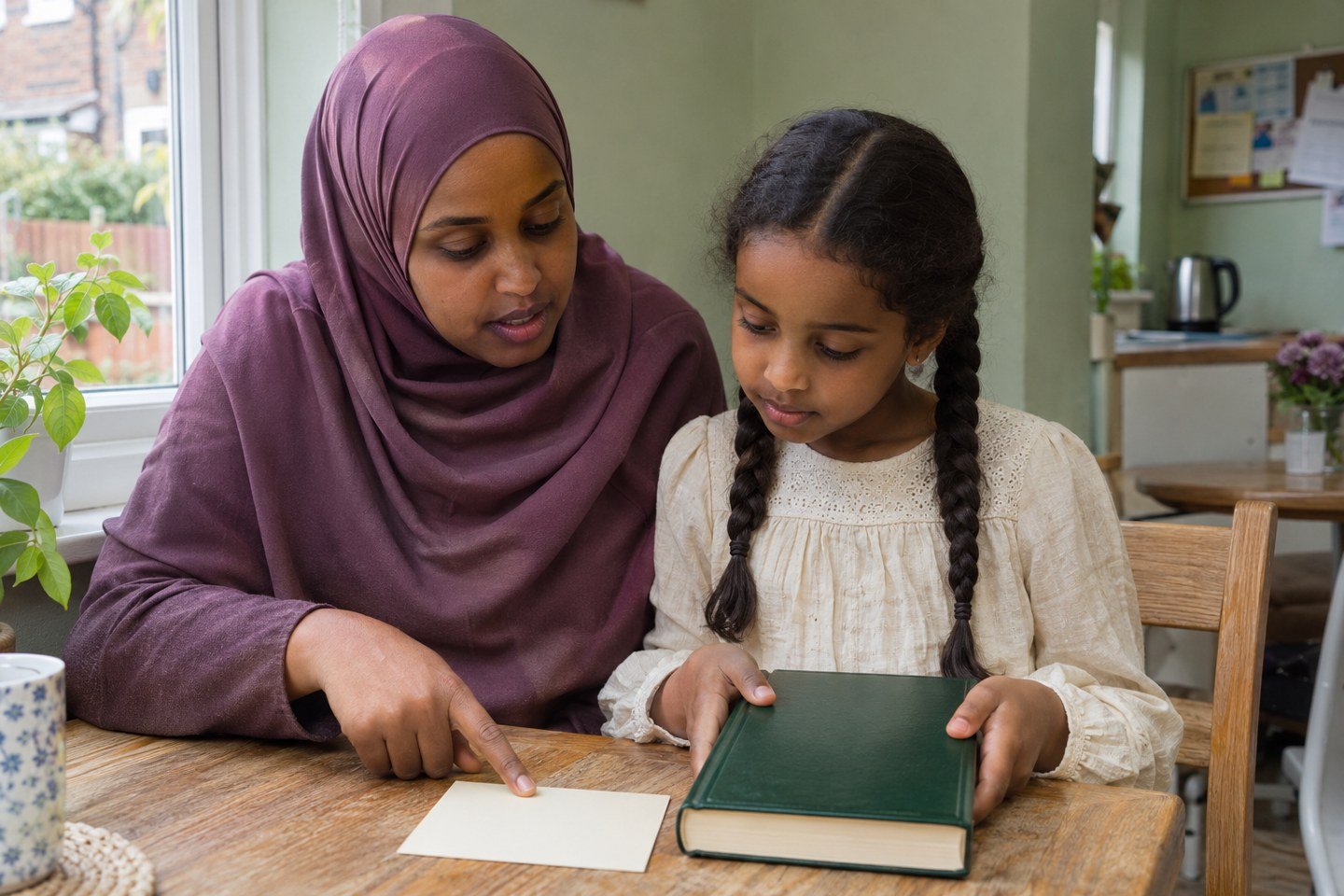
Your child is ready for Quran practice. The book is on the table, but the first question is, “Where do I start?” You find the page, point to the line and begin again tomorrow. That small moment can become frustrating for both of you, especially when your child can read the passage once someone finds it.
Finding an assignment is a skill you can show separately from reading it. This guide offers a practical way to explain the reference, find the passage in your own copy and check its beginning and end. The activities are editorial suggestions; adapt them with your tutor rather than treating them as a fixed teaching programme.
What do surah, ayah, juz and page mean?
Start with the labels your child actually needs for today’s assignment. You do not need to teach every sign in the book at once.
- Surah: a chapter of the Quran. The surah name and its number help identify it.
- Ayah: a verse within a surah. In a reference such as 112:2, 112 identifies the surah and 2 identifies the ayah.
- Juz or para: one of the Quran’s 30 parts. This is a different division from a surah. Finding the right part narrows the search but does not identify every assignment within it.
- Page: a location in a particular printed layout. Record it as an extra aid for that copy, alongside the surah and ayah reference.
The Irfan ul Quran index lists surahs and parts separately. For this guide’s example, its Al-Ikhlas page identifies the surah as number 112, with four ayahs, in Juz 30. These are location facts; this activity does not quote or explain the verses’ meaning.
A useful parent phrase is: “The first number tells us which surah. The next number tells us which ayah inside it.” Ask your child to tell you what the numbers refer to before opening the book.
Before practice, make the assignment clear
“Read the next page” may work when the tutor and learner are using the same copy and both know the starting point. If either is uncertain, ask for a fuller reference.
Write the surah name and number, starting ayah and ending ayah. Add a page number only after checking your copy. If the assignment begins or ends partway through an ayah, ask the tutor to identify the exact word and stopping point; a verse number alone will not describe that task fully.
Keep the relevant copy nearby. A complete Mushaf, a separate Juz booklet and a beginner’s textbook may have different contents and indexes. If your child uses a booklet, first check that the assigned surah is included. Not finding it there does not mean your child has failed to search properly.
You could message the tutor: “Could you confirm the surah number, first and last ayah, and where to begin? We will check the page in our own copy.”
A worked example: find Al-Ikhlas 112:1–2
Illustrative task: locate Surah Al-Ikhlas, ayahs 1–2. This is a navigation example, not an assignment for every learner. Use your tutor’s actual selection for practice.
1. Read the reference together
Say: “We need Surah Al-Ikhlas, number 112. We begin at ayah 1 and finish at the end of ayah 2.” Ask: “Which number tells us the surah?” If your child points to 2, calmly return to the written labels. There is no need to test recitation yet.
2. Find the surah in your copy
Look for the contents or surah index, wherever your edition places it. Find the name or number, then use the page listed there. If the child does not yet read the index independently, you can read its entries aloud while they look for 112. Check the heading when you arrive; a page can contain more than one short surah.
If there is no usable index, ask the tutor to show a suitable route in that copy. Opening near the end may help locate a familiar short surah, but learning one shortcut is different from being able to find any assigned passage.
3. Identify the ayah boundaries
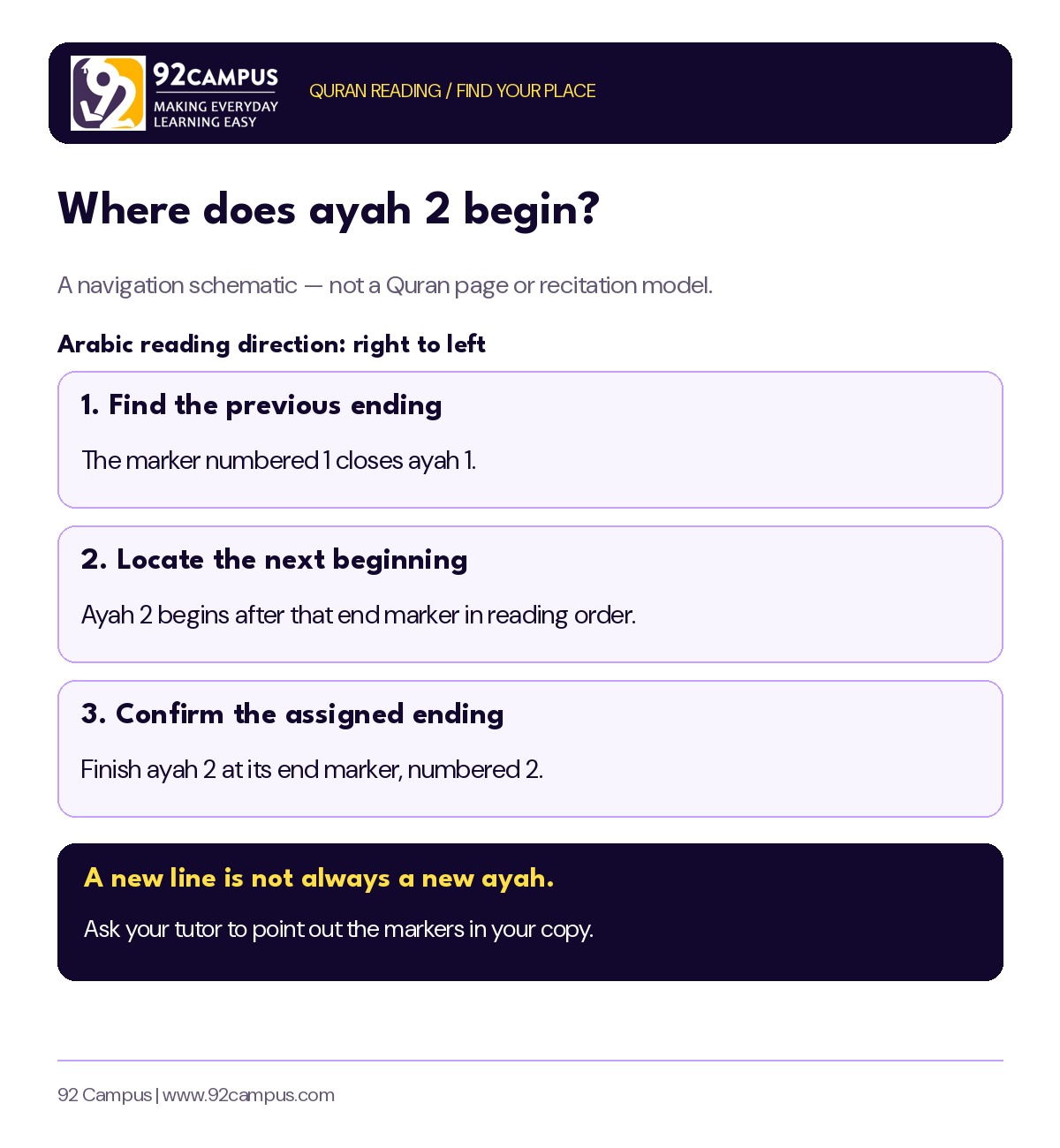
Ask the tutor to show which symbols in your copy are ayah-end markers. A numbered end marker closes the ayah before it; it is not a label telling the learner to start reading after that number for the same ayah. For ayah 2, identify its beginning after ayah 1’s end marker and its ending at marker 2.
An ayah can continue across lines. A new printed line does not automatically mean a new ayah. Other margin signs and numbers may serve different purposes, so do not guess from a nearby number alone. Ask the tutor about an unfamiliar sign, including how the opening Bismillah is handled in the assigned passage.
4. Check the beginning and ending before reading
Ask your child to point to the assigned start and then to the end. Say: “Show me where our task finishes.” When those locations are clear, begin the reading practice the tutor set. Do not quietly extend the task into the next surah because it appears on the same page.
5. Let the child try the search again
Close the book gently, keep the assignment visible and offer another turn if the child is comfortable. Give the smallest useful prompt: “Where could we look up a surah?” rather than immediately opening the correct page. If the task becomes tiring, leave the book at the right place and practise locating it another time.
Notice what happened: “Found the surah using the index; needed help identifying ayah 2.” That tells the tutor more than “couldn’t do homework.”
Why does the tutor’s page number not match ours?
Different layouts can put the same ayah on different pages. Quran Foundation’s page-layout documentation explicitly describes this difference between Mushaf editions. A different page number alone does not show that the assignment or text is wrong.
Compare the surah name, surah number and ayah range first. Then find that reference using the index and markers in your own copy. If the references still do not agree, pause and ask the tutor to check both copies. Do not solve a mismatch by choosing the closest-looking line.
Keep the same copy available when practical, and write identifying details on the separate location card: for example, publisher and edition from its title page. If you change books or switch to an app, recheck the location. A bookmark helps you return to a place; it does not replace understanding the reference.
Save a blank and filled assignment-location card
Use these cards as separate notes beside the book. You can save or print the images, or copy the headings onto paper. They contain no Quranic text. All fields are also listed below so the activity works without the images.
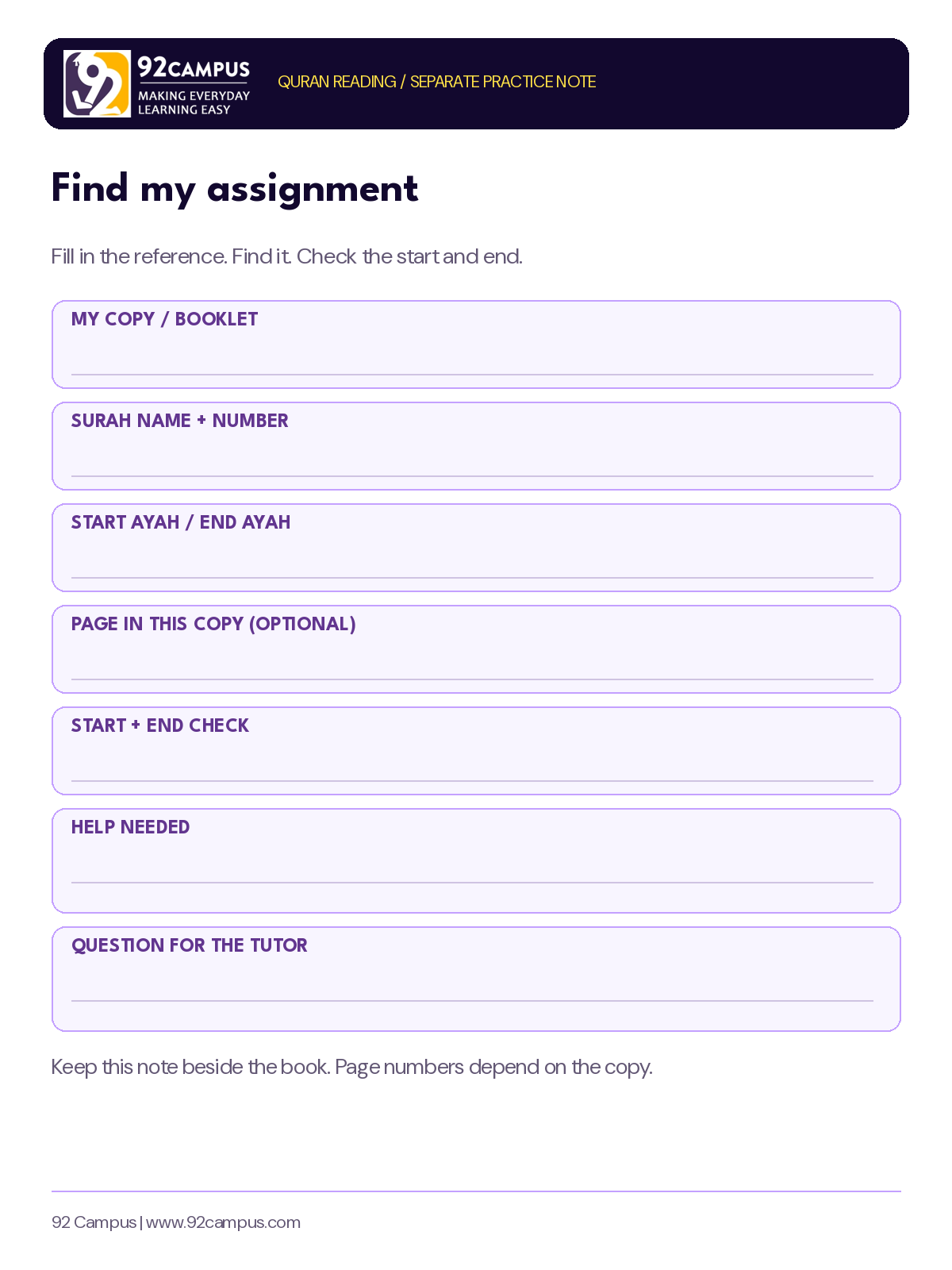
Blank record: My copy or booklet: ____; surah name and number: ____; start ayah: ____; end ayah: ____; page in this copy, if useful: ____; start and end checked: ____; help needed: ____; question for the tutor: ____.
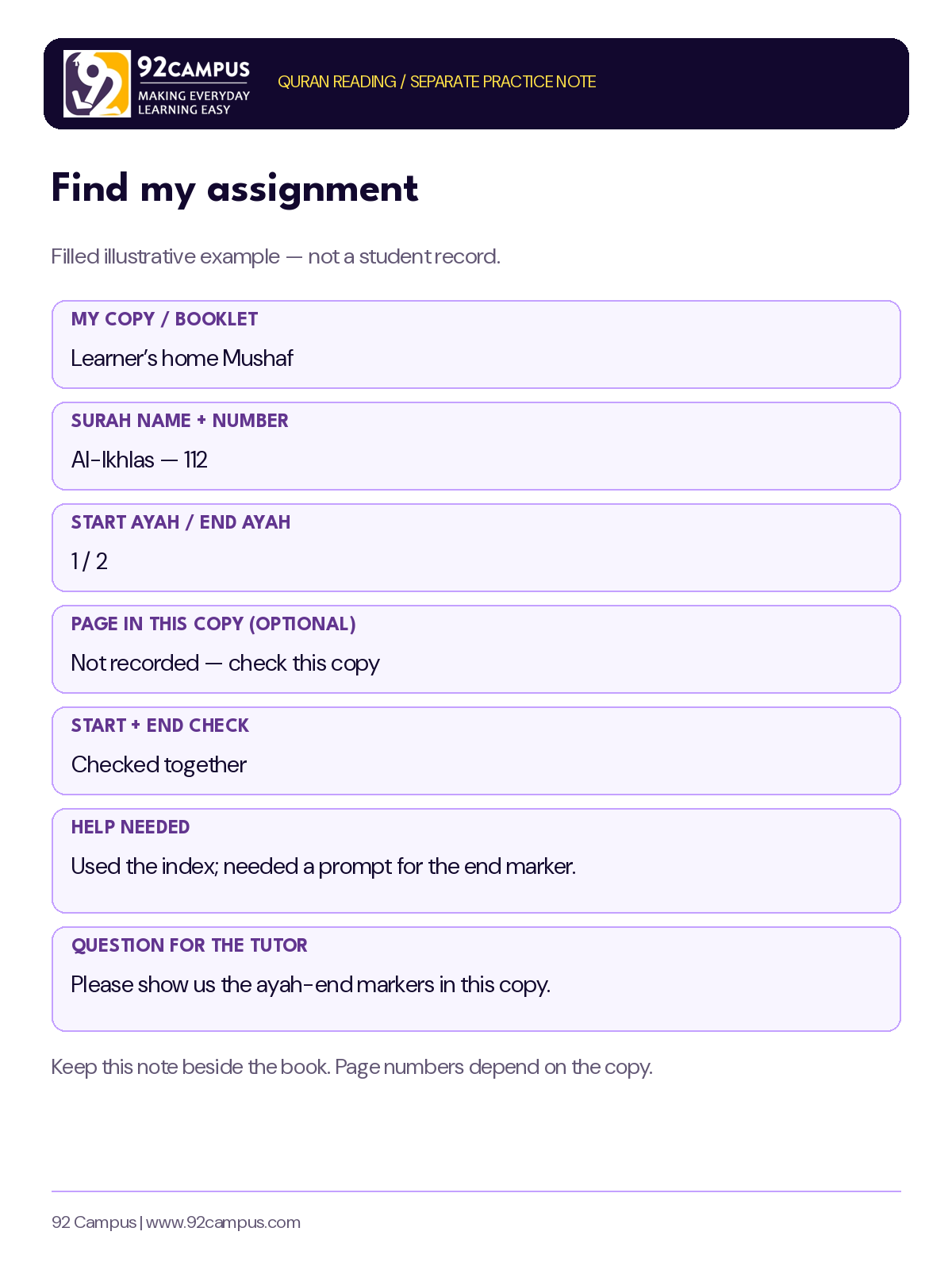
Filled illustrative record: Copy: learner’s home Mushaf; surah: Al-Ikhlas, 112; start: ayah 1; end: ayah 2; page: not recorded—check this copy; start and end: checked together; help: found the surah using its index, needed a prompt for the end marker; tutor question: “Please show us how to recognise the ayah-end markers in this copy.”
After practice, keep navigation and reading observations separate. “Located it with one prompt” describes finding the assignment. “Needed help reading a word” describes recitation. Improving one does not automatically mean the other is secure.
What to say when your child gets stuck
- Wrong surah: “Let’s compare the heading with our card. Which name or number are we looking for?”
- Wrong number: “That may be a page or margin number. Let’s ask which marker shows the ayah.”
- Waiting for you to open it: “I’ll stay beside you. Show me the first place you would look.”
- Feeling frustrated: “Finding the place is today’s small task. I can help with this part, and we can try again later.”
There is no fixed age or deadline for independent searching. A child may need a larger print copy, help recognising numerals or fewer steps at once. Ask what makes this particular task difficult rather than assuming reluctance or a reading problem from a single attempt.
Agree the next step with the tutor
Bring a specific observation to the lesson: “She found the surah heading but treated the line break as the end of the ayah.” Ask the tutor to demonstrate that point in the actual copy, then let your child show it back. Once the location is clear, the tutor can listen to the reading separately.
If you are deciding where to start, the Qaida, Quran Reading and Tajweed comparison explains the different learning focuses. You can also explore the free learning resources for other home-practice tasks.
92 Campus Quran Reading lessons include individual listening, correction and an agreed next practice task. If your child needs help finding and reading the assigned passage, discuss both skills with a tutor. Share the copy you use and the point where help is needed. A trial request becomes a confirmed appointment after the team checks availability.
Join the conversation
Comments are reviewed before publication. Your name and approved comment will be public. Please leave out private learner or contact details.