

Your child finishes a familiar passage. You ask what it means, and the answer is a shrug or “I don’t know.” You may feel that something important is missing, especially when you want Quran learning to become part of how your child thinks and lives.
The reading they have learned still matters. Pronouncing the text accurately and explaining its meaning are different learning goals. Instead of treating the question as a test they should already pass, use it to agree the next goal: understanding a small, clearly identified selection with suitable guidance.
This guide is mainly for parents of older children and teenagers who already have some Quran reading experience. The worked activity is an editorial example checked against the named sources; a qualified teacher’s review of the complete activity is still pending. It is not a report about a real student.
Keep reading and understanding as separate goals
A learner might recognise the Arabic letters, follow a familiar passage and use taught recitation rules without knowing the vocabulary. Another might explain an English translation but still need support with Arabic reading. Notice each skill rather than using one as proof of the other.
- Reading goal: read the assigned Arabic selection with the tutor’s correction.
- Meaning goal: follow its attributed translation and explain one main point.
- Vocabulary goal: recognise a few selected words in that passage.
- Question goal: identify what needs further explanation from the tutor.
For the next lesson, a useful parent message is: “My child can read this selection, but cannot yet explain it. Could we add a short meaning activity without dropping the reading support they still need?” You do not need to wait for the child to finish the entire Quran before discussing an appropriate starting selection.
Choose a small selection and a language the learner understands
Ask the tutor to choose a passage that suits the learner’s age, reading level and language confidence. Familiarity can make a useful starting point, but a familiar passage is not automatically simple to explain in full. Keep the initial question narrow and leave deeper questions open for guidance.
Use an identified translation in a language the learner can follow. Name the translator and record the surah and ayah. If a word in the English translation is unfamiliar, explain that English word before asking the child to summarise the passage. Do not interpret difficulty with an English term as proof that the child is not interested.
The 92 Campus translation course describes guided meanings and contextual vocabulary for older students and adults. Ask the team to confirm age suitability and the available teaching language. The public course description does not establish that every younger child or language request can be accommodated.
Worked activity: Surah Al-Ikhlas, ayah 1
Selection: Surah Al-Ikhlas, 112:1. This single-ayah activity is an introduction to one meaning, not a complete explanation of the surah. Read the wider surah and any needed explanation with a qualified tutor.
Arabic text
قُلْ هُوَ ٱللَّهُ أَحَدٌ
The Arabic text is checked against the Irfan-ul-Quran ayah page. Ask the tutor to check recitation separately from the meaning activity.
Attributed translation
“Say: ‘He is Allah, the Unique One.’”
Source: Irfan-ul-Quran, English translation by Dr Muhammad Tahir-ul-Qadri, Surah Al-Ikhlas 112:1. The source page also displays an alternative English rendering. This activity uses the wording beginning “Say”; it does not combine the two renderings into a new quotation.
Main meaning: a labelled paraphrase
Simple paraphrase: this ayah declares Allah’s oneness. This sentence is an editorial summary, not another quoted translation. Keep its purpose modest: help the learner identify the main statement, then ask the tutor about explanation that goes beyond it.
Selected vocabulary in this ayah
- قُلْ — qul: “Say.”
- هُوَ — huwa: “He.”
- أَحَدٌ — ahadun: “the One” in the Quranic Arabic Corpus’s gloss for this ayah.
These are contextual word aids. They are not a replacement for the full attributed translation, an instruction to assemble a translation word by word or a rule that every word has the same English equivalent everywhere. Transliteration helps identify the terms here; it does not replace reading the Arabic with a tutor.
Questions for a calm conversation
Ask one question and give the learner room to answer. The aim is to discover what they understood, not to make them reproduce an adult’s exact wording.
- “Which words in the translation tell us the main statement about Allah?”
- “Can you find qul in the Arabic and its word aid?”
- “How would you explain the main point in a short sentence?”
- “Is there a word or question you want us to take to your tutor?”
An illustrative answer to the main-point question is: “It tells us Allah is One.” Treat this as an initial summary to check with the teacher, not proof that the learner understands every aspect of the ayah or the whole surah.
A question to take back to the tutor
“What does ‘Unique One’ mean here, and how do the other ayahs help explain it?” A parent can respond: “That is worth asking. Let’s write it down and look at the explanation with your tutor.” Avoid filling the gap with a speculative comparison or an answer invented on the spot.
Use the blank sheet and the filled example together
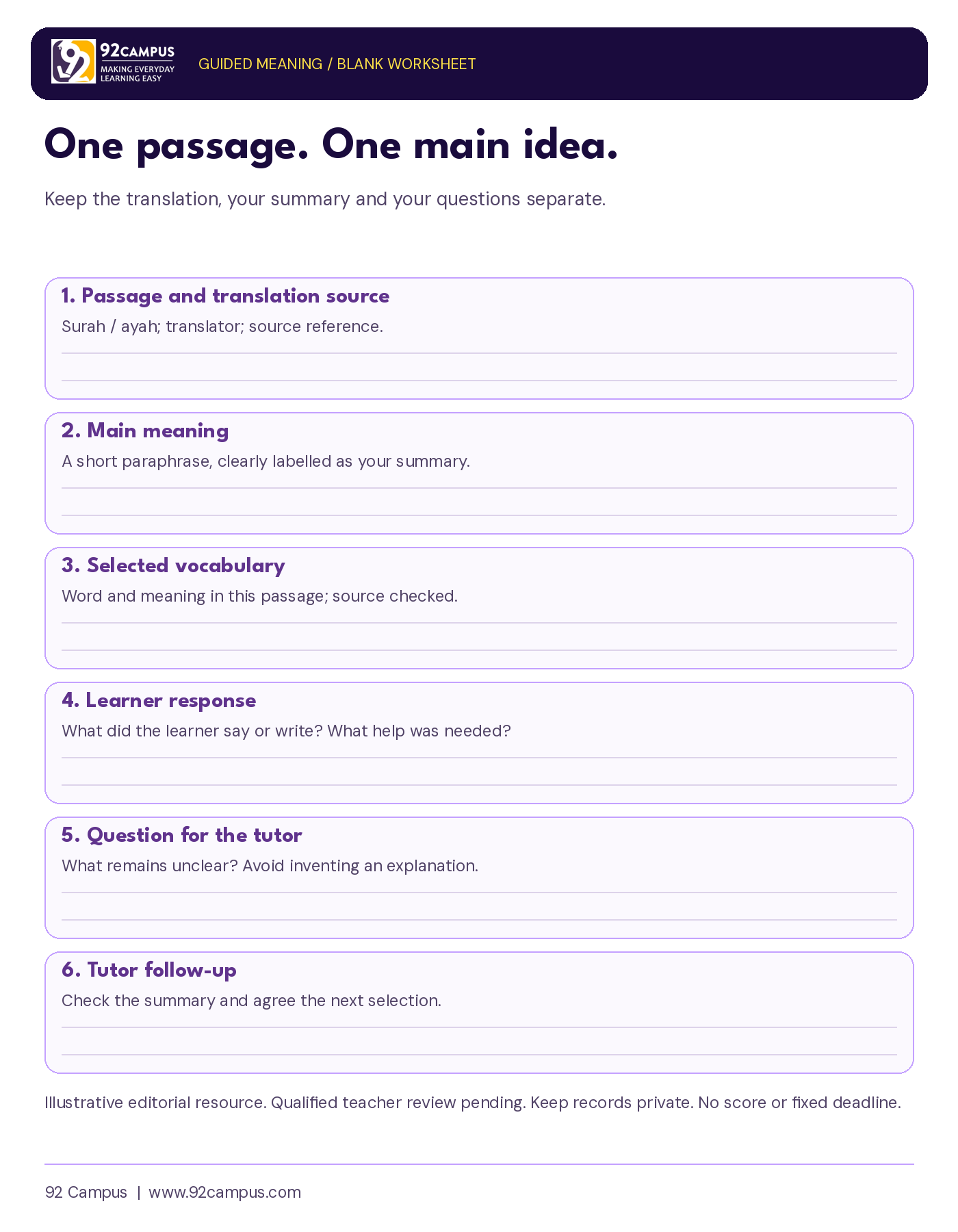
The blank meaning worksheet gives separate spaces for the passage reference, translation source, main meaning, selected vocabulary, learner response and tutor question. Keep the source’s words separate from the learner’s summary.
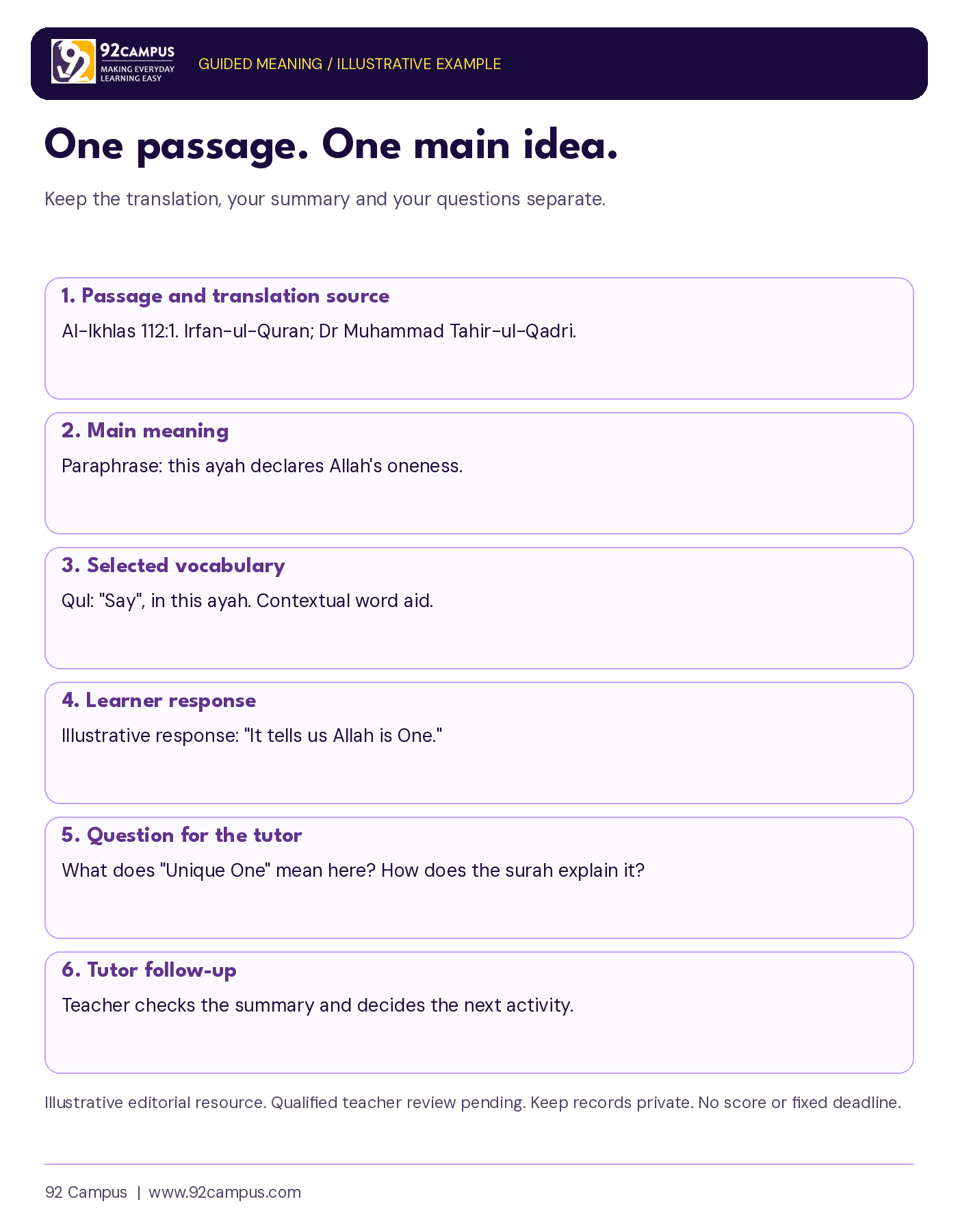
The filled illustrative sheet shows how an unfinished question can sit alongside something already understood. It is not a model answer to memorise or a claim about a student’s results.
- Passage and source: Al-Ikhlas 112:1; Irfan-ul-Quran, Dr Muhammad Tahir-ul-Qadri.
- Main meaning: the ayah declares Allah’s oneness. Label this a paraphrase.
- Word noticed: qul — “Say,” in this ayah.
- Learner response: “It tells us Allah is One.” Illustrative, not a real student quotation.
- Question still open: ask the tutor about “Unique One” and the rest of the surah.
- Next step: teacher checks the summary and chooses whether to revisit this ayah or extend the selection.
Respond helpfully when your child cannot explain
If the answer is “I don’t know,” try: “Let’s read the translation together and choose one thing it says.” If the learner simply repeats your sentence, ask, “Which words helped you decide that?” An answer supported by the text is more informative than a copied sentence alone.
If an answer seems inaccurate, return to the selected translation rather than using embarrassment as motivation: “Let’s check that against the wording. Which part are you thinking of?” Write down a question for the teacher when the meaning is unclear to you too.
Some teenagers prefer to write a short note before talking. Offer that option without insisting on an immediate spoken explanation. Keep the task age-respectful: a teenager does not need babyish rewards or a public performance for relatives to show that a discussion was useful.
Avoid “You’ve been reading for years and still know nothing.” A more accurate description is: “You have built reading skills; now we are adding guided understanding.” This keeps earlier effort visible while acknowledging the next learning need.
Build a flexible routine around one clear question
Agree a manageable selection with the tutor. Read it, revisit the attributed translation, notice one or two contextual words and write a question. Stop at the agreed point rather than expanding a short activity into an unexpected lesson.
At a later check-in, ask whether the learner can still identify the main point or find the selected word. Record whether they needed the translation open, a reminder or a teacher’s explanation. Needing support is useful information for planning; it does not erase what was learned.
If the learner remembers a word but cannot summarise the passage, ask the tutor how to connect the word to the wider sentence. If they can repeat a summary but cannot locate its basis in the translation, return to that link. Do not use a fixed vocabulary count or an unsupported percentage of Quran understanding as a progress claim.
For the wider question of pacing, see how long Quran learning takes. Reading, vocabulary and guided understanding need their own realistic goals rather than one universal completion date.
Leave deeper interpretation open for qualified guidance
A translated sentence, a vocabulary gloss, a plain-language summary and a personal discussion prompt do different jobs. Keep those labels visible. A reflection question is not permission to derive a detailed religious ruling from an isolated phrase.
When a question needs context, scholarly explanation or knowledge you do not have, record it and ask a qualified teacher. For a younger child, discuss a simpler format and age suitability first. Do not assume that an older-learner translation course is automatically a suitable programme for every child.
The broader aim of supporting faith at home is discussed in keeping children connected to Islam. For this activity, keep the immediate next step concrete: one selection, one main meaning and one honest question.
Discuss a suitable starting point
Tell the team what the learner can already read, which language they understand best and what they would like to ask about Quran meanings. The Quran translation course offers a place to discuss guided study for older learners; age suitability, teaching language and tutor availability should be confirmed before booking.
Join the conversation
Comments are reviewed before publication. Your name and approved comment will be public. Please leave out private learner or contact details.