

Your child’s tutor asks a question. There is a pause, and before you notice yourself doing it, you supply the answer. You want the lesson to go well. You may also worry that silence means your child is stuck, distracted or falling behind.
Being close enough to help and answering for your child are different decisions. You can support the connection, observe the lesson and stay available while letting the tutor hear the child’s own attempt. The useful question is not simply “Should I stay or leave?” It is “What help is needed for this task, and who should give it?”
This guide offers practical discussion tools for younger and developing learners who currently receive substantial live help. The scenarios and filled plan are illustrative examples, not records of 92 Campus students or an approved company-wide procedure. Agree the actual arrangements with your tutor and academy.
Separate three kinds of parent involvement
Setup and access support
This includes helping your child join, position the device, hear the tutor and find the assigned material. Fixing a muted microphone does not tell the child the answer. If the connection fails, it is reasonable to identify the technical issue before treating the silence as a reading difficulty.
Observation and availability
You may be watching, listening nearby or staying within reach, depending on the child’s needs and the agreed arrangements. Observation can continue even when answer prompts are reduced. Do not treat leaving the room as proof of successful learning.
Academic prompts and corrections
Naming a letter, whispering a sound, pointing to the correct answer or mouthing the next word can all change the task. Sometimes a tutor may ask for a specific kind of help. Make that help explicit so the tutor knows which part the child completed and which part was supported.
92 Campus’s children’s course page asks a parent or guardian to help younger children with the device and remain available. It describes individual tutor listening and feedback. It does not set a universal age for a parent to leave or establish every observation arrangement discussed here.
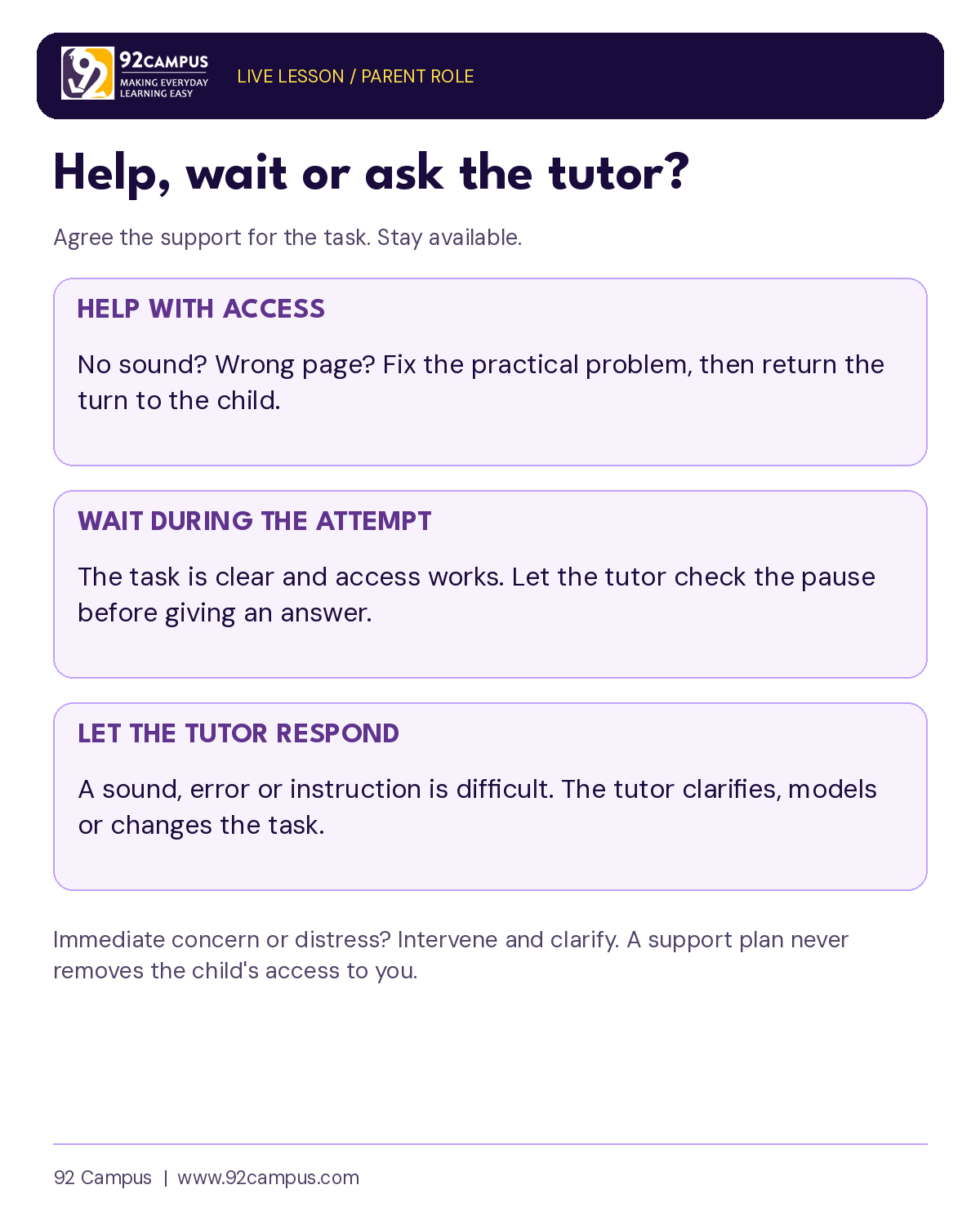
Help, wait or let the tutor respond?
Use the following as an editorial decision aid. It is a starting point for a parent–teacher conversation, not a rule that overrides a child’s access needs or a concern requiring immediate action.
- Help with access: the child cannot hear, use the device or locate the assigned page. Say briefly what you are fixing, then return the turn to the child.
- Wait when the child has access and a clear task: a pause alone does not tell you why the answer has not arrived. Give the tutor room to check.
- Let the tutor respond to a learning difficulty: the child asks for a sound, makes an error or does not understand the question. The tutor can clarify, model or change the task.
- Intervene for an immediate concern: significant distress, discomfort or inappropriate conduct should not be ignored to preserve a planned independent attempt.
Five situations that change the decision
1. The child is silent because the audio has stopped
What happens: the tutor speaks, but the child looks confused and does not answer. You notice the speaker volume is down.
Parent response: “I’m checking the sound. Could you repeat the question once it is working?” Restore access, then step back from the academic answer.
What to note: the original pause cannot fairly be used as a reading assessment. Once the question is audible, the tutor can check understanding. Do not add a whispered answer while adjusting the device.
2. The child pauses after a familiar reading question
What happens: the assigned page is open, the sound works and the question seems clear. You are about to say the answer.
Parent response: stay attentive and allow the tutor to manage the turn. If needed, say, “Your tutor is listening to your attempt.” Do not repeatedly remind the child while they are trying to respond.
Tutor’s possible next step: check whether the child understood, point to the target or model it. There is no universal number of seconds the parent must wait; agree a cue and approach suited to the learner.
3. The child turns to you and asks for the sound
What happens: your child looks away from the screen and asks, “What is this one?”
Parent response: “Let’s ask your tutor to help with that sound.” If your tutor has requested a particular prompt from you, use only that agreed prompt and make it visible: “I pointed to the line, but did not give the sound.”
What to note: seeking help does not make the attempt a failure. The useful record is whether the child needed a cue, a model or another explanation. Ask the tutor how you should respond to the same request next time.
4. The child needs help finding the line, but can try the reading
What happens: the tutor asks for a section, and the child loses their place. You know exactly where it is.
Parent response: first clarify the lesson goal. If the tutor is checking reading, they may ask you to help locate the line. If locating the section is itself being practised, they may prefer to guide that step.
What to note: the same pointing action can be access support in one task and an answer cue in another. Write, “Parent located line; child read with tutor feedback,” rather than recording the whole task as independent.
5. The child becomes upset or uncomfortable
What happens: your child withdraws, becomes distressed or says something about the interaction that concerns you.
Parent response: pause the immediate demand and check what is happening. “We need a moment. I’d like to understand what felt difficult.” Raise concerns through the academy’s confirmed contact route. Do not wait until the review date if something needs attention now.
What to note: reducing prompts does not mean reducing the child’s access to you. A communication plan must allow a child to ask for help and a parent to intervene when appropriate.
Agree a practical parent role before changing it
A short agreement can prevent the child receiving different instructions from two adults. Ask the tutor which part they want to hear without an answer cue, what support should remain and how they will request your help.
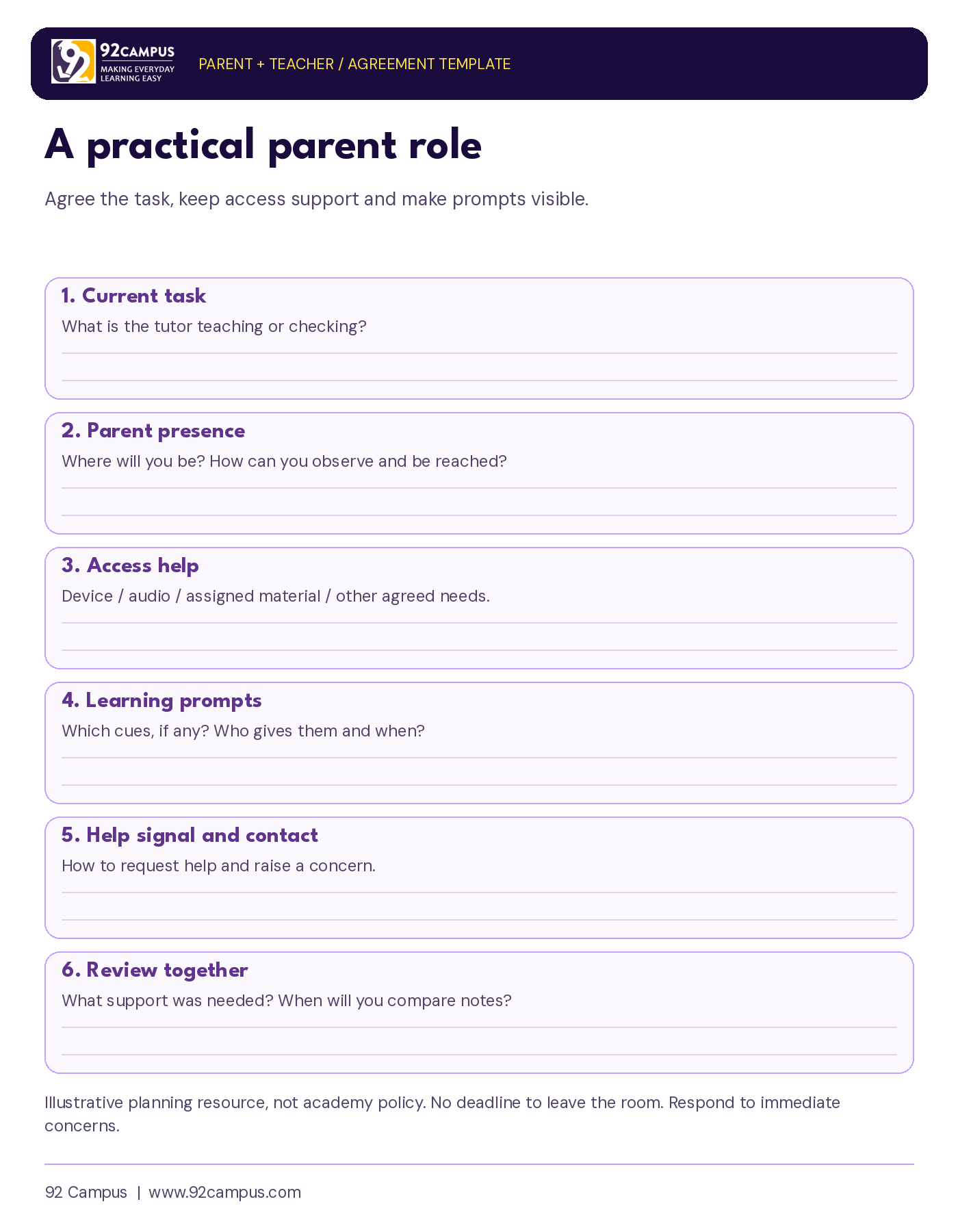
Use the blank parent–teacher role card, or record these points in a private note:
- Current task: what is the tutor teaching or checking?
- Parent presence: where will you be, how can you observe, and how will the child reach you?
- Access help: what device, page or other support will you provide?
- Learning prompts: which cues, if any, are agreed, and who gives them?
- Help signal and contact: how will the tutor request help and how will concerns be raised?
- Review: what will be noticed and when will you compare notes?
A useful message is: “I notice I sometimes answer before my child. I want to remain available and able to observe. Could we agree which prompts you want me to stop, which practical help to keep and how you will signal when you need me?”
Filled example: change support to fit the task
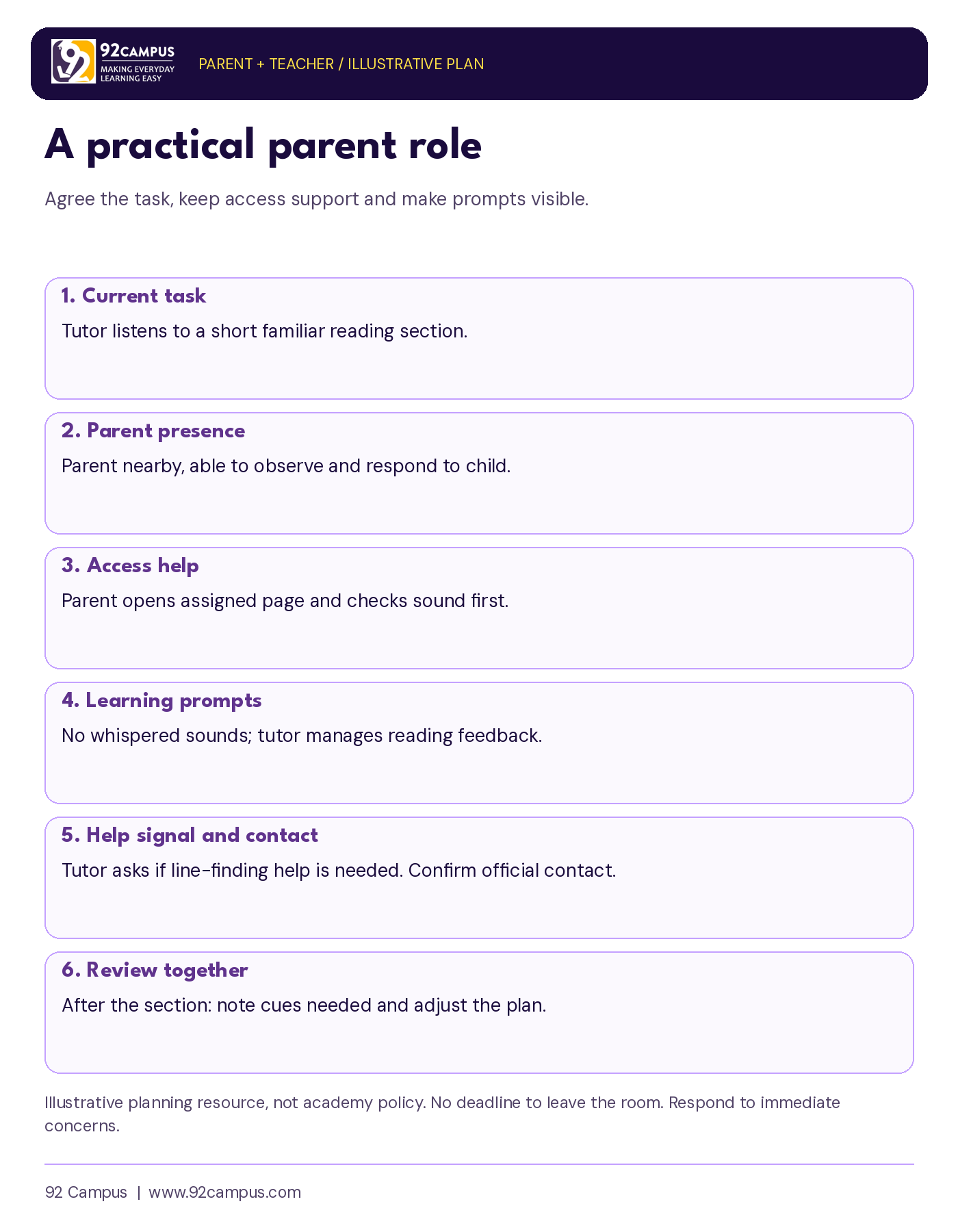
The following is illustrative. It shows how an agreement could change during a lesson without requiring the parent to leave.
- Task: the tutor listens to a short familiar reading section.
- Presence: the parent remains nearby, able to observe and respond to the child.
- Access support: the parent opens the assigned page and checks sound before the attempt.
- Reading attempt: the parent gives no sounds or whispered words. The tutor manages pauses and corrections.
- Task adjustment: if the child loses the line, the tutor decides whether to guide the search or ask the parent to locate it. That help is noted separately.
- Review: after the agreed section, compare what the child attempted and what support remained necessary. Keep the arrangement if helpful or revise it; do not assume less help is always the correct next step.
Keep observation while reviewing prompts
Agree the actual observation arrangements with the academy before changing where you sit. Ask whether you can hear or view the lesson, whether any setup changes are needed and which official contact route to use. Do not assume that a provider’s recording or observation policy matches another academy’s policy.
Tell your child the plan in simple terms: “I’m here for help with the lesson setup. Your tutor will help with reading. You can still tell me if something is wrong.” Avoid making reduced prompting sound like withdrawal of your attention.
If a learner needs continuing support for communication or access, discuss that need directly. This article does not set an age limit, diagnose a difficulty or require a child to manage the same way as another learner. An agreement can preserve substantial parent involvement while making the source of each answer clearer.
Review what happened, rather than counting days until you leave
Ask what the tutor could hear from the child: an attempt without a sound cue, a question asked directly or a response after a model. Also record what remained difficult. A quieter parent does not by itself prove that the child learned more, and one correct answer does not establish independence.
If the child waits for a parent prompt, discuss whether the task was clear and manageable. If the child cannot access the material without you, keep that support while the tutor works on the appropriate learning target. Review the plan as needs change, with no deadline for leaving the room.
Progress-monitoring guidance can help you record tasks and prompts. For the broader format, read what to check when considering online Quran learning. Keep live-lesson roles distinct from the homework routine you use afterwards.
Use the trial to discuss roles
During a trial, explain the help your child currently receives, including device support, page finding and answer cues. Ask what the tutor would like you to do during a short activity. The trial guide explains the starting-level discussion.
92 Campus offers one-to-one classes for children. Discuss your family’s observation and support needs with the team. A saved request is not a confirmed appointment: the team checks availability before confirming the lesson.
Discuss the help your child currently needs and agree a practical parent role with the tutor.
Join the conversation
Comments are reviewed before publication. Your name and approved comment will be public. Please leave out private learner or contact details.