
Your child can explain a Tajweed rule at the table. During reading, however, the same rule is missed. You ask, “But you just told me the rule—why didn’t you use it?” The child may not have an answer, even after making a sincere effort.
Try changing the next task rather than repeating that question. Ask the tutor to listen to a short passage and identify where the difficulty begins: noticing the relevant place, choosing what to do, producing the sound or continuing through the surrounding words. Each gives you a more useful practice target than “remember all your rules.”
This guide is for learners who can already read connected Arabic, including children and older students. It uses an owner-supplied, teacher-approved Hamzatul Wasl lesson as a concrete starting point. The practice comparisons below are labelled illustrative; they are not measured outcomes from the recorded learner.
Knowing a rule and using it are different tasks
When you ask for a definition, you are checking whether the learner can explain an idea. When you ask them to read, you are checking whether they can use the relevant idea at the right place while following the text. A correct definition does not, by itself, show that the reading is accurate.
Separate four questions in your next discussion with the tutor:
- Recall: Can the learner explain the selected rule in their own words?
- Recognition: Can they locate an occurrence in the assigned text?
- Guided application: Can they read it after the tutor models or prompts it?
- Application with less help: Can they use it in another suitable example without the same cue?
These are planning distinctions, not a diagnostic scale or a compulsory sequence for every lesson. A learner may recognise a marked example but need help when the surrounding words change. Another may find the place independently yet still need the tutor’s pronunciation model. Record the support actually needed.
92 Campus’s Tajweed course describes practising rules in short passages and checking application during new recitation. That course description supports this learning focus; it is not evidence of how many families experience the problem or proof that one practice routine works for everyone.
A concrete target: Hamzatul Wasl
Hamzatul Wasl is the connecting hamza, shown as ٱ in many Quran print styles. Its pronunciation depends on whether reading begins at that word or reaches it in connected recitation. When beginning at the word, the hamza is pronounced with the appropriate starting vowel. When joining from the preceding word, that hamza is not pronounced.
This is a distinction to hear and practise with the tutor. It is not an instruction to remove every alif you see, use one starting vowel for every word or change where you stop in a verse. The tutor should confirm the exact word, the appropriate starting sound and a suitable reading or restarting point.
For the first practice, keep the question narrow: “Am I beginning at this word, or joining into it?” Naming Hamzatul Wasl is useful only if the learner also knows which situation they are reading.
The supplied lesson: notice the place before reading it
The supplied recording, 1.mp4, is 20 minutes and 31 seconds long. The owner identifies Hamzatul Wasl at the beginning of the video and confirms teacher approval. Opening visuals show connected Quran text from Surah Al-Ma’idah, with marking around the beginning of a selected word. The still below is taken at approximately 00:30; participant areas have been excluded.
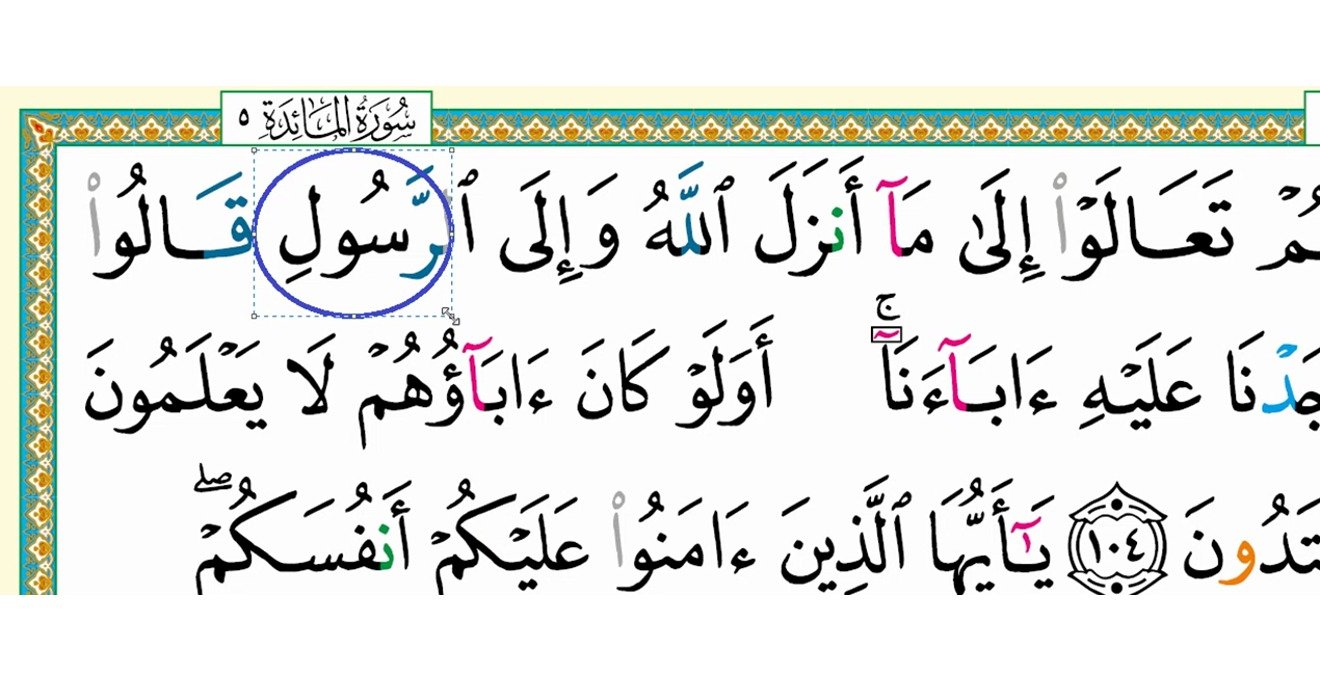
Use the teacher-identified word in that opening passage as the first target. Ask the tutor to show where the connecting hamza occurs, then model two clearly announced tasks: beginning at the selected word as a teaching demonstration, and joining into it from an appropriate preceding phrase. The tutor should explain any other pronunciation features needed for that word so the learner does not treat the hamza as the only feature that matters.
The useful comparison is the same target in two reading situations. Do not ask a parent to reconstruct the sound from this screenshot. The supplied teacher model or live tutor listening is needed to check what is actually pronounced.
About the example: teacher approval is confirmed by the owner. The recording has not been independently assessed here for every spoken correction. The practice sequence and comparisons that follow are an editorial application of the identified target, not a verbatim transcript or a claim that every step appears in the recording.
Practise one target, then change the example
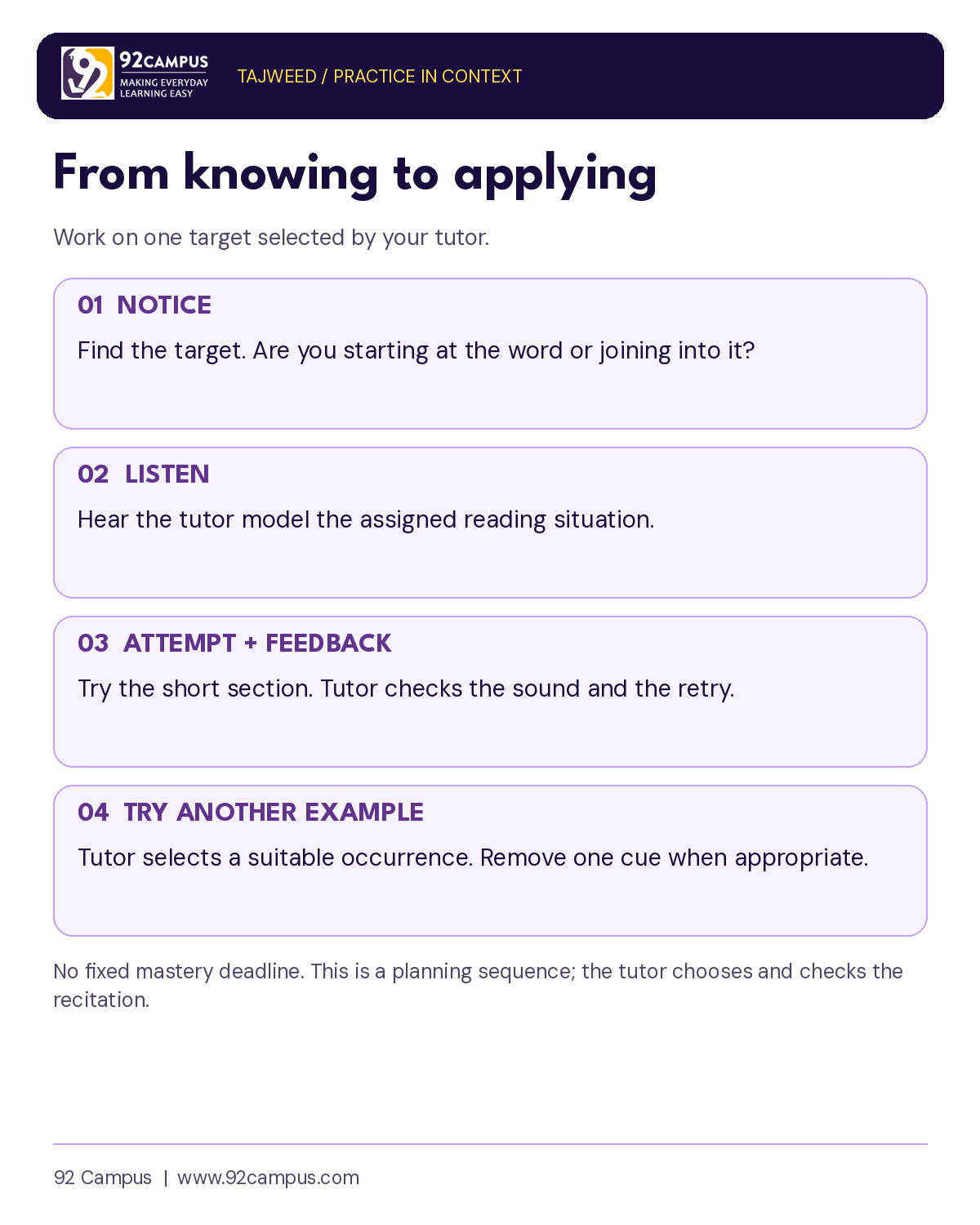
1. Ask the learner to notice the situation
Let the tutor choose a short, readable section. Ask, “Show me the word we are practising. Will you start there, or join into it?” If the learner cannot locate the target, the tutor can point or mark it. Note that cue rather than recording the attempt as independent.
A parent can say: “You remembered the explanation. Now we’re finding where to use it.” This acknowledges what the learner can already do without pretending the reading task is complete.
2. Listen to the tutor’s model
Ask for one clear model of the assigned task. The tutor can contrast starting and joining if appropriate, then say which version the learner should attempt. Avoid asking the child to hold several new corrections in mind at once.
If the model is unclear because the connection breaks up, request it again. “I couldn’t hear the beginning clearly” is a useful learning question. Guessing at the sound does not make the practice more independent.
3. Attempt and receive a specific correction
The learner reads the chosen section. The tutor listens for the target and identifies the next adjustment. Useful feedback tells the learner what to change in that attempt, then gives another turn to try it.
An illustrative exchange is: Learner: “I know it connects, but I’m unsure when I get there.” Tutor: “Let’s identify the place first. Listen to my connected model, then try this short phrase.” The tutor supplies the actual recitation; the script does not prescribe a sound.
4. Try a second suitable example with less help
Once the tutor is ready to move on, ask them to select a different suitable occurrence. Keep the reading difficulty manageable. Initially remove one cue—for example, ask the learner to locate the target without a coloured circle—rather than changing the rule, passage difficulty and pace together.
The second example must be checked by the tutor for the same intended learning point. A visually similar word is not enough to establish that the same starting vowel or reading treatment applies. This guide does not supply an unchecked second Arabic example or claim that a transfer attempt was observed in the recording.
If the learner needs the model again, record that and use it. The next lesson can revisit the target. There is no fixed number of repetitions or days after which the skill must be mastered.
Compare the help needed, not just a correct answer
The following is an illustrative comparison, not a real student report or evidence of improvement caused by this method.
- Prompted attempt: the tutor points to the connecting hamza, names the joining situation and models the phrase. The learner repeats it. Record: “Read after a model; target pointed out.”
- Less-prompted attempt: in another checked example, the tutor asks the learner to locate the target and decide whether the task is starting or joining. The tutor then listens. Record what happened: “Located independently; needed one model for pronunciation,” or “Located and read without that prompt; tutor checked.”
The second record can show a different level of support without claiming full mastery. A repeated model, a familiar marked page and a new unmarked passage are different practice conditions. Keep those details visible when comparing attempts.
Do not make speed the deciding measure. Let the tutor judge when to return the target to a longer section and whether additional reading foundations need attention. If the surrounding words are too difficult, shorten or change the selection with the tutor rather than labelling the learner careless.
Keep a simple practice card
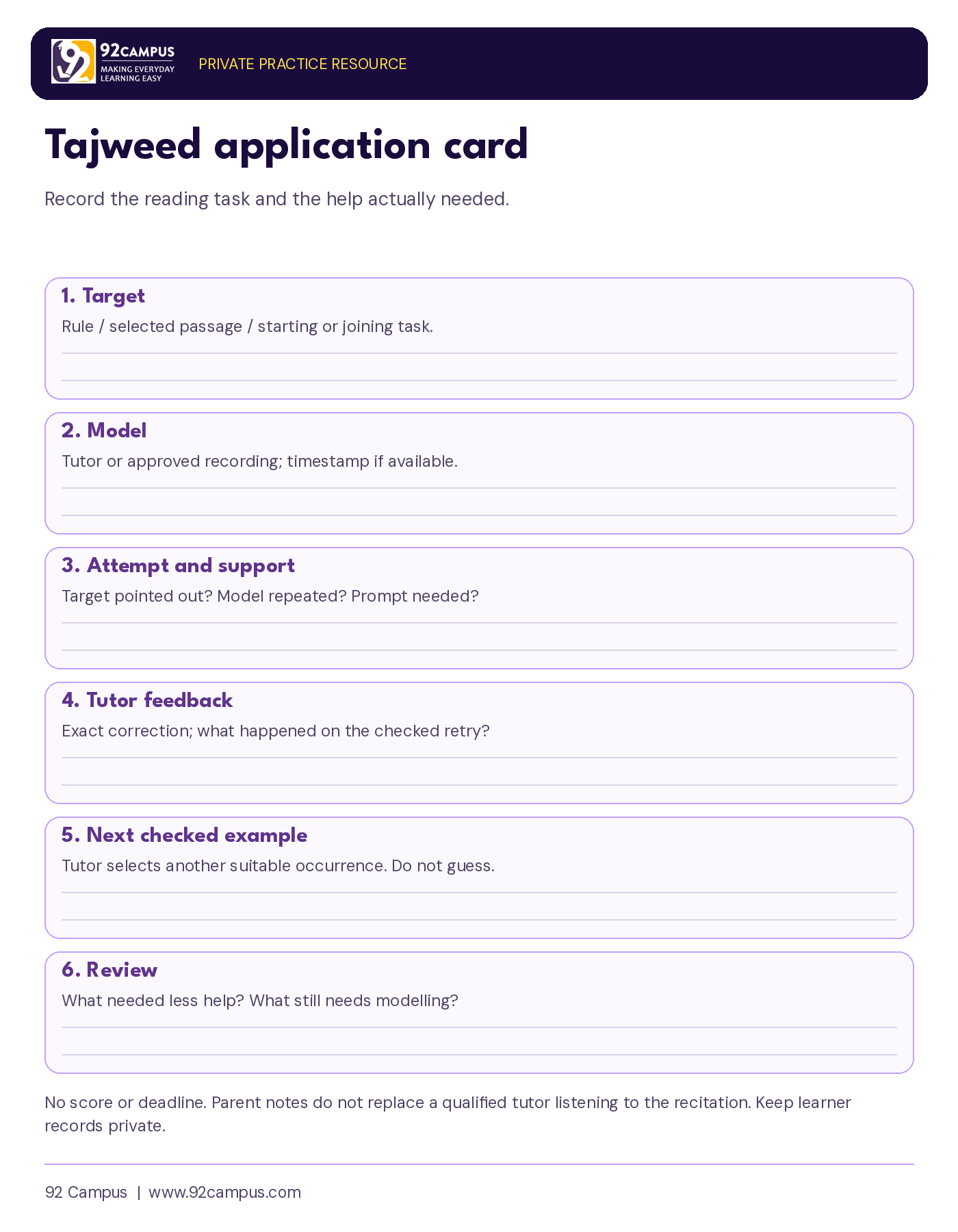
Download the one-page practice card or copy these headings into a notebook. Use the card to prepare the next tutor conversation, not to award a pass or fail.
- Target: rule, selected word or passage and whether the task is starting or joining.
- Model: the tutor or approved recording used; add a timestamp when available.
- Attempt: what the learner read and the cue or model provided.
- Tutor feedback: the precise correction and whether the retry was checked.
- Next example: another occurrence chosen and approved by the tutor; leave blank until selected.
- Review: what can now be done with less help and what still needs a model.
Illustrative filled entry: “Target: Hamzatul Wasl, teacher-selected word from the opening lesson. Task: join from the agreed preceding phrase. Model: tutor demonstrates live. Attempt: learner locates the marked word and repeats after the model. Feedback: tutor to confirm the sound and set the retry. Next example: not yet selected. Review: check recognition without the mark before claiming independent application.”
What parents can do between lessons
Ask for an exact assignment: “Which passage should we practise, which model should we use, and what should I leave for you to check?” The parent’s role may be to help locate the assigned material and note a question. It does not have to include judging unfamiliar pronunciation.
If your child says, “I already know this,” respond: “Yes, you can explain it. Today’s job is to use it in this short reading.” If an attempt becomes frustrating, pause and ask the tutor to clarify the next step. Repeating definitions more loudly does not tell you where the application broke down.
Older learners can use the same card themselves. Replace “my child” with “I”: “I can identify this rule when asked, but I need a prompt during reading.” That gives a tutor a specific starting point without making the learner’s effort the problem.
For broader tracking, see how parents can monitor Quran learning progress. The Tajweed confidence guide discusses the wider confidence goal; this article focuses on applying a taught rule in context.
Bring one example to your tutor
92 Campus offers individual listening and contextual practice through its online Tajweed classes. Share the rule the learner can explain, the passage where it is missed and any prompt that already helps. Ask the tutor to choose a suitable next example and agree how to check it.
Tell the tutor which rule your learner understands and where applying it becomes difficult.
Join the conversation
Comments are reviewed before publication. Your name and approved comment will be public. Please leave out private learner or contact details.