

You open a beginner resource and see Arabic writing, an unfamiliar line in English letters and a sentence in ordinary English. Both English-letter lines may look like help with the same task. However, Quran transliteration and translation serve different purposes, so it helps to know which one you are using.
This guide is for English-speaking beginners and parents helping a learner choose the right kind of support. You will learn to identify each text layer, explain the difference through a simple vocabulary example and ask a clearer question when the page becomes confusing.
Quran transliteration and translation: the basic difference
Transliteration represents Arabic words using another writing system, commonly Latin letters—the letters used for English. It keeps a connection to the Arabic word rather than replacing it with an English meaning. Some learning resources use a more pronunciation-focused transcription; the notation depends on the resource.
Translation conveys meaning in another language. Reading an English translation therefore involves English words and sentences. A line can use Latin letters without being an English translation.
Keep three questions separate:
- Arabic script: Which Arabic word or letters am I looking at?
- Transliteration: Which Arabic word is this Latin-letter notation representing?
- Translation: What meaning is being conveyed in English?
The Quranic Arabic Corpus’s transcription guide, for example, documents its own symbols and notes that pronunciation depends on context. Its notation is not simply ordinary English spelling.
One ordinary word makes the difference visible
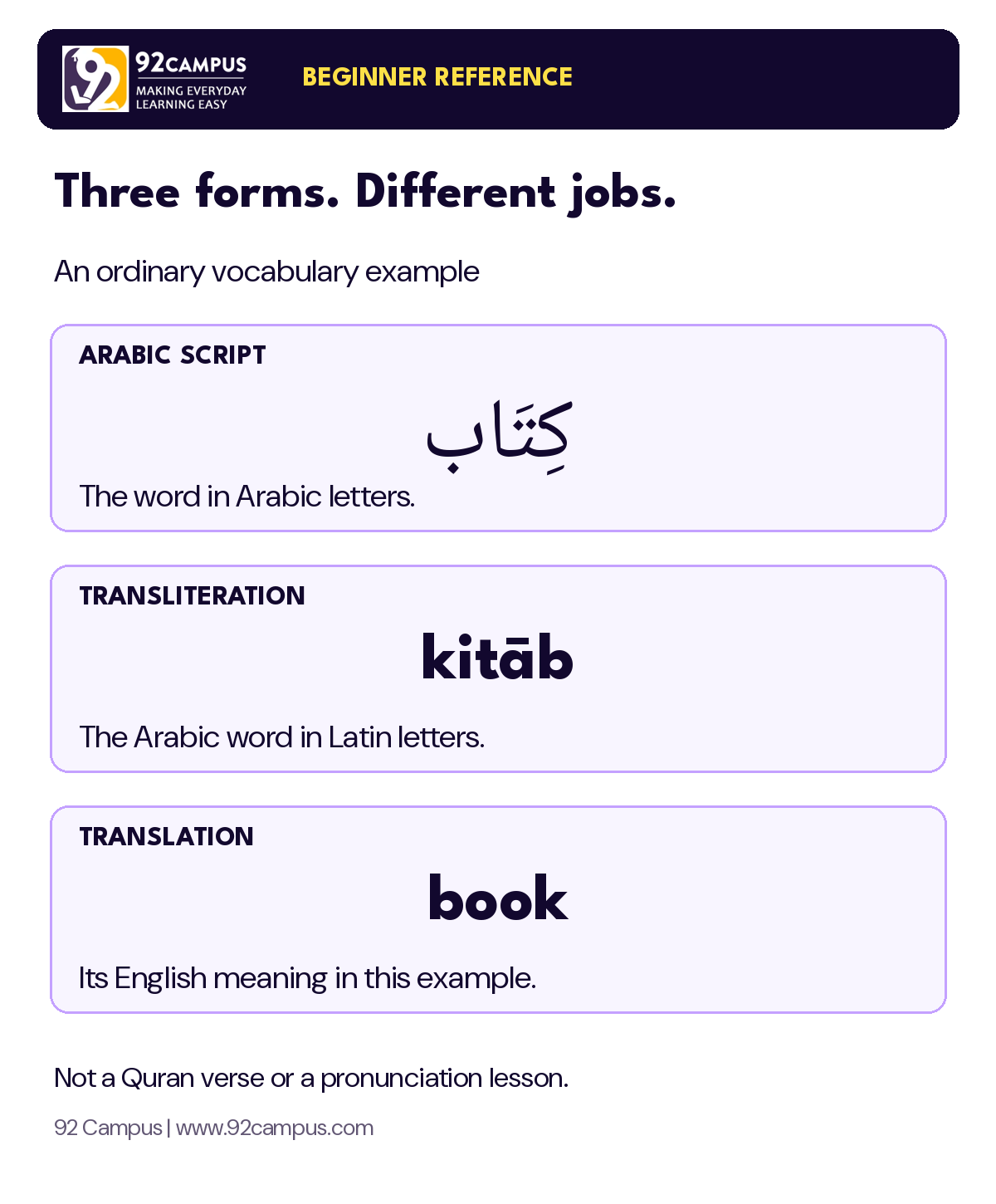
Consider a basic Arabic vocabulary word. This is an ordinary word example, not a quoted Quran passage or a recitation exercise:
- Arabic script: كِتَاب
- Transliteration: kitāb
- English meaning in this vocabulary example: book
Madinah Arabic’s vocabulary entry identifies the Arabic word and its English meaning. The Library of Congress Arabic romanization table also gives kitāb alongside its Arabic spelling. That table is a cataloguing reference, not a Quran recitation syllabus.
If a learner says “book,” they have supplied the English meaning in this example. If they follow kitāb, they are using a Latin-letter representation of the Arabic word. Neither response alone tells you whether they can recognise and read the Arabic script.
The line over the ā is part of the notation. Do not treat it as decoration or assume it works like an English accent mark. Ask the teacher to explain the symbols in the actual resource you use.
Choose the help that matches your question
Before changing books or courses, name what you are trying to do. “I cannot read this” can mean several things, and the next step depends on which part is difficult.
If the Arabic letters are unfamiliar
Ask for help with recognising the script, its reading signs and the sounds being taught. The 92 Campus Noorani Qaida course covers reading foundations for children and older beginners. Following a Roman-letter line is different from learning those Arabic letter forms.
If you recognise the text but need pronunciation help
Show the teacher the Arabic and the exact notation you have been following. Ask them to model the relevant part and listen to your attempt. The Latin spelling cannot hear your voice or check whether you have produced the intended sound.
If you want to understand the meaning
Look for the identified translation, then ask about wording you do not understand. Adding more sound spellings will not answer a meaning question. The academy’s Quran Translation course describes guided meaning and vocabulary study for older students and adults. Younger learners’ suitability and teaching language need to be discussed separately.
Why two transliterations can look different
Quran transliteration is not one universal English spelling system. Before comparing two versions, check whether each resource explains its notation. A difference on the page may concern the system being used; it does not by itself tell you which pronunciation is correct.
For instance, the Corpus guide distinguishes ḥ from h and uses ā, ī and ū for long vowels. These are specific conventions in that guide. Knowing how an ordinary English word uses “h” does not explain the distinction between those symbols.
If a printed key is missing or unclear, ask: “Which Arabic letter does this symbol represent here, and can you demonstrate it?” Bring both versions if necessary. Avoid creating a new spelling by combining pieces from several resources and assuming the result has been checked.
A clear notation can identify information on paper, but learning to produce a sound also needs listening and feedback. This guide explains the resource labels; it does not teach articulation through English spellings.
A worked conversation when “English Quran” is unclear
Illustrative scenario: A parent tells a tutor that their teenager “reads the Quran in English.” The phrase leaves the actual learning task unclear. The following exchange is fictional, not a student case or an approved teaching demonstration.
Parent: “There are English letters under the Arabic, and my child follows those.”
Tutor: “Are they representing Arabic words, or are they English sentences explaining the meaning? Please show me the resource.”
Parent: “They represent the Arabic words. My child also listens and repeats, but I am unsure which Arabic letters they recognise.”
A clearer request: “Could you check Arabic-script reading separately from repetition, and explain the notation where it is confusing?”
If the parent instead means that the child reads ordinary English sentences, the useful question changes: “Could you help them understand this translation and discuss which Arabic reading support they need?” In both cases, describing the activity is more informative than the label “English Quran.”
For a learner who feels embarrassed, try: “You have shown me which line you use. Now we can ask for help with the part you want to learn.” There is no need to turn a resource-label mix-up into a judgment about effort.
Try a simple label-and-purpose check
Use the ordinary vocabulary example above before introducing a passage. This editorial activity checks understanding of the labels, not recitation or overall reading ability.
- Point to كِتَاب and name it as Arabic script.
- Point to kitāb and ask what kind of line it is: an Arabic word represented in Latin letters, or an English meaning?
- Finally, show “book” and ask which question it answers.
- Ask the learner to explain the difference in their own words. If needed, model the explanation and record that help honestly.
Filled illustrative response: “The Arabic line shows the word in Arabic letters. Kitāb represents that Arabic word in Latin letters. ‘Book’ gives its ordinary English meaning here.” If an adult supplied that explanation first, repeating it is a supported response; it is not proof of independent reading.
When you return to a Quran resource, locate its labels or ask the tutor to identify the layers. Keep the source’s text unchanged. You can write a separate note such as “notation question” or “meaning question” beside the relevant reference.
Use a clearer question for your next lesson
If you use Quran transliteration, tell the teacher which resource it comes from and what you use it for. A focused question might be: “I can follow the Latin line, but could you help me recognise the Arabic word?” Or: “I can identify the word, but need you to check the sound.”
For a meaning question, name the translation and the passage instead. You can study reading and meaning with suitable guidance, while keeping each task clear. Ask a qualified teacher about religious interpretation or questions about worship; those require more than identifying a text layer.
To discuss support with 92 Campus, share your learner’s current reading level, goal and preferred teaching language. The team checks availability and confirms the tutor and local appointment time. A submitted trial request is not an automatic booking.
Join the conversation
Comments are reviewed before publication. Your name and approved comment will be public. Please leave out private learner or contact details.