
Your child starts reading, reaches the edge of the line, then goes quiet. “Where was I?” You point, they continue, and a little later the same thing happens. It can be hard to know whether to help with the page or ask the tutor about the reading.
First, notice the moment when the place is lost. Finding the next line and reading its words are different tasks. This guide offers an illustrative parent–tutor conversation and a simple way to record the help needed. The home-practice suggestions are editorial options to agree with your tutor, not a prescribed programme.
Notice what happens before giving more practice
Instead of writing “keeps making mistakes”, describe what you saw or heard. These three situations need different follow-up questions:
- Assignment not located: “We have the book open, but do not know the starting point.” Use the guide to finding a surah and ayah before beginning.
- Position lost: “After looking up, my child searched the page,” or “At the line change, their finger moved down two rows.” Ask the tutor to observe how they follow the text.
- A difficult word, despite a clear position: “They point to the intended word but need help reading it.” Ask the tutor to listen and identify the reading task. More pointing alone may not address it.
These are observations, not diagnoses. A pause does not tell you its cause, and a wandering finger does not prove which words were recited. If you cannot follow Arabic, report the visible event without claiming to have checked pronunciation or omissions.
Set up one clear view of the passage
Before reading, ask the tutor to identify the exact beginning, ending and suitable stopping or restarting points. Keep the book steady and the whole current line visible, including the small signs above and below letters.
On a screen, choose a readable size before the turn begins. Then keep the view still while the child follows it. If zooming changes the layout or hides part of the line, check the starting point again together.
A larger page is an option to discuss, rather than an automatic solution. Changing copies also changes the visual layout, so confirm the assigned passage in the new copy. The aim is a usable view of today's task, not a test of reading from every format.
Try one page guide, then notice who is doing the locating
The National Association of Special Education Teachers’ home-reading handout suggests a marker, finger or plain index card when a child loses their place. This is general reading guidance; it does not establish a tested Quran-specific method or explain why your child is struggling.
With the tutor, choose one support to try. For example, your child could move a finger just below the words, or use a plain card below the current line. Keep letters and signs uncovered. If the guide obstructs the text or becomes frustrating, stop and discuss another option.
Notice who moves it. When an adult points to every next word, the child has help locating the text. When the child moves their own guide, you can observe that action separately. Neither observation, by itself, confirms accurate recitation.
You might say: “Would you like to move your finger, or shall I help you find this part first?” Afterwards, describe the support accurately: “Found the next line after I pointed,” rather than “Read independently.”
Show the move to the next line separately
Arabic is read from right to left, as the Michigan State University Arabic course explains. When the text continues onto the following printed line, the reader finds its beginning on the right. A child may need that page movement demonstrated, even when the words themselves are familiar.
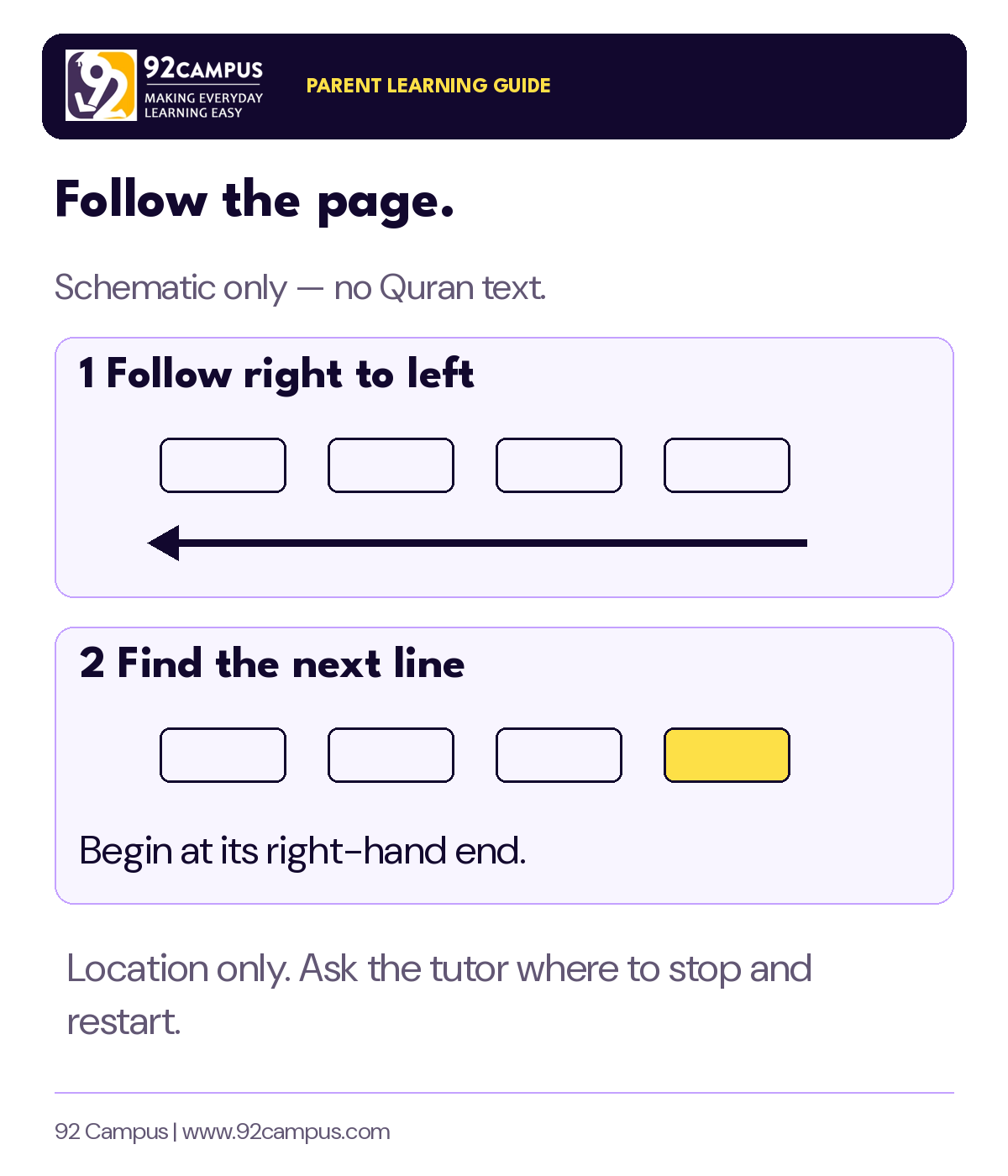
Ask the tutor to demonstrate this movement in the actual passage. At a tutor-selected practice point, invite the child to show the next line’s beginning without supplying its sound. Then let the tutor guide the reading.
A printed line ending is not automatically a recitation stopping point. Do not teach a pause at every left-hand edge. Ask the tutor where to stop and restart in the selected passage; the diagram shows location, not stopping rules.
If the child looks away, try: “Let’s find the place together.” Return to a confirmed location instead of guessing the next word. Where the correct restart is uncertain, ask the tutor.
If your child looks away, practise finding the place again
A bookmark can return you to the page, but it may not identify the current word. Agree a separate recovery task with the tutor:
- Keep the view still. Avoid turning the page or scrolling while the child is trying to relocate the text.
- Find a confirmed location. Ask the child to show where they were. If neither of you is sure, ask the tutor to identify it rather than choosing a familiar-looking word.
- Separate finding from restarting. Pointing to a place does not decide the correct recitation restart. Let the tutor confirm that before continuing.
- Try the return with suitable support. The tutor can choose a safe practice break and invite the child to locate the place again. Record whether the child found it, needed a pointing cue or needed the tutor to show it.
Do not create repeated interruptions just to test this skill. Instead, use a naturally occurring pause or a tutor-planned demonstration. If the child continues from memory, ask the tutor how to check page-following separately; hearing familiar words alone does not show where the child is looking.
A worked example: location help or reading help?
Illustrative scenario: these conversations are invented teaching examples, not a student record or a reported result.
What the parent notices
At a line change during a lesson, the child’s finger moves to the row below the intended one. The tutor pauses the reading. The parent says: “Your finger moved down two rows. Let’s check the place before continuing.” This describes an action without calling the child careless.
What the tutor checks
The parent asks: “Could you show the line change once, then let her locate the next beginning?” The tutor confirms the passage and demonstrates the movement. In this example, the child needs a pointing prompt to locate it. The tutor then listens to the reading separately.
How the next task changes
The tutor might choose another suitable transition with a smaller location prompt. Alternatively, if the child locates it but struggles with the word, the tutor may model that reading instead. These are possible next steps to discuss, not a claim about a fixed 92 Campus procedure.
A useful follow-up is: “She found the next beginning after one pointing prompt. Please check whether the reading needs separate practice.” This keeps the observation modest and gives the next lesson a clear question.
Keep a short note that separates support from accuracy
You do not need to count every hesitation. Choose one recurring event and record what happened around it. Keep the note beside the book or in your usual lesson messages.
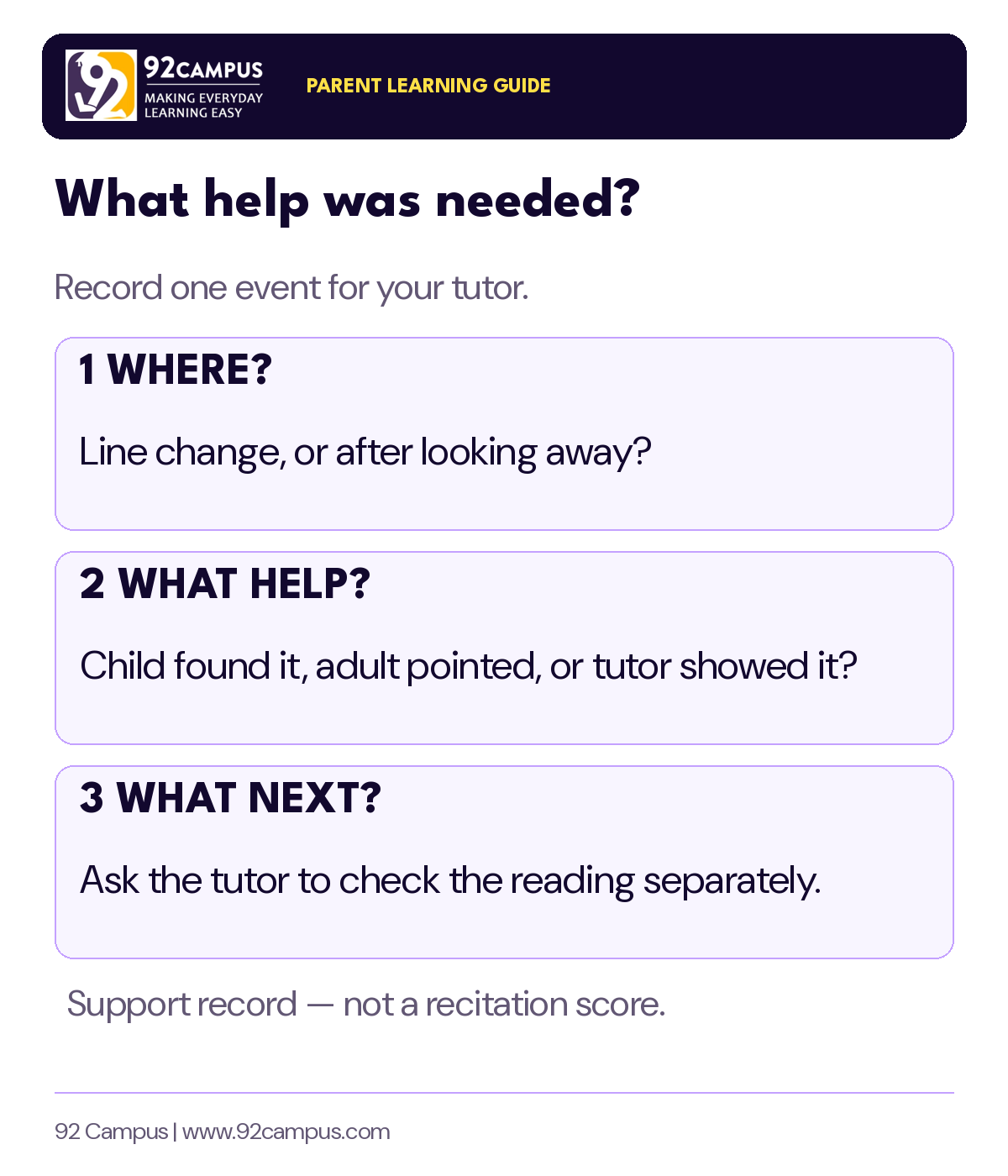
Copyable blank note: Passage confirmed with tutor: ____; place lost when: ____; location help given by: ____; what the child did next: ____; reading question for tutor: ____.
Filled illustrative note: Passage: today’s tutor-selected section, start and end confirmed; event: finger moved past the next row; help: parent pointed to the intended beginning after the tutor paused; next: child located that beginning with support; question: “Please listen to the reading and show which part to practise next.”
At the next discussion, compare the same kind of task and mention any changed support. For instance, moving a guide independently differs from following an adult’s pointer. Use specific progress observations rather than a page-count target. There is no fixed age or deadline for removing help.
Agree the next step without turning practice into a test
If the same difficulty continues, bring the actual copy and a precise example to the tutor. Ask them to observe a line change, listen to the words, and suggest a manageable next task. Avoid increasing the amount simply to see whether the child can push through it.
If similar difficulties concern you in other reading, discuss those observations with the child’s school teacher too. This page cannot identify a learning or health condition. For Quran pronunciation and suitable stopping or restarting, continue with a qualified Quran tutor.
92 Campus’s one-to-one Quran classes for children include individual listening and feedback. Share where your child loses their place and discuss a suitable starting task with a tutor. The team checks availability and confirms the appointment after a trial request.
Join the conversation
Comments are reviewed before publication. Your name and approved comment will be public. Please leave out private learner or contact details.