

You would love your child to memorise more Quran, but you also know what an ordinary school week looks like. Homework, meals, family responsibilities and rest already need room. Part-time Hifz may sound like a suitable option; before enrolling, ask what the commitment includes beyond the lesson itself.
Start by checking the learning goal, the tutor’s assessment, the home assignments and the support expected from you. A short appointment does not describe the whole workload. This guide helps parents turn a promising course description into a clear starting agreement they can discuss with the teacher and child.
Part-time Hifz: check what the programme means
Ask the provider to explain its actual arrangement. For example, Darussalam’s education page describes a part-time Hifz route for pupils remaining in mainstream school, with evening and weekend classes. That is one provider’s model, not a universal timetable for every programme using the label.
Before comparing options, establish the goal. Are you discussing selected surahs, a particular section or a longer memorisation path? Then ask about live lesson frequency, the format and the work between lessons.
At 92 Campus, the Hifz course page asks for a reading assessment and a discussion of available practice time. It includes new work alongside revision and allows a discussion of selected surahs, a juz or a longer path. Your child’s actual starting task still needs to be agreed.
Ask about new work, recent revision and older revision
“Revise at home” leaves several questions unanswered. Which material should be revisited, how should the learner prepare it, and who will check it?
Keep the following parts identifiable when discussing the programme:
- New memorisation: the selection the teacher currently wants the learner to prepare.
- Recent revision: returning to material learned recently.
- Older revision: revisiting earlier memorisation rather than looking only at the newest assignment.
The Guidance Hub Hifz curriculum, for example, names these components as Sabak, Sabki and Manzil. Ask your chosen teacher what their terms refer to and which material belongs in each part of your child’s plan.
This distinction is useful before enrolment because a timetable showing only the live class can leave the home commitment unclear. Ask to see how an assignment will be communicated. You need an identifiable task, rather than a family promise to “do more revision” whenever time appears.
Let the tutor check the starting point
Tell the teacher what your child has studied and already memorised, while leaving the recitation assessment to them. Being able to repeat a familiar passage does not answer every question about reading accuracy, existing revision or the support needed for new work.
Ask what the teacher wants to hear before suggesting an initial load. A useful question is: “Could you check the reading and existing memorisation, then explain which task you would start with and why?”
The academy’s course description says that reading or Tajweed preparation may be recommended before new memorisation. Discuss that recommendation if it arises. You can ask how the preparation connects to your child’s goal without treating it as a failed attempt to join Hifz.
Include your child in the conversation too. Try: “Which part would you like help with? What do you think practice at home would involve?” Their answer can identify a question to clarify; it is not a formal readiness test.
Check the work expected between lessons
When comparing part-time Hifz options, ask for the home task and the adult role separately. A family may be able to provide a quiet place and help with attendance, but need the teacher to handle pronunciation feedback.
- What exactly will the learner prepare before the next lesson?
- Which recent and older material also needs attention?
- How should we record a part the learner cannot complete or is unsure about?
- Does an adult need to listen, supervise preparation or simply help organise the routine?
- Which questions should go back to the tutor rather than being corrected at home?
Then explain your real availability. “I can help organise practice after school, but I cannot reliably assess recitation” gives the teacher useful information. Avoid agreeing to a daily adult role that your household cannot provide.
Once the tasks are clear, consider where they fit. The school-and-homework routine guide can help with the wider day. Here, the first decision is whether you understand the proposed commitment well enough to plan for it.
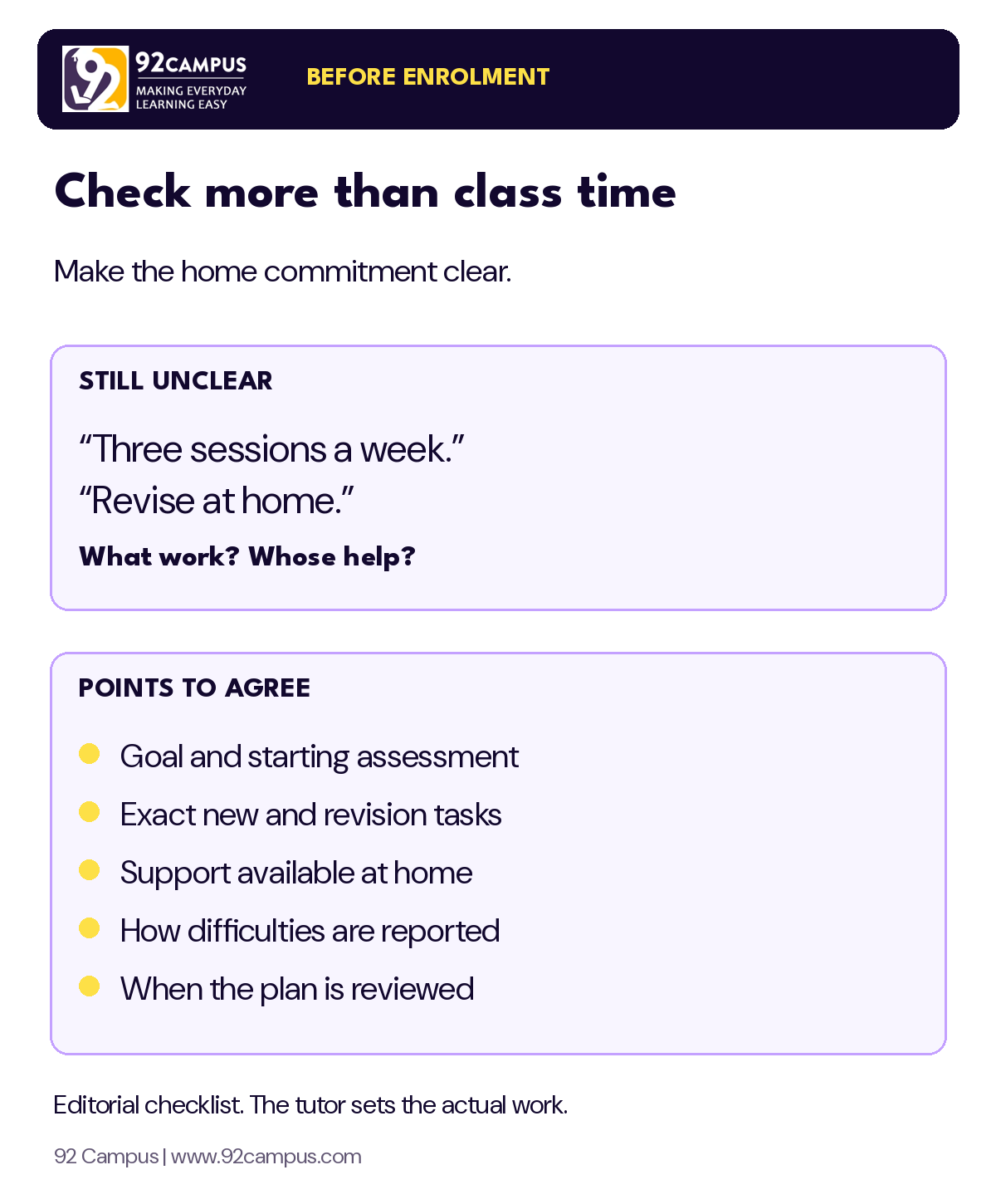
Worked example: a clear class slot, unclear homework
Illustrative scenario: Yusuf already reads some Quran and has memorised a small collection of surahs. His parent is considering three weekly lessons. This fictional planning example leaves the actual memorisation assignment to the tutor after assessment.
The incomplete plan: “Three lessons a week, with revision at home.” The parent knows when the calls might happen, but not which preparation is expected or whether the adult role is workable.
Parent: “Before we agree, could you explain what Yusuf would prepare between lessons, including his older revision? I can help him organise the work, but I need you to check recitation.”
A possible teacher response: “First I need to hear his reading and current memorisation. Then we can identify the starting selection, the revision to keep and how you should note difficulties.”
Child: “What should I do if I cannot finish the task?”
A point to agree: how to report that difficulty, what to bring back for checking and when the teacher will review the assignment. The family does not need to invent extra pages to make an incomplete task look complete.
A filled discussion note for this fictional family
- Initial goal: selected-surah memorisation with existing work kept in revision; discuss a longer path later.
- Starting check: teacher listens to current reading and memorisation before choosing the work.
- New task: teacher specifies the exact selection after that check; no amount is assumed in this planning example.
- Revision: teacher identifies the recent and older material to revisit.
- Home support: parent helps organise practice and records questions; recitation feedback remains with the tutor.
- Review: discuss what was attempted, where help was needed and whether the assignment fitted the available practice time.
In a real agreement, replace the unresolved selection with the teacher’s actual reference and instructions. Until those details are known, the note is a discussion framework rather than a complete practice assignment.
Ask how the plan can change
A starting plan should include a way to raise a problem. Ask what happens if older revision needs more attention, an instruction is unclear or the agreed home task repeatedly does not fit the available time.
92 Campus describes reviewing retention and accuracy alongside the amount memorised; its tutor may reduce new work when revision needs attention. Ask how that would be communicated for your learner. A large new portion is not the only detail worth discussing.
If practice repeatedly overruns the agreed window, bring a specific observation: “We attempted the assigned work on these occasions, needed help here and could not complete this part.” The teacher then has more useful information than “We need to try harder.”
You can also ask your child, “Was the task clear? Which part needed help?” Keep that answer alongside the teacher’s listening feedback. Neither a completion tick nor a comparison with another child gives the full picture.
Before you enrol, confirm the whole commitment
For part-time Hifz, aim to leave the discussion knowing the goal, the starting assessment, the live arrangements, the home work and who provides which help. Confirm how progress will be reviewed and how you should raise a difficulty.
Ask the team to explain the applicable schedule and fees before paid enrolment. A programme label, another family’s experience or an example timetable cannot confirm your child’s actual arrangements or completion date.
To explore support with 92 Campus, share your child’s reading experience, current memorisation and realistic practice availability. Ask the tutor to discuss a suitable starting goal. The team checks tutor availability and confirms the local appointment time; submitting a trial request does not automatically book the lesson.
Join the conversation
Comments are reviewed before publication. Your name and approved comment will be public. Please leave out private learner or contact details.