
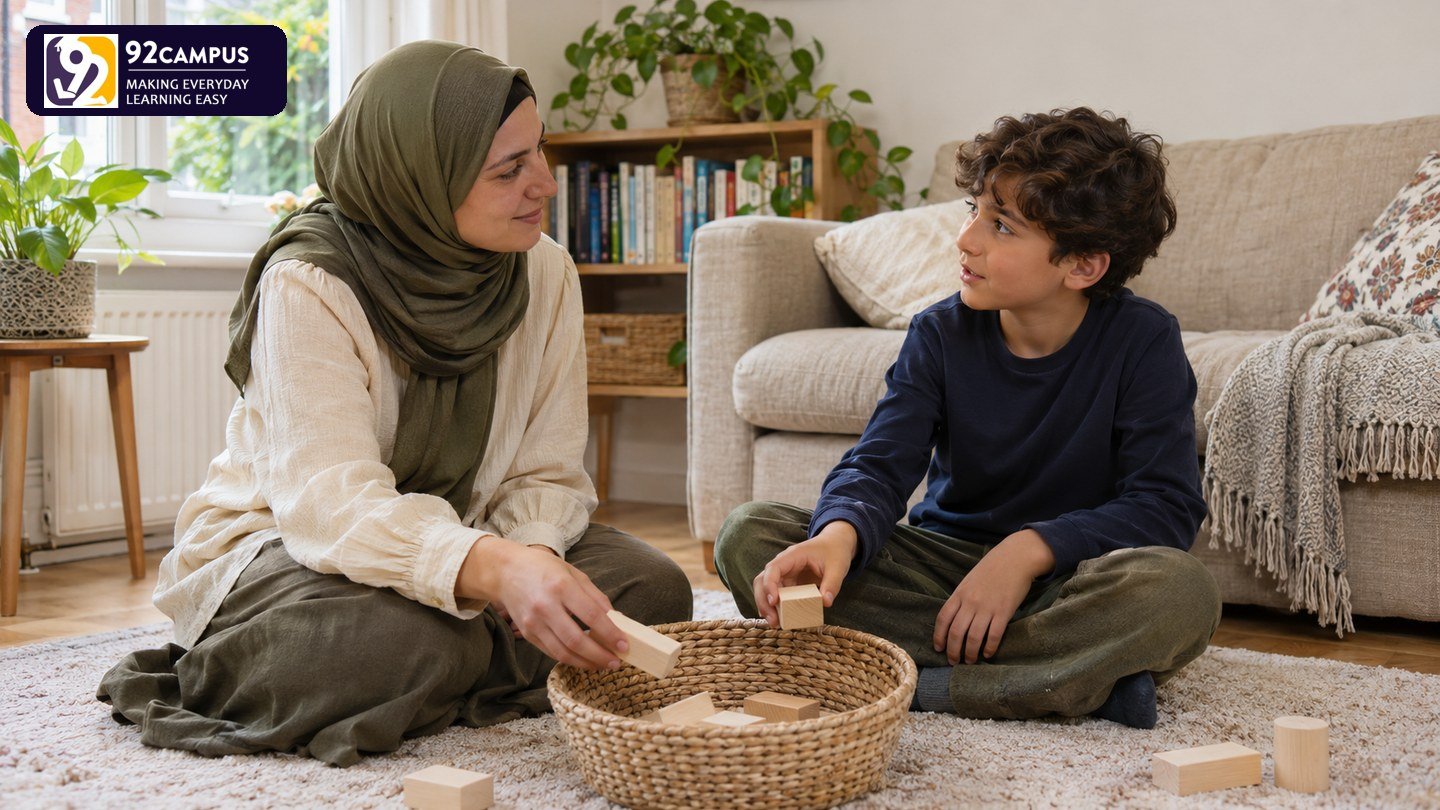
“What does niyyah mean?” Your child answers, “Intention.” But when you ask why they are helping, sharing, or learning, the answer is, “I don’t know,” or, “Because you told me to.”
You do not have to turn that moment into a test. Start with something familiar: putting away a game so someone else can use the floor, offering a spare pencil, or learning what a lesson means. Help your child notice the action and the purpose behind it. Then connect the conversation gently with wanting to please Allah.
This guide introduces niyyah for kids through parent modelling, three worked conversations, and a private action–purpose–reflection sheet. The scenarios and records are illustrative teaching examples, not accounts of actual students.
What does niyyah mean for a child?
Niyyah means intention. A simple starting explanation is: “It is what you mean to do and the purpose you have in doing it.” In Islamic learning, introduce the importance of sincerely seeking Allah’s pleasure, alongside understanding the everyday action.
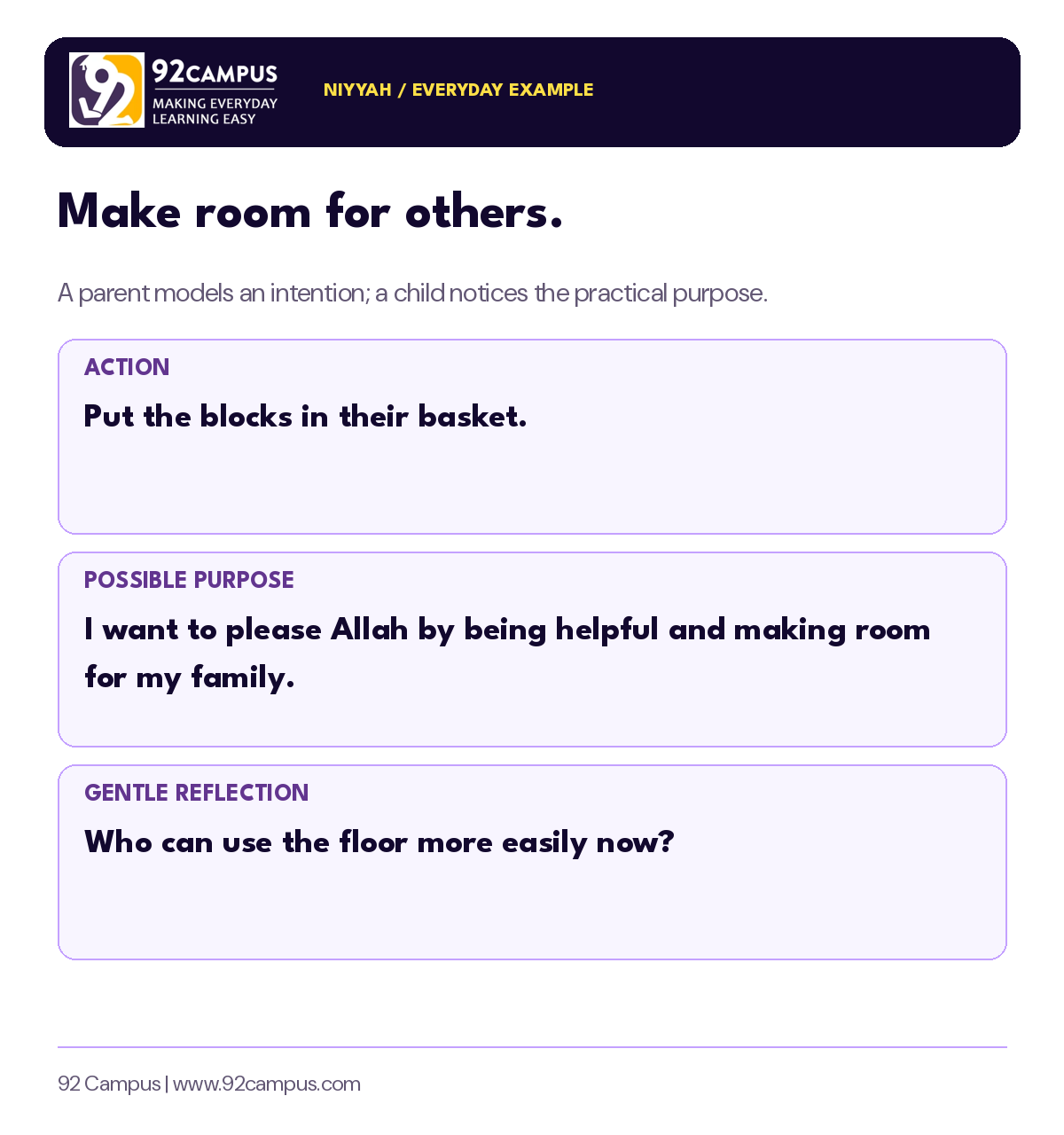
For example, the action might be putting blocks into a basket. One practical purpose is making room for the family to walk. A parent can model a further intention: “I want to please Allah by being helpful and considerate.” This is a suggested explanation, not a quotation or a judgement about anyone’s heart.
Keep three ideas separate:
- Action: What am I doing?
- Purpose: What am I trying to do it for?
- Reflection: What can I notice or learn afterwards?
An action is visible. A child’s explanation can help you discuss their understanding. Neither a neat worksheet nor a fluent answer gives you a way to measure their sincerity.
The Islamic foundation: intentions matter
Hadith teaching — paraphrase: In the narration of ‘Umar ibn al-Khattab, the Prophet Muhammad ﷺ teaches the importance of intentions in deeds and what a person intends to attain. The narration illustrates this with migration undertaken for different purposes.
The narration is included in Al-Minhaj-us-Sawi, hadith 383, printed pages 373–374. It can also be read as Sahih al-Bukhari 1, Book 1, Hadith 1. The family activities here apply the concept for discussion; they are not additional wording from the hadith.
Quranic teaching — paraphrase: Al-Bayyinah 98:5 teaches sincere devotion to Allah and also mentions establishing prayer and giving Zakat. Read the full translation in Irfan ul Quran. A practical benefit, such as a tidy room, should not be presented as the whole meaning of Islamic sincerity.
Quranic teaching — paraphrase: Al-i-Imran 3:29 teaches that Allah knows what people conceal or reveal within themselves. For this activity, keep the parent’s role modest: model, explain, and listen. Do not use a child’s answer to declare whether a deed has been accepted or how much reward it receives.
Model your own purpose before asking about theirs
A short explanation of your own action gives the child something concrete to consider. Choose an ordinary moment and say what you are doing, who it helps, and the intention you want to bring to it.
“I’m moving my bag from the doorway so nobody trips over it. I want to please Allah by being considerate.” Then move the bag. The words and the action belong together.
You do not need a running commentary on every good deed. One calm example gives you enough to discuss. Later, ask, “What was I trying to make easier?” If the child remembers only “moving the bag,” explain the purpose again without turning the exchange into a failure.
Use language the child understands. They may answer with a phrase, a drawing, or a choice between two possibilities. A child who points to an open doorway may be showing that they understood the practical purpose, even if they cannot yet explain the religious concept in a full sentence.
Three worked conversations about everyday intentions
Use one scenario at a time. These scripts offer possible responses, not words a child must repeat. Start with a fictional person if discussing the child’s own motives feels uncomfortable.
Scenario 1: Making the shared floor usable
What happens: A parent starts putting blocks into a basket after a game.
Parent models: “I’m putting these away so we can all walk here. I want to please Allah by helping look after our shared space.”
Child says: “You want the room to look nice.”
Parent responds: “That is one thing that happens. I’m also thinking about making room for everyone. What might be difficult if the blocks stay in the doorway?”
What you can observe: The child connects the action with its effect on other people. If they only name the objects, show the walking space and explain again. Do not turn this into a score for faith.
Scenario 2: Offering a pencil without taking over
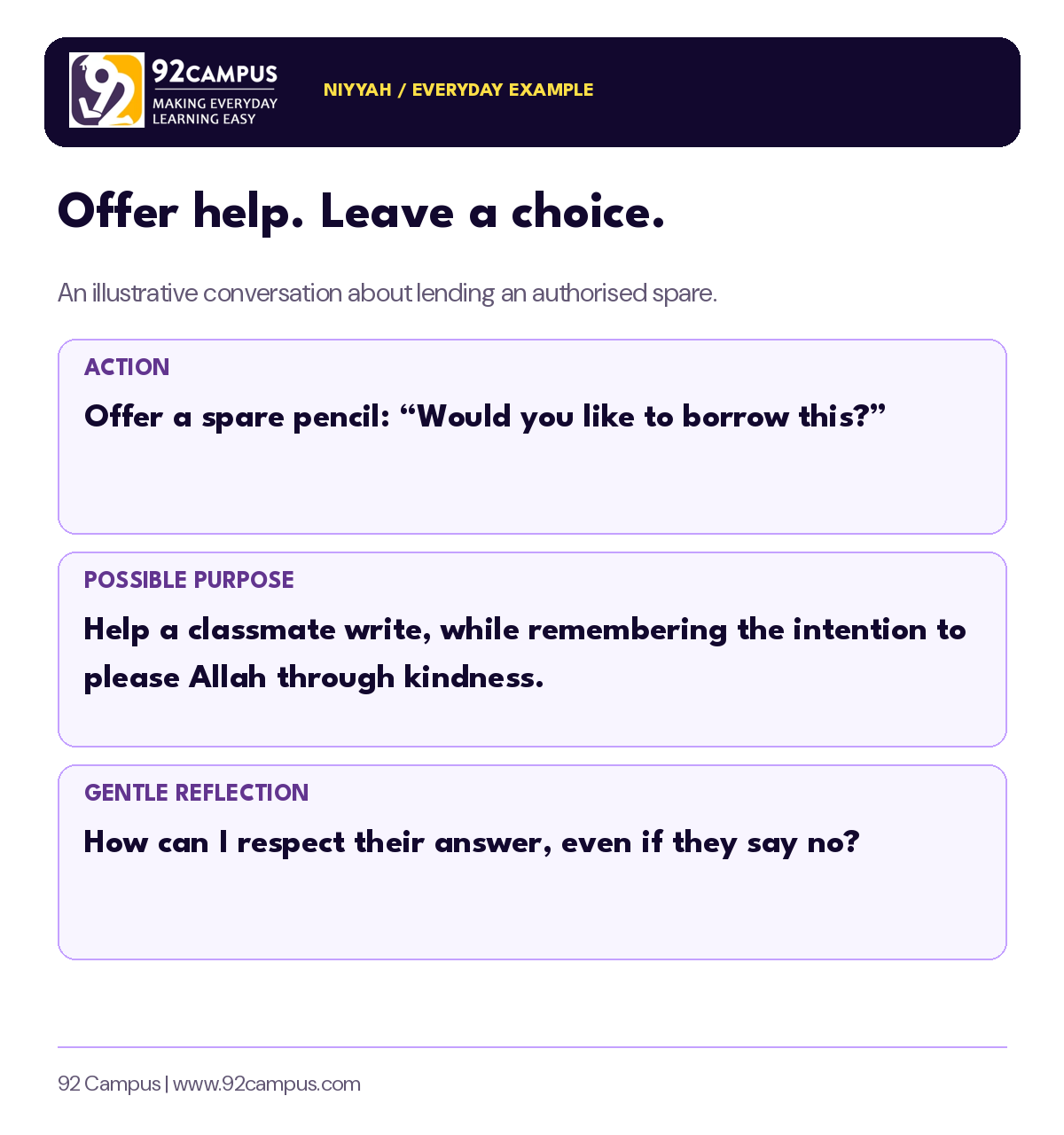
What happens: A fictional classmate cannot find a pencil. Your child has a spare one they are allowed to lend.
Parent asks: “What could you offer, and what would you be trying to help with?”
Child says: “I could offer my spare so they can write.”
Parent responds: “You have explained the action and the help you mean to give. We can also remember wanting to please Allah through kindness. What could you say before handing it over?”
Possible child response: “Would you like to borrow this?”
What you can observe: The child identifies a purpose and a respectful way to offer help. If the classmate declines, the next step is to respect the answer. A helpful intention does not mean taking someone’s belongings or insisting that they accept help.
Scenario 3: Learning when the first answer is “You told me to”
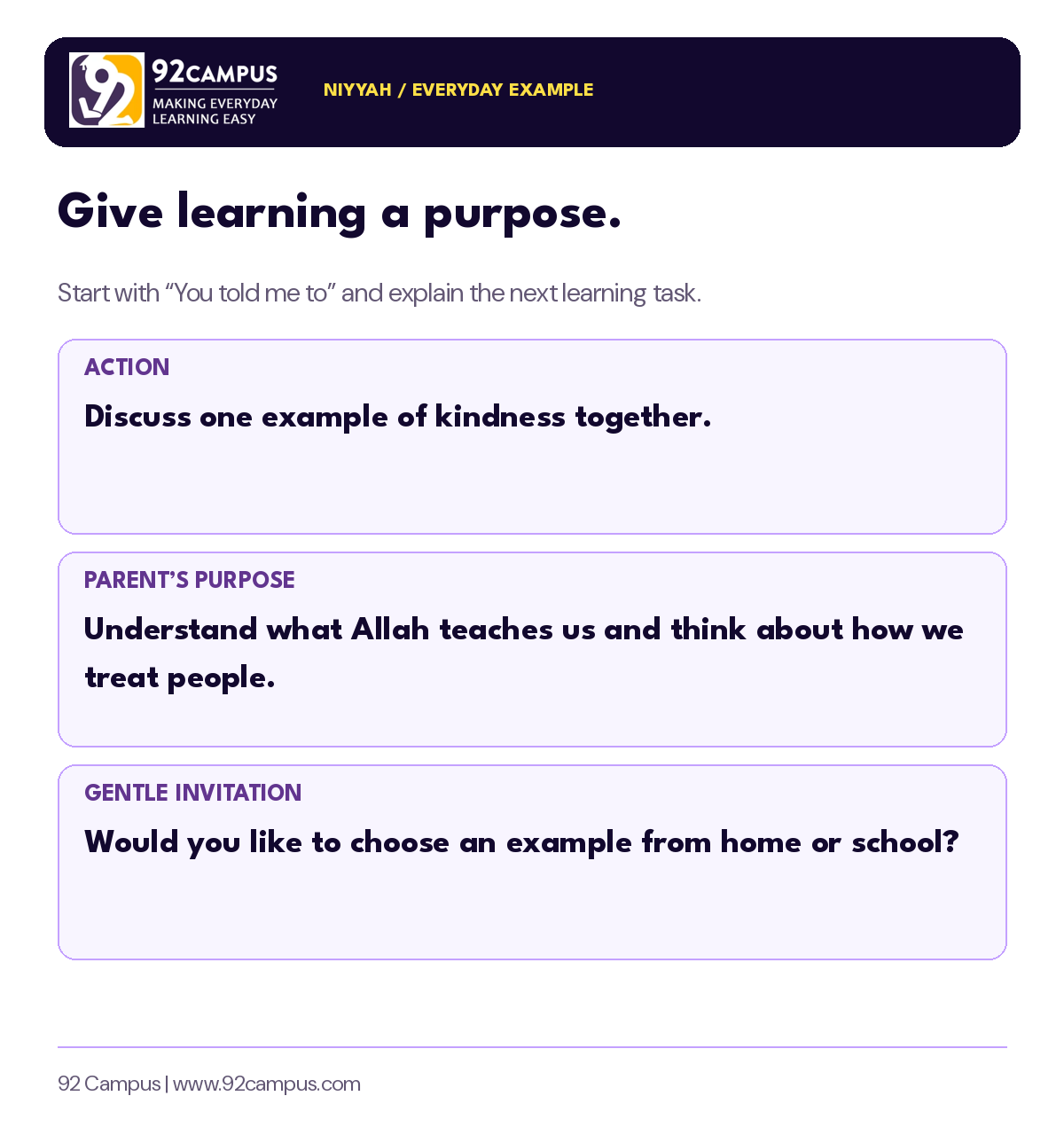
What happens: You invite your child to discuss a familiar Islamic Studies topic.
Child says: “I’m doing it because you told me to.”
Parent responds: “Thank you for telling me. I asked you to join me. Today we’re learning what kindness can look like. I want us to understand what Allah teaches us and think about how we treat people.”
Gentle follow-up: “Would you like to choose an example from home or school?”
What you can observe: The child chooses or explains a relevant example. If they are unsure, offer two simple situations. You are providing a starting purpose for learning, not demanding that they produce a polished declaration of sincerity.
Use a private action–purpose–reflection sheet
Try this after one familiar example. The child can write, draw, speak, or leave a field blank. Keep it private; there is no need to read personal answers to siblings, post them online, or compare whose intention sounds best.
The prompts are optional teaching supports. They are not an intention formula, a required step before worship, or a record of accepted deeds.
Blank reflection sheet
Action — what am I doing?____________________ Purpose — what am I trying to do it for?____________________ Reflection — what did I notice or learn?____________________ Optional question I want to discuss____________________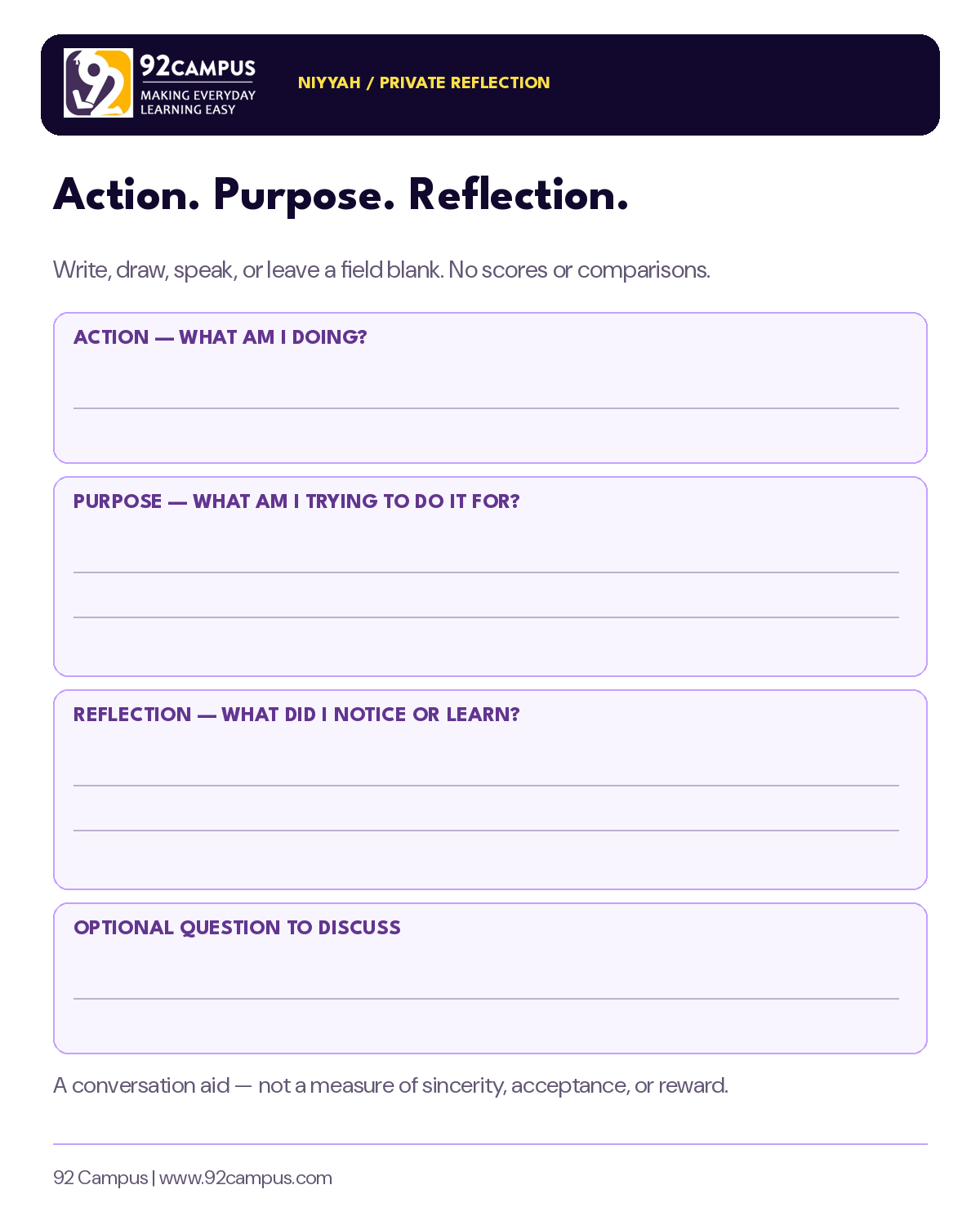
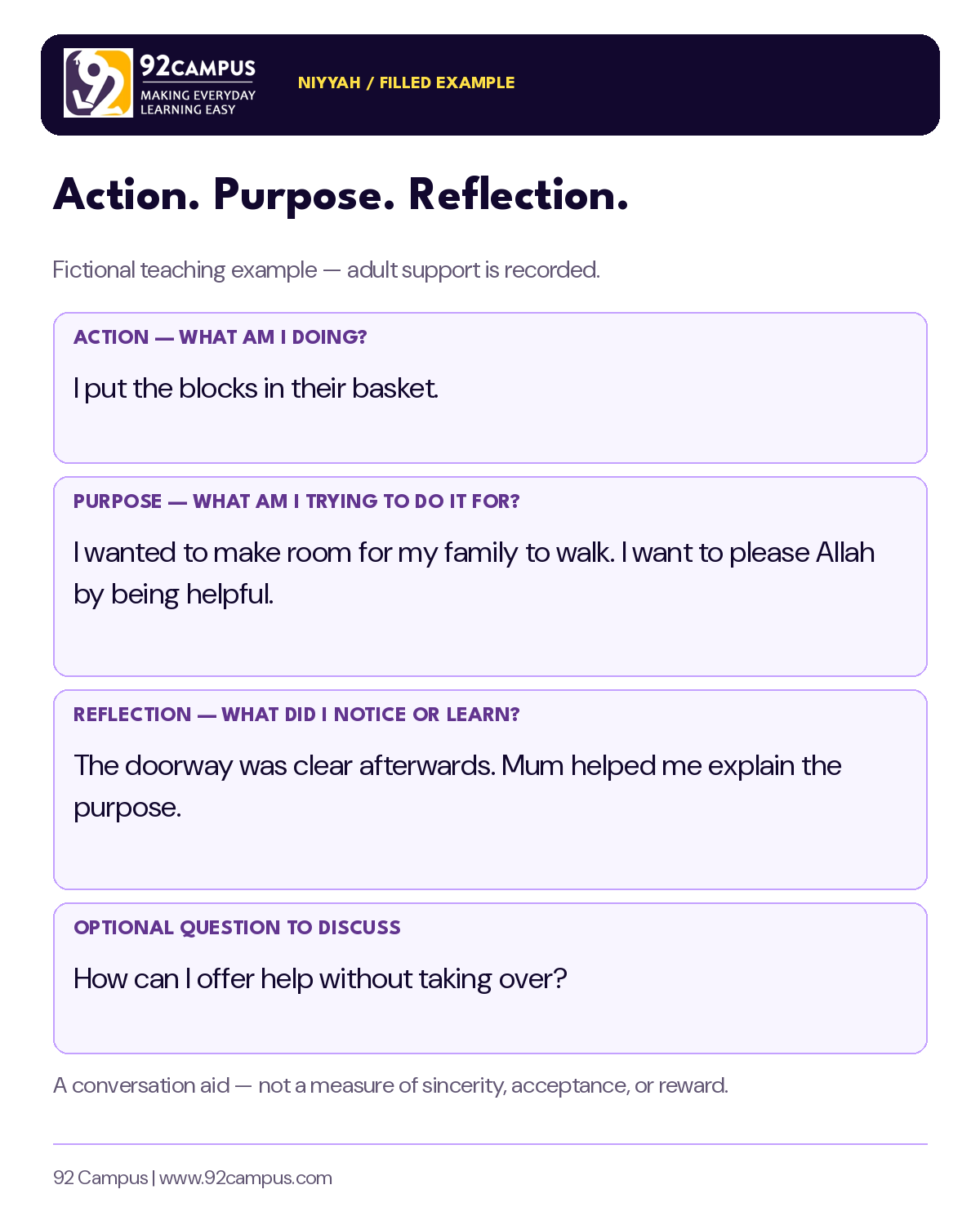
Filled illustrative example: helping with a shared space
ActionI put the blocks in their basket. PurposeI wanted to make room for my family to walk. I want to please Allah by being helpful. ReflectionThe doorway was clear afterwards. Mum helped me explain the purpose. QuestionHow can I offer help without taking over?The record includes the support given. A sentence completed with an adult’s help is a supported response, not evidence that the child can explain niyyah independently. The clear doorway is an observed outcome, not proof of sincerity or acceptance.
Listen to honest answers without searching for hidden motives
“I wanted a sticker.”
Try: “Thank you for being honest about what you wanted. Let’s also think about what this action helps us do.” Discuss the purpose and model sincerely seeking Allah’s pleasure. Do not announce that the child’s deed is worthless, or insist that they replace their answer with something more impressive.
If your family uses rewards, keep that conversation separate from rating the child’s heart. This guide does not determine the religious status of mixed motives. Ask a qualified Islamic Studies teacher or scholar when you need a religious explanation beyond the introductory activity.
“I don’t know.”
Offer a smaller question: “Was the person trying to make space to walk, or make the blocks harder to find?” Discuss the fictional person rather than pressuring the child to reveal a personal motive. Accept a pause or a decision not to answer.
“My brother only helped so you would praise him.”
Bring the conversation back to what was observed: “We saw him help carry the books. We don’t need to decide what was in his heart. Let’s think about the intention we want to bring to our own actions.” Avoid setting children the task of investigating one another’s sincerity.
Notice understanding without turning reflection into a test
You can observe whether a child distinguishes an action from a purpose, suggests a considerate way to act, or asks a relevant question. You can also note whether they needed a model, a choice, or help finding the words.
For instance, “putting away blocks” names an action. “So people can walk safely” explains a practical purpose. “I want to please Allah by helping” expresses a religious intention the learner may be discussing. These responses support different conversations; they are not levels of piety.
Choose one gentle prompt, give time to respond, and return to normal family life. Revisit the concept when another useful example arises. There is no fixed number of reflections or deadline for a child to master this understanding.
Connect the discussion with suitable Islamic Studies support
92 Campus’s one-to-one Islamic Studies lessons introduce foundational concepts, manners, and practical family situations. Share what your child can explain and what wording still confuses them. Ask the tutor to choose an example suited to their understanding. These cards are editorial resources; they are not presented as an already approved academy lesson.
If your child mixes intention with a future commitment, the guide to Insha’Allah and keeping promises addresses clear agreements and follow-through. For group practice of visible actions, explore the Islamic values classroom activities. This guide’s focus stays on understanding purpose.
Begin with one action of your own today. Explain the purpose you want to bring to it, then carry it out. Give your child room to ask a question rather than requiring the perfect answer.
For a suitable learning starting point: share which Islamic concepts your child can explain already and discuss an Islamic Studies lesson. The team checks availability and confirms the tutor and local time after a trial request.
Join the conversation
Comments are reviewed before publication. Your name and approved comment will be public. Please leave out private learner or contact details.