

“Insha’Allah, tomorrow.” You mean that you will check whether an outing is possible. Your child hears that the outing is happening. Tomorrow arrives, the plan falls through, and the conversation becomes: “But you promised!”
Teaching children to keep promises in Islam starts before anyone gives their word. It starts with making the answer understandable. Children need opportunities to hear a sincere yes, an honest no, and a clear explanation when a decision has not yet been made. Parents need those same choices.
This guide offers everyday scripts, three scenario cards, and a blank and filled commitment sheet. All family conversations and records are original, illustrative examples, not accounts of actual students. The activities are suggestions for family practice, not religious rulings or a tested programme.
Why everyday commitments deserve attention
To an adult, “later” may be a passing comment. To a child waiting to show a drawing, it may be the most important plan of the afternoon. Making the timing clearer gives both people something they can recognise and follow up.
Seattle Children’s guidance on trust and respect encourages caregivers to be dependable, align words with actions, listen attentively, and give children appropriate responsibilities. This is general parenting guidance; it does not establish that a particular worksheet will produce a measurable outcome.
You do not need an expensive family activity to practise reliability. Reading a familiar book together, returning a borrowed pencil, or putting a lunchbox by the sink can provide a small, visible commitment. Choose something the person can reasonably do, rather than something impressive.
Insha’Allah and keeping your word: two connected lessons
Quranic foundation — paraphrase: Al-Kahf 18:23, read together with 18:24, teaches us to acknowledge Allah’s will when speaking about what we intend to do in the future. Verse 24 also includes remembering Allah when one forgets. Read the connected passage in Irfan ul Quran for the translation and its fuller wording.
Quranic foundation — paraphrase: Al-Isra 17:34 teaches fulfilment of commitments and accountability for them. The verse also addresses the protection of an orphan’s property. The family activity below draws on its commitment-related teaching; it is not an explanation of the entire verse.
Child-friendly explanation: Insha’Allah means “if Allah wills.” You might explain: “We make a sincere plan and do our part, while remembering that the future is in Allah’s control.” This explanation is a parent script, not a quotation of scripture.
Use the phrase respectfully alongside a clear answer. If you have not checked your schedule, say that. If the answer is no, say no kindly. If you sincerely intend to do something, explain the action and timing. The wording should help your child understand your intention, rather than leave them guessing whether Insha’Allah secretly means refusal.
This article concerns ordinary family communication. It does not decide individual cases involving oaths, vows, compensation, or religious responsibility. Take those questions, with the exact words and circumstances, to a qualified scholar.
Before saying yes: commit, check first, or decline
The following three-choice approach is an editorial planning aid. It is not a scriptural classification of promises.
Commit when the action is realistic
Ask yourself: What am I agreeing to? When will I do it? Do I have the time, permission, materials, and help needed? Avoid guaranteeing another person’s decision or something outside your control.
Instead of “I’ll help sometime,” try: “Insha’Allah, I will sit with you after dinner to help find your library book.” Put a reminder where you will actually notice it. Choose timing that fits your own household.
Check first when an important detail is unknown
“I haven’t agreed to the sleepover yet. I need to speak with the other parent. Insha’Allah, I will update you after dinner, even if I am still waiting for an answer.”
The update is now the commitment. The sleepover remains undecided. Returning with “I am still checking” fulfils an update; silently letting the question disappear does not give the child the same clarity.
Decline honestly when the answer is no
“We are not buying that game this month. I understand you wanted it.” You can acknowledge disappointment without offering another promise to make the feeling go away.
An alternative is optional. Offer one only if it is genuinely available: “We can choose a game we already own.” A clear no may still be unwelcome, but it leaves less room for a mistaken expectation.
Three everyday scenario cards
Read one scenario together. Ask, “What has actually been agreed?” The suggested wording is adjustable; no child must memorise these sentences.
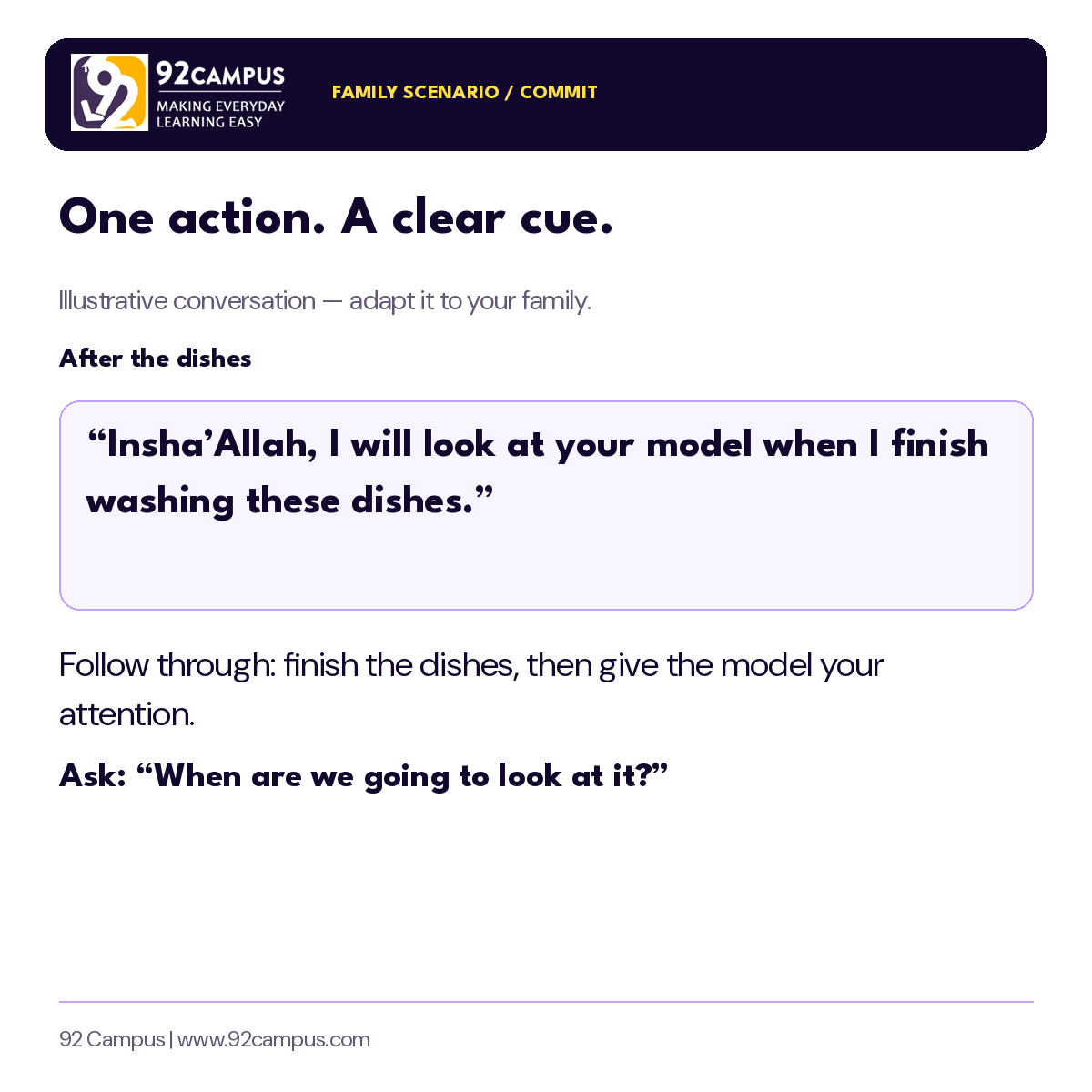
Card 1: A parent commits to shared time
Situation: Your child wants to show you a model they have made while you are finishing a task.
Unclear answer: “Yes, yes, later.”
Clearer answer: “Insha’Allah, I will look at it with you when I finish washing these dishes. Please leave it on the table.”
Follow-through: Finish the dishes, go to the table, and give the model your attention. If another task interrupts, explain the change before starting it. Do not treat the child’s reminder as wrongdoing.
Understanding check: “When are we going to look at it?” If your child answers “tomorrow,” clarify the cue now.
Card 2: A child checks before agreeing
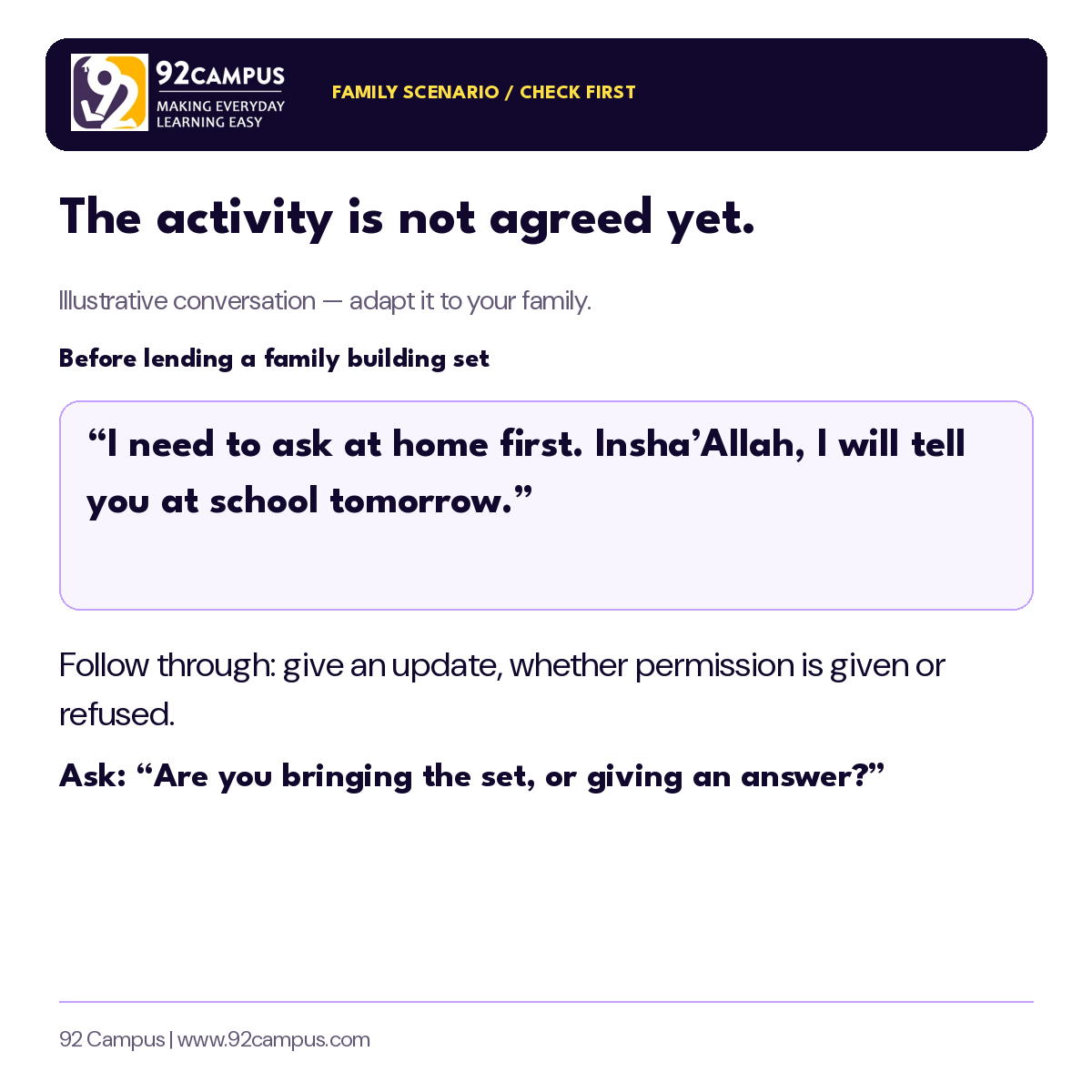
Situation: A friend asks to borrow a building set that belongs to the family.
Unclear answer: “Yes, I’ll bring it tomorrow,” before asking at home.
Clearer answer: “I need to ask at home first. Insha’Allah, I’ll tell you at school tomorrow. I haven’t agreed to bring it yet.”
Parent support: Praise the specific decision: “You checked permission before agreeing.” Help the child prepare an update whether permission is given or refused. Avoid saying that they have failed simply because the answer turns out to be no.
Understanding check: “Are you bringing the set, or giving your friend an answer?” The difference is the learning task.
Card 3: A child declines an unrealistic request
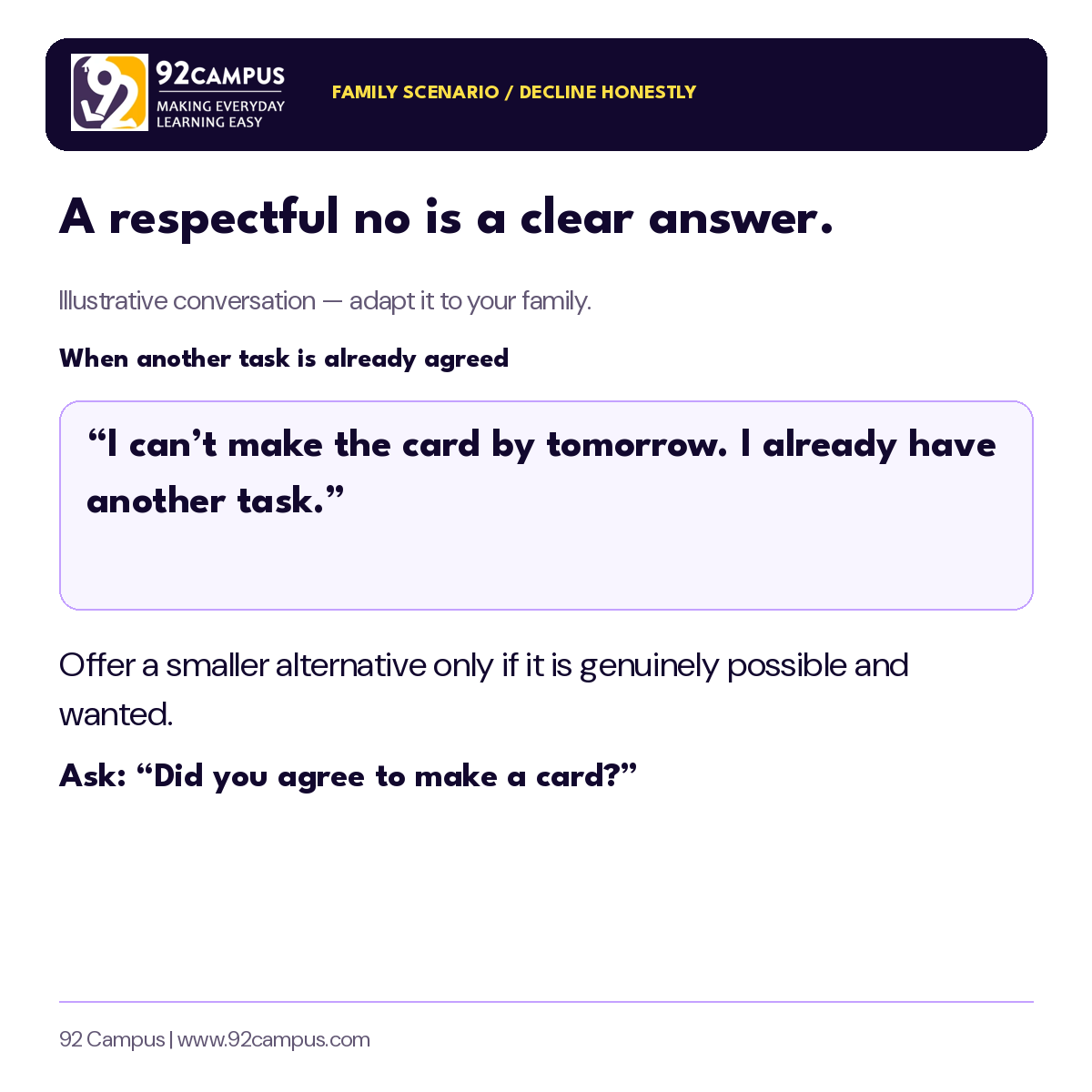
Situation: A sibling asks for a handmade birthday card by tomorrow, but the child has already agreed to another task.
Unclear answer: “Fine, I promise,” just to end the conversation.
Clearer answer: “I can’t make the card by tomorrow. I already have another task.” If a smaller alternative is realistic, the child might add: “I can help you choose some stickers now.”
Parent support: Let the sibling be disappointed without forcing a new commitment. Ask whether the offered alternative is wanted; do not present it as equivalent to the original request.
Understanding check: “Did you agree to make a card?” A respectful no is an answer the family needs to hear accurately too.
Help your child choose a commitment they can manage
“Promise you will always behave” gives a child very little to work with. Narrow it to an observable action: “After snack, I will put my cup beside the sink.” Ask what help is needed, and make sure the task is appropriate and safe.
For a younger child, draw the cup and point to the after-snack cue. A child who can write may prefer a short note. An older learner can check an existing diary before agreeing to lend an item or help with a project. Adapt support to the child’s understanding, rather than removing reminders at a fixed age. For a group setting, the guide to Islamic values and social-skills activities offers broader playful practice; here, keep the focus on making one agreement understandable.
Invite the child to explain the agreement in their own words. “What will you do, and when?” is more informative than repeatedly asking, “Do you promise?” If the child is not ready to agree, help them identify what needs checking.
Notice the process: “You remembered your agreement and asked for help before the time ran out.” Keep adult commitments visible too. This should not become a chart that monitors children while adults’ words go unexamined.
A blank commitment sheet and a filled example
Use one sheet for one manageable agreement. It can be spoken aloud, drawn, or written. The sheet is a conversation aid, not a behaviour score, diagnosis, or religious certificate.
Blank sheet: what are we agreeing to?
Person making the commitment____________________ Action, or decision still being checked____________________ Agreed time or everyday cue____________________ Permission, materials, or help needed____________________ Reminder we will use____________________ Who will be updated if something changes?____________________ What happened, and what is the next step?____________________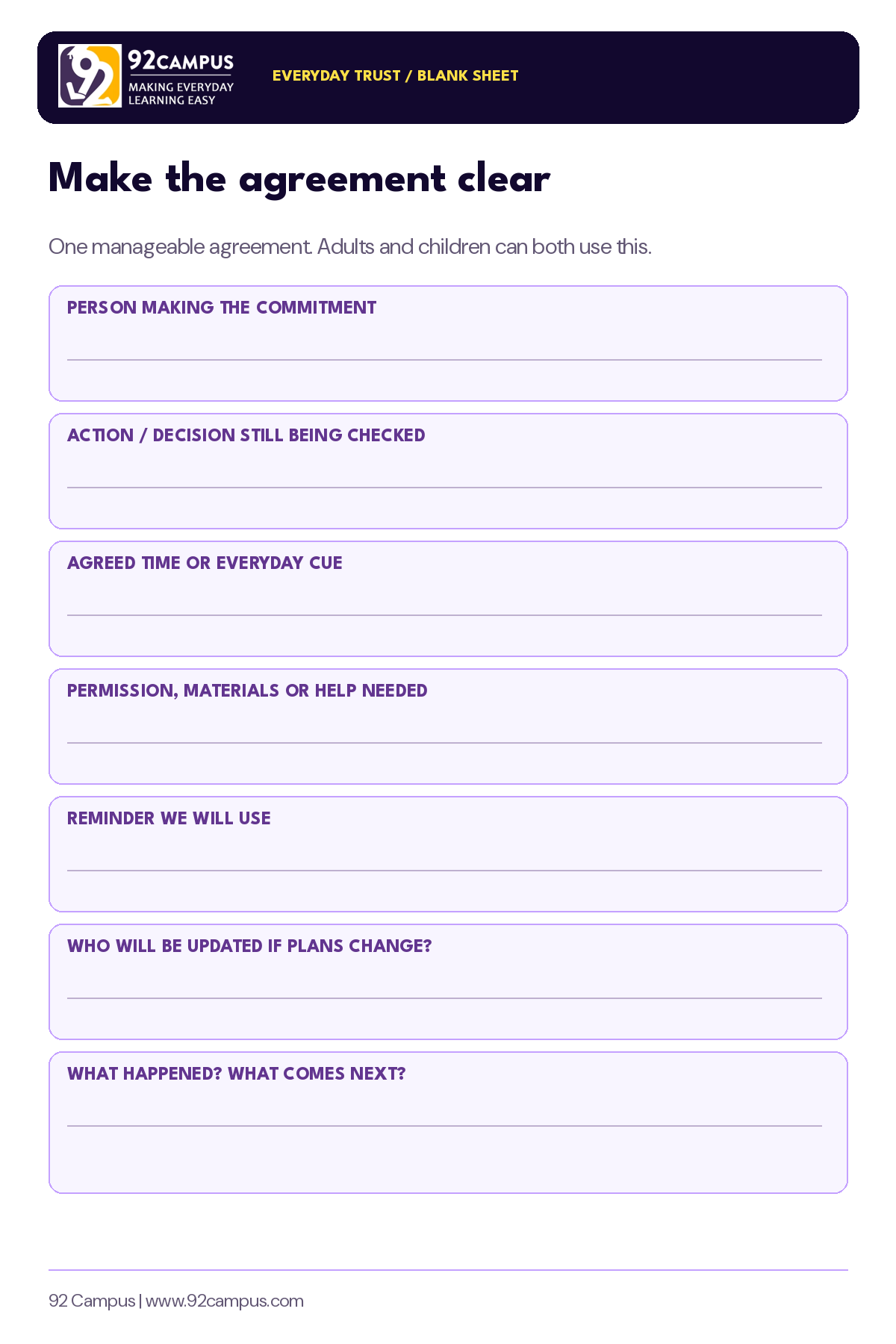
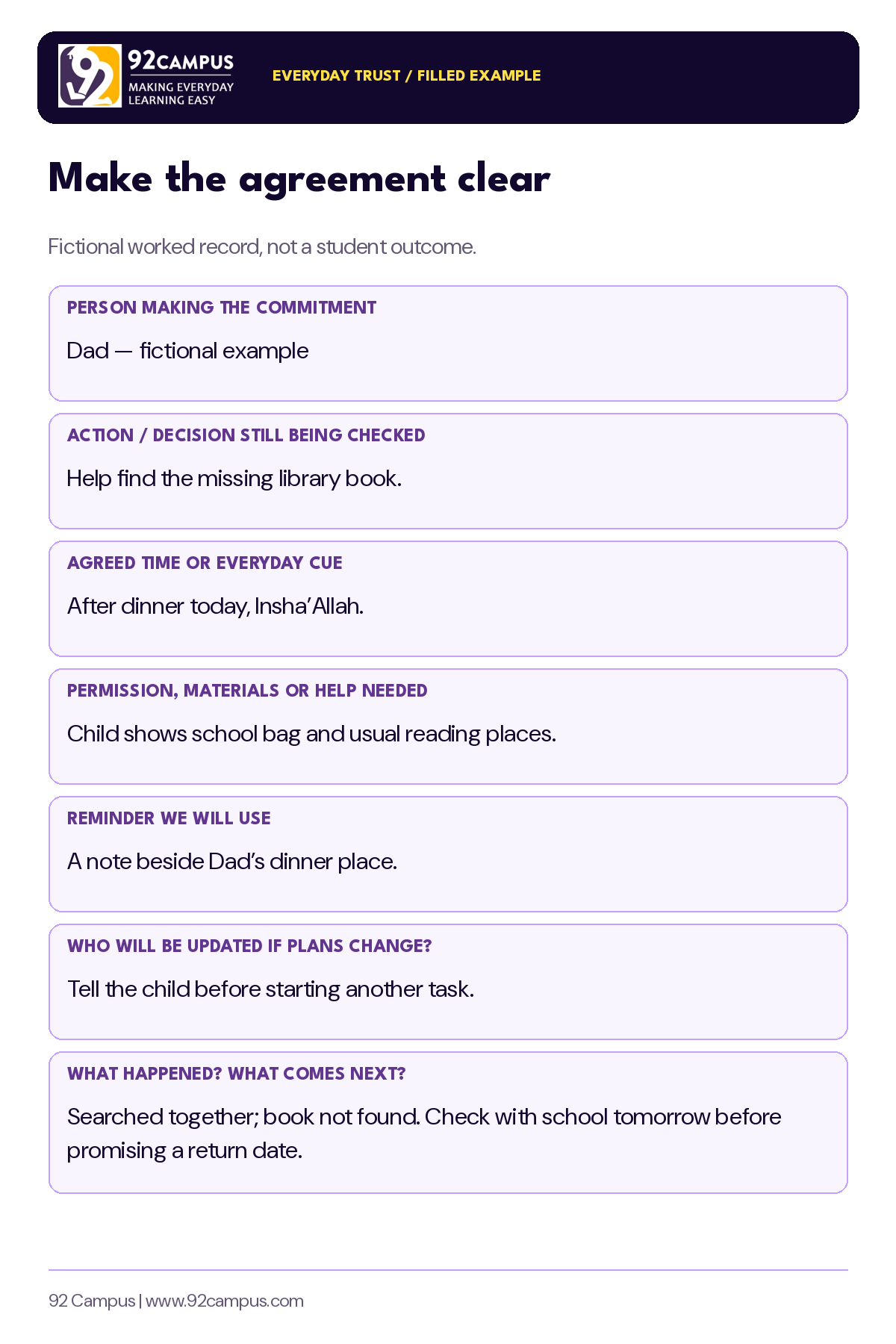
Filled sheet: an adult models follow-through
PersonDad — fictional example. ActionHelp find the missing library book. TimingAfter dinner today, Insha’Allah. SupportChild shows the school bag and usual reading places. ReminderA note beside Dad’s dinner place. UpdateTell the child before starting another task if plans change. Outcome and next stepSearched together after dinner; book not found. Check with school tomorrow before promising a return date.The adult committed to helping search, not to guaranteeing that the book would be found. The search happened; the desired result did not. That distinction keeps the record fair and prevents a new unsupported promise.
When plans change or someone forgets
First establish what happened. Was the agreement understood? Was permission missing? Did the person forget, run out of time, or encounter a genuine obstacle? These are different observations; “You never keep your word” does not explain any of them.
A parent can say: “I said I would look at your model after the dishes. I started another job and forgot. I’m sorry. I can look now; would you like to show me?” Do not insist that an apology immediately removes the child’s disappointment.
For an unavoidable change: “You were expecting our walk. I’m unwell, so we cannot go today. I understand you are disappointed. I can’t confirm another day yet.” Avoid making a replacement promise until you have checked it.
With a child, agree a practical next action: return the item, update the friend, or finish the task with suitable help. If commitments repeatedly go unfinished, reduce the size of the agreement and review the cue or support. Do not turn one missed task into a judgement about the child’s whole character or faith.
Turn one everyday example into an Islamic Studies discussion
Ask your child: “What did the person agree to? What did they still need to check? How could they keep the other person informed?” A response can reveal understanding even when the child needs help remembering the task itself.
92 Campus’s one-to-one Islamic Studies lessons include manners and responsibility through everyday examples. Share a brief, non-identifying scenario with the tutor and ask whether a similar discussion suits your learner. Agree a manageable home activity rather than assuming this sheet is part of the academy’s approved curriculum.
For the wider family context, explore the guide to Muslim parenting challenges in the UK and USA. For today, choose one agreement that you, as the adult, can make clear and follow through.
Want support with an everyday character skill? Share what you would like your child to understand and discuss a suitable Islamic Studies lesson. A trial request is followed by the team checking availability and confirming the tutor and local time.
Join the conversation
Comments are reviewed before publication. Your name and approved comment will be public. Please leave out private learner or contact details.