

Your child starts reading, hears a correction and goes quiet. A moment later, the book is closed or the headset comes off. You want the Quran to remain a meaningful part of family life, and you also want your child to learn to read accurately. It can feel difficult to protect both in that moment.
Start by finding out what happened between the correction and the silence. Did your child know which part to change? Were several adults speaking? Did a sibling hear the mistake? These questions give you something useful to discuss with the teacher without deciding that your child is stubborn or that every correction is harmful.
This guide offers practical communication suggestions for early and developing readers. The conversations and records are illustrative examples, not accounts of 92 Campus students or a teacher-reviewed pronunciation demonstration.
Notice the interaction before naming the problem
“My child hates Quran correction” describes a difficult experience, but it does not yet explain what needs to change. Write down one brief sequence: the task, the teacher’s words, the child’s response and what happened next. Keep observations separate from guesses about feelings.
- Observation: “After ‘again’, she reread the whole line. The teacher stopped her, and she stopped speaking.”
- Possible interpretation: “Perhaps she did not know which word to repeat.”
- Question to ask: “When the teacher said ‘again’, what did you think you needed to do?”
Ask later, when your child is ready to talk. “Was the instruction unclear, did the stopping bother you, or was it something else?” gives options without insisting on an explanation. Accept “I don’t know.” A younger child could point to the difficult word or show you where the lesson became hard.
Notice practical conditions too: unclear audio, a delayed connection, an unfamiliar instruction language, tiredness or people listening nearby. These are things to check, not established explanations for your child’s reaction. Do not record or share a lesson without the necessary permission; a short written note is often enough for the discussion.
What to say when your child becomes upset
Keep your first response short. A lecture about effort, respect or the importance of learning adds another conversation before the current one has been understood.
“I can see this is difficult right now. Let’s pause. We can ask which small part to try next.”
If the child can continue, offer a manageable choice agreed with the tutor: listen once more or attempt the selected word together. If they are crying or cannot engage, stop the immediate demand and agree a later check-in. A pause does not need to become a punishment or a promise that the remaining task has disappeared.
Speak to the teacher calmly: “Could we pause and clarify the target? I think she may be repeating more than you intended.” If the child needs immediate protection from humiliation or threatening behaviour, intervene directly. Otherwise, save the longer teaching discussion for a private conversation rather than debating over the child’s head.
Make the next attempt understandable
The Education Endowment Foundation’s teacher-feedback guidance emphasises the principles behind useful feedback and notes that poorly delivered feedback can be unhelpful. Its scope is general education for ages 5–18; it does not establish a Quran-specific treatment or guarantee that a particular script will prevent upset.
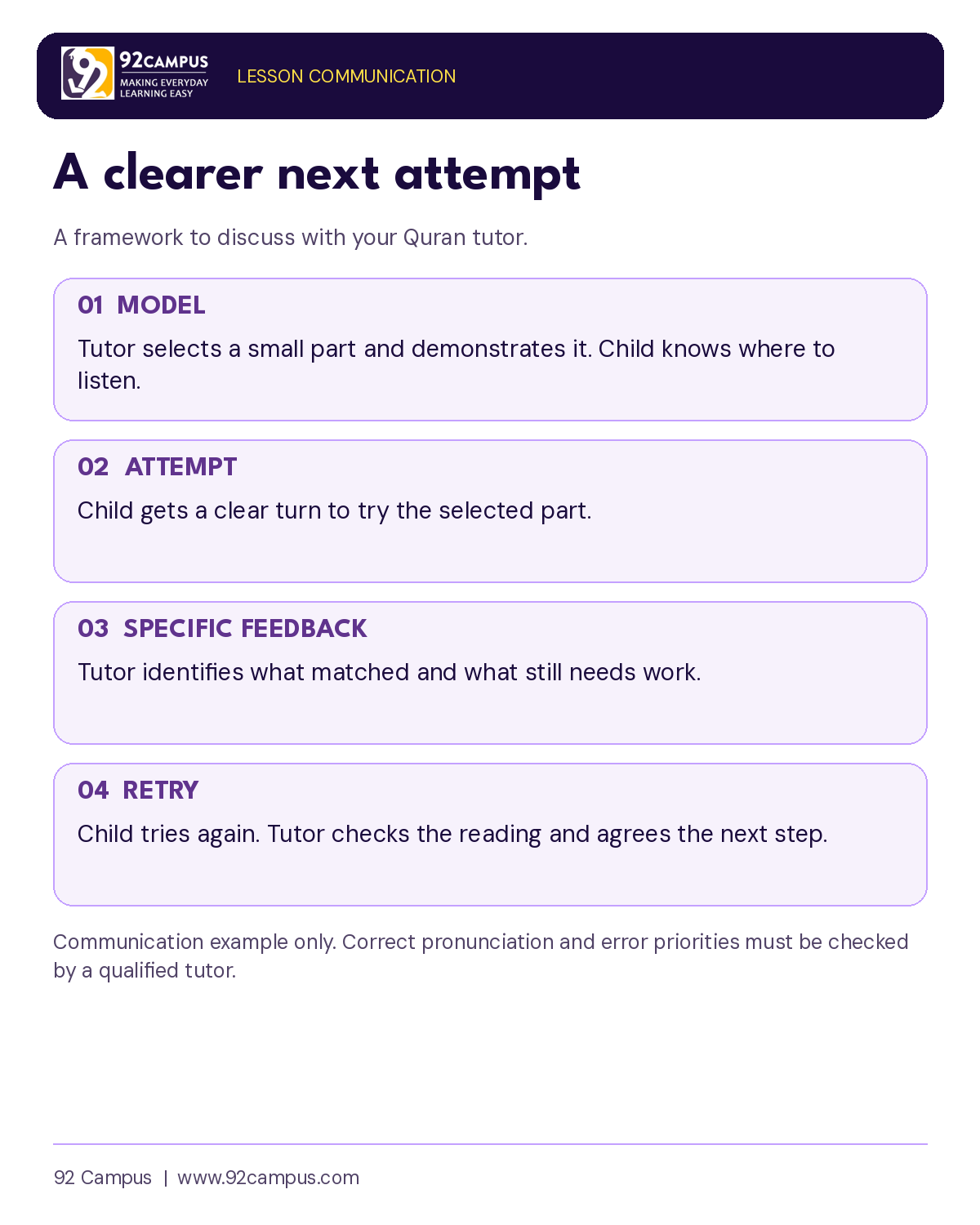
For a parent–teacher discussion, a useful editorial framework is model → attempt → specific feedback → retry. Ask the tutor to choose the exact recitation target and decide which errors need immediate attention. Choosing a small focus does not mean approving other errors as correct.
- Model: Identify the selected word or sound. “Listen to this part first. You do not need to read the whole line yet.”
- Attempt: Give the child a clear turn. “Now you try this word.” Allow time to respond.
- Specific feedback: Say what matched and what still needs work. “You followed the word I pointed to. Listen again to the sound I’m modelling.” Only describe an improvement that actually happened.
- Retry: State the next task. “Try that same word again. Then I’ll tell you whether we can put it back into the line.”
This is a written interaction example, not an approved recitation sample. A qualified Quran tutor should select the material, demonstrate correct pronunciation and check the attempt. A parent who is unsure should not invent a sound explanation or use English spelling as a substitute for that check.
Three worked conversations
All three scenarios below are illustrative. Their purpose is to show how an observation becomes a clearer task, not to promise that every child will respond in the same way.
1. The instruction was unclear
What happened: The teacher said “again” after a word. The child started the whole line, was stopped and said, “I already did it.”
What the child said they understood: “I thought I had to do the line again. I didn’t know what was wrong.” The parent checks this rather than assuming it.
Teacher clarification: “I meant this one word. I’ll point to it and read it first. Your job is to listen, then try only that word.”
Child: “Only that one?” Teacher: “Yes. We’ll work on that part before returning to the line.”
Parent follow-up: “Today we found that ‘again’ was confusing. Could you mark the exact word for home practice and tell me what help to give?”
What to review next: Can the child point to the target and explain the next action? If the instruction is understood but the sound remains difficult, the tutor can revisit the reading skill. Understanding an instruction and mastering pronunciation are separate checks.
2. Repeated interruptions made the task hard to follow
What happened: The child began a phrase, the tutor corrected a sound, and the parent added another reminder before the child retried. The child said, “Everyone keeps stopping me.”
What the child said they understood: “I couldn’t finish anything.” This does not tell us that every interruption was unnecessary; it tells us what to clarify together.
Teacher clarification: “During this attempt I will give the correction. Let’s use this short section. If I stop you, I’ll show the exact place and explain the retry.”
Parent: “I’ll leave the reading feedback to your tutor. I can help with the screen if you need me.”
Parent follow-up: “Which errors should I flag during home practice, and which should I note for you? Where should our short practice section end?”
What to review next: Did the child get a clear turn after feedback? Could they complete the agreed section with the support the tutor specified? The aim is a workable correction process, not an arbitrary rule that the tutor must never interrupt.
3. Being overheard felt embarrassing
What happened: A sibling laughed nearby after a correction. The child covered the page and refused to read aloud.
What the child said they understood: “They’ll laugh if I get it wrong again.” Do not answer this by comparing siblings or demanding a public demonstration of confidence.
Parent response: “We don’t laugh at someone’s practice. I’ll make this space quieter. You can tell us if you need a pause.” Address the sibling separately.
Teacher clarification: “We can begin with a familiar part in this private lesson. I’ll explain the correction to you directly, and you can ask me to model it again.”
Parent follow-up: “Could we keep feedback between you and the child and avoid asking them to repeat the difficult part for relatives?”
What to review next: Is the setting private enough, and is the child willing to make an attempt there? If the child is still uncomfortable, ask what support they prefer rather than announcing that the problem is solved.
Respectful feedback can still be accurate
Kindness does not require pretending that a mistaken reading is correct. It means describing the task without attaching the mistake to the child’s character. Use these alternatives as conversation starters, adjusting the wording to the learner’s age and language.
- Instead of “You never listen,” try: “Show me which part you think we are practising.”
- Instead of “How many times have I told you?”, try: “Let me demonstrate it another way. Then we’ll try the selected part.”
- Instead of “Your sister can do this,” try: “This is your current practice target. We’ll check it against your earlier attempt.”
- Instead of “Stop being sensitive,” try: “Tell me what made that correction difficult to use.”
- Instead of “Perfect!” when it is not accurate, try: “You found the right place. Your tutor will help you check the sound.”
Qari Academy’s guide to children finding correction difficult also recommends clear feedback and a parent–teacher discussion. It is practical provider guidance, not evidence of how common this concern is. The examples here add a record of the instruction, the child’s interpretation and the next agreed task.
Use a short parent–teacher observation card
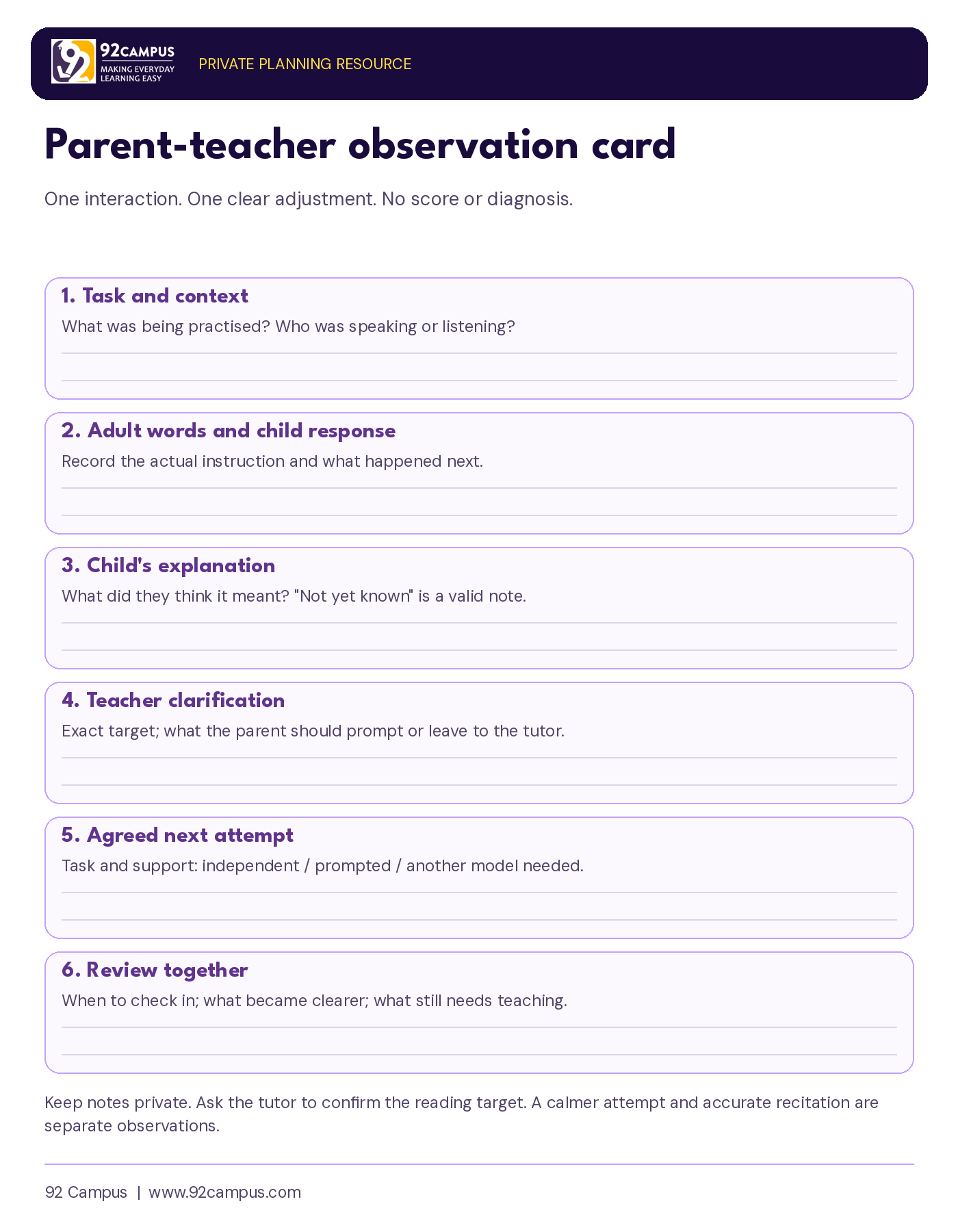
Choose one difficult interaction rather than scoring the whole lesson. Download the one-page observation card, or copy the following headings into a private notebook:
- Task and context: What was being practised? Who was speaking or listening?
- Words and response: What did the adult say? What did the child do or say next?
- Child’s explanation: What did they think the instruction meant? Write “not yet known” if they did not explain.
- Teacher clarification: What is the precise target? What should the parent model, prompt or leave for the tutor?
- Next attempt: What small task was agreed? Note whether it was independent, prompted or needed another model.
- Review: When will you compare notes? Was the instruction clearer, and what still needs teaching?
Illustrative filled note: “Selected word in today’s assigned line. After ‘again’, child restarted the line and went quiet. Child said they thought the whole line was wrong. Tutor will point to one word and model it. Parent will avoid adding a second correction. At the next lesson, check whether the child identifies the target and attempts it after a model. Pronunciation still to be checked by tutor.”
A useful message to send privately is: “After today’s correction, my child became quiet and said they didn’t know which part to repeat. Could we agree one clear target and the words you’d like me to use at home? Please also tell me when to stop and refer a difficulty back to you.”
Review the adjustment without turning it into another test
At the agreed check-in, ask whether the child understood the instruction, had a chance to retry and knew how to ask for help. Record accuracy separately from willingness to attempt. A calmer lesson does not by itself confirm correct recitation; a correct attempt does not tell you whether the child felt comfortable.
If the same difficulty continues, revisit the task size, starting level, explanation language, audio and lesson timing with the tutor. Avoid adding several new changes at once if that makes it impossible to tell what helped. There is no fixed number of lessons after which a child should stop becoming upset.
For a broader record of prompts and skills, see how parents can monitor Quran learning progress. The Tajweed confidence guide covers the wider reading-confidence topic; this card focuses on what happens during a particular correction.
When a lesson needs more than a wording change
Ridicule, threats, humiliating comparisons or pressure to hide what happened should be raised with the academy promptly. Do not ask a child to tolerate mistreatment as proof of commitment. Discuss the facts, request an appropriate response and consider pausing the arrangement while the concern is addressed.
This article does not diagnose anxiety, trauma or a developmental condition. If distress continues beyond these lesson interactions or you have broader concerns about your child’s wellbeing, seek appropriate professional advice. Share relevant learning needs with the tutor so that educational support can be discussed within their role.
Agree a suitable next step with your tutor
92 Campus’s one-to-one Quran classes for kids describe individual listening, tutor modelling and a practice task matched to the learner. Explain what your child finds difficult and ask how correction would be handled for their current level. The actual tutor approach and availability should be discussed with the team.
You do not need to arrive with a label or a perfect explanation. One concrete example—what was said, what your child understood and what happened next—gives the tutor a useful place to begin.
Join the conversation
Comments are reviewed before publication. Your name and approved comment will be public. Please leave out private learner or contact details.