
Request your demo
Send the course name, learner age, level and preferred local-time windows.
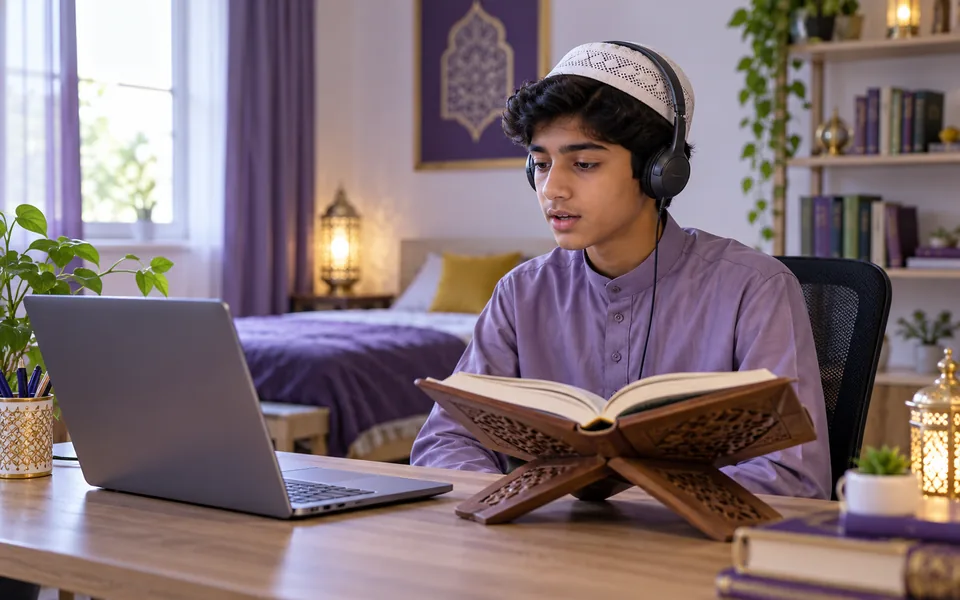
Learn to apply Tajweed during recitation with a tutor who listens to you individually. These one-on-one online Tajweed classes for beginners combine explanation, modelling and guided repetition.
Send your contact details and starting course interest. Timing and tutor preferences can be discussed after the request is saved.
Compare local currencies and plans →Students who can read connected Arabic and want to improve pronunciation, understand recitation rules and correct recurring mistakes.
Basic Quran reading is recommended. The demo includes a short reading check so the tutor can suggest suitable starting topics.
The tutor uses these stages as a guide and adjusts the starting point, examples and revision to your assessment.
Identify sounds that need attention and practise relevant makharij through listening and repetition.
Study noon sakin, tanween and meem sakin through examples, then apply the lesson in short passages.
Work on selected madd patterns, ghunnah and qalqalah at the depth suitable for your level.
Practise suitable pauses and revisit passages to improve consistency without focusing only on rule names.
Your tutor listens to you individually, checks understanding and allows time to repeat a difficult part. The balance of explanation, reading and discussion depends on the course and learner.
Begin with a brief check-in and review the previous assignment.
The tutor explains or models the next skill using a manageable example.
Try it yourself, ask questions and repeat with correction or clarification.
Finish with a clear revision task and a focus for the next lesson.
Lesson duration and frequency are agreed during booking. Each activity takes the time the learner needs, rather than following an identical minute-by-minute timetable.
Repeat tutor-selected examples and short passages slowly. Keep a note of one or two corrections to focus on each day, rather than trying to fix everything at once.
The tutor checks whether you apply a rule during new recitation, not just recall its name. Earlier topics are revisited to help corrections become consistent.
Talk to the tutor or support team about recurring difficulties, missed lessons or a change in your routine so the next steps remain realistic.
If you cannot yet read Arabic letters, Noorani Qaida or Quran Reading is usually a better first step. The tutor will recommend a route after your demo.
This page offers guided Tajweed learning and recitation practice. An ijazah or formal certification is not promised as part of this course.
Share your country, city, weekly availability and preferred lesson duration. The team confirms a tutor slot and the fees for your plan before you enroll.
A phone, tablet or computer, reliable internet and a quiet place are enough to begin. The team sends joining instructions. A parent should help younger children get connected.
Parents share their experience of learning with our academy.
Send the course name, learner age, level and preferred local-time windows.
Join a one-on-one demo and discuss a suitable learning path.
Review the suggested schedule and fees, then decide whether to continue.
One learner, 30-minute one-to-one lessons. The same confirmed plans apply to Quran and Urdu courses. Tutor availability and your final schedule are agreed before enrollment.
Other durations and family plans: use the fee calculator. See missed-class and cancellation terms. The trial request requires no payment.
Request a Free TrialTell the tutor what the learner already recognises or reads. In the trial, a small reading or listening activity helps identify the next skill. Beginners may need Qaida foundations; readers may focus on fluency, Tajweed or another assessed goal.
A typical lesson revisits a familiar task, introduces a manageable next step and gives time to try it with feedback. Ask for one revision task and discuss what the learner can do with less prompting. Progress is individual; no fixed completion date is promised.
Request a male or female tutor and tell us the language needed for explanations. We confirm the tutor, teaching language and appointment before the lesson. For younger children, a parent or guardian should help with the device and remain available.
Regular fee examples use one learner and 30-minute lessons. Other durations and frequency are agreed with the team. View the current plans.
A saved form returns a reference. The team then checks availability and confirms joining details. A receipt email may be delayed or filtered; your saved request reference remains useful. Keep your reference if you need support.
Contact the academy before a missed lesson or schedule change. Makeup lessons and refunds follow the current cancellation policy and availability. See service arrangements or contact support.
92 Campus videos from our basic Islamic learning course for children. Your trial follows the learner level and chosen course.
This is a written learning example, not a recorded lesson or a claim about a particular tutor. During your trial the tutor models sounds, listens to your attempt and explains corrections.
ا ب ت
Parents: notice comfort and attention, rather than counting how quickly the child finishes.

A gentle beginner path for children learning Arabic letters, sounds, joining, and fluency.
Explore course
One-on-one Quran reading classes focused on confidence, correct pronunciation, and steady progress.
Explore course
Memorization plans with revision routines, parent updates, and teacher-led accountability.
Explore course
Age-appropriate lessons in duas, seerah, manners, beliefs, and daily Islamic practice.
Explore course
Understand Quran meanings with simple translation lessons, vocabulary support, and practical reflection.
Explore course
Child-friendly online Quran classes for ages 4 to 16 with patient tutors, parent updates, and gentle progress.
Explore course
Flexible beginner and improvement classes for adults who want Quran reading, Tajweed, or Islamic learning support.
Explore course
One-on-one Urdu lessons to connect letters, read everyday words, build handwriting and practise conversation.
Explore course