
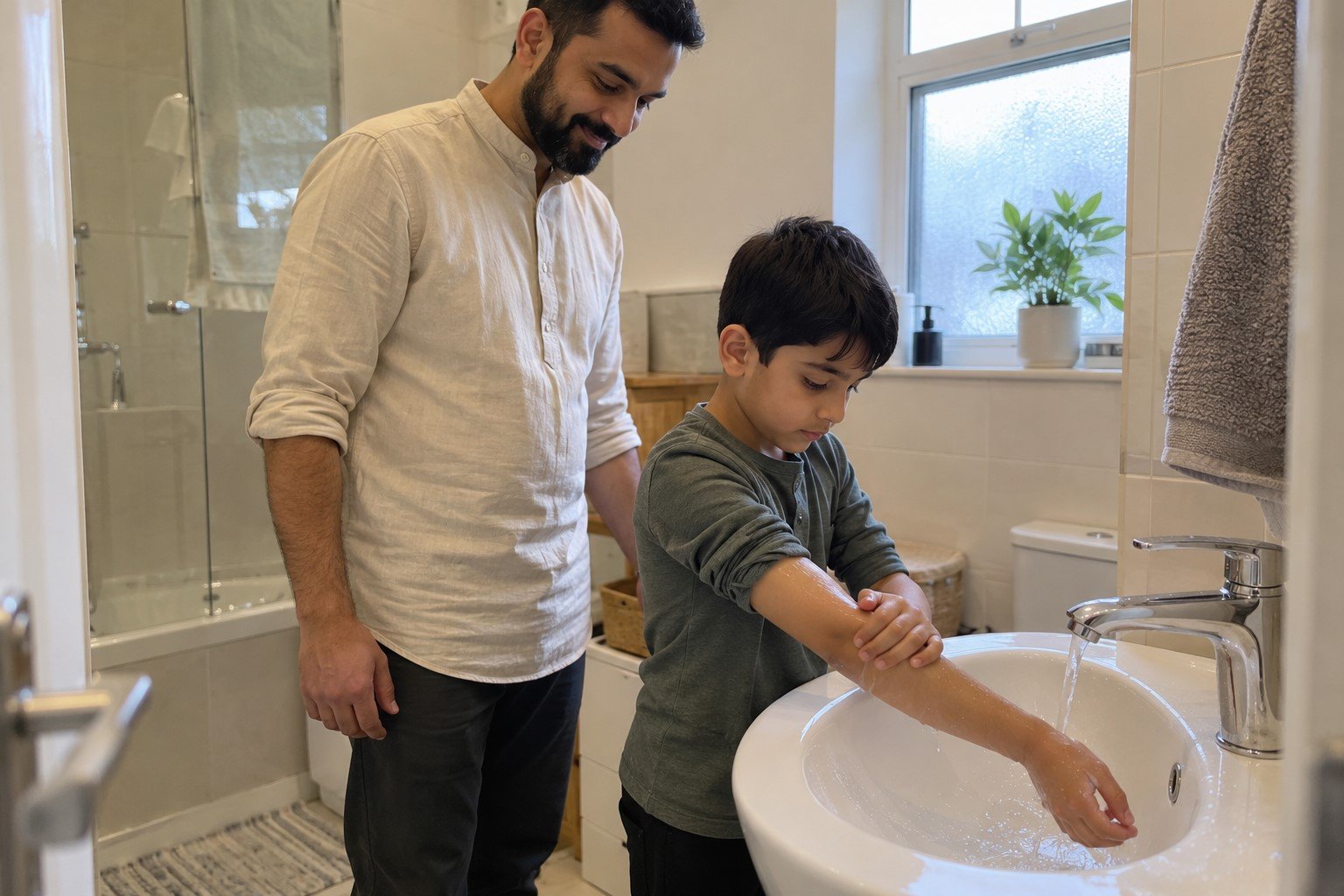
Your child finishes making wudu, reaches for a towel, and asks, “Did I do everything properly?”
You remember the familiar steps: washing the hands, rinsing the mouth, wiping the head. But explaining which actions are essential—and which complete the Sunnah practice—can feel less straightforward.
Learning the fard and Sunnah of wudu helps children and adults approach purification with understanding. Instead of following movements without knowing their purpose, they learn what must be completed and how to perform wudu with care.
This guide explains the Hanafi method in simple language, with practical ideas for parents teaching children at home.
Where Does the Quran Teach Us About Wudu?
The main Quranic passage explaining wudu is Surah Al-Ma’idah, verse 6. It instructs believers preparing for prayer to wash the face and arms, wipe the head, and wash the feet.
The verse also connects purification with Allah’s intention to purify believers rather than place unnecessary difficulty upon them.
For a young learner, this offers a meaningful starting point: wudu is preparation for standing before Allah in prayer. It deserves attention, but learning it should not feel frightening. Read Surah Al-Ma’idah 5:6.
The Four Fard Acts of Wudu in Hanafi Fiqh
Use these four actions as a simple memory aid when introducing the obligatory acts of wudu.
The four obligatory acts: a Hanafi summary
| Fard act | What to remember |
|---|---|
| Wash the face | Cover the required facial area fully |
| Wash both arms | Include the hands and elbows |
| Wipe the head | Wipe at least one-quarter with wet hands |
| Wash both feet | Include the ankles |
1. Wash the Whole Face
Wash from the normal hairline to the bottom of the chin, across the face between the ears.
Teach children to wash gently and thoroughly rather than throw water towards their cheeks. A parent’s slow demonstration often explains more than repeated instructions.
2. Wash Both Arms, Including the Elbows
Water must reach the hands, forearms, and elbows.
Rolling sleeves up beforehand makes the movement easier. Encourage your child to look at the elbow rather than assume that water running down the arm has reached everywhere.
3. Wipe at Least One-Quarter of the Head
The Hanafi obligatory minimum is wiping one-quarter of the head with wet hands. Wiping the whole head belongs to the complete Sunnah method.
Explain the difference between washing and wiping: the head is wiped with wet hands, rather than washed like the face.
4. Wash Both Feet, Including the Ankles
Wash each foot thoroughly, including the heels and ankles.
Children sometimes concentrate on the top of the foot and miss the back. Show them how to reach these areas safely, without balancing on a slippery surface.
These are the four fara’id described in Hanafi teaching. Detailed questions about beards, dressings, or other circumstances should be discussed with a qualified teacher. Hanafi method of wudu
A Practical Wudu Routine to Learn and Practise
Knowing the minimum is useful. Practising the complete routine helps it become familiar.
The following teaching sequence brings together obligatory actions and Sunnah practices. It is a learning sequence, not a claim that every action has the same legal classification.
Begin With Intention and Bismillah
Approach wudu as an act of worship. Make the intention in your heart and begin with Bismillah.
With children, explain the purpose simply: “We are preparing ourselves for Salah.”
Wash the Hands and Clean the Mouth
Wash both hands to the wrists. Include cleaning the teeth with miswak as part of learning the Sunnah routine.
Rinse the mouth gently, taking care not to swallow the water.
Rinse the Nose Carefully
Draw water gently into the nostrils and clean the nose. Demonstrate without encouraging forceful sniffing.
Wash the Face and Arms
Wash the face, followed by the right arm and then the left, including the elbows.
The well-known report of ‘Uthman’s wudu describes washing the hands, face, arms, and feet three times, alongside rinsing the mouth and nose and wiping the head. Read Sahih al-Bukhari 159.
Wipe the Head and Ears
Learn how to wipe the whole head and the ears correctly. Demonstration is particularly helpful here because a written instruction cannot show every movement.
Wash the Feet and Finish Carefully
Wash the right foot and then the left, including the ankles and between the toes.
Other practices taught in the Hanafi method include passing the fingers between the fingers and toes, maintaining the prescribed order, and continuing without unnecessary interruptions. Hanafi method of wudu
Why Do Some Guides List Different Numbers of Wudu Obligations?
You may find a guide listing four obligatory acts and another listing six. This can reflect differences between recognised schools of Islamic law.
For example, intention and maintaining the order are obligatory elements in the Shafi‘i school, while their classification differs in Hanafi teaching.
This is why a useful wudu guide should identify the perspective it follows. Parents can ask their child’s teacher which school’s method is being taught and keep home practice consistent with that instruction. Shafi‘i guidance on the obligatory elements of wudu
A different count does not automatically mean that a guide is mistaken.
Common Learning Difficulties—and How Parents Can Help
A child may know the order perfectly and still struggle to perform the movements. Watch what happens in practice before assuming that more memorisation is needed.
Rushing Before Prayer
If wudu begins when everyone is already waiting, children may hurry.
Allow a little preparation time. Give one clear reminder, such as, “Take your time around the elbows,” instead of several instructions at once.
Forgetting the Meaning of the Steps
Ask your child to explain one action in their own words:
- “Which parts do we wash?”
- “Which part do we wipe?”
- “What are we getting ready for?”
Keep the conversation encouraging. The aim is understanding, rather than catching them out.
Struggling to Reach the Basin
Make the setting suitable for the child. Where needed, use a stable, non-slip step with adult supervision.
A comfortable position allows the child to concentrate on learning.
Becoming Worried About Every Small Detail
Correct clear mistakes calmly. Avoid turning every practice session into repeated checking.
If a child develops persistent doubts, ask a qualified teacher for guidance rather than making the routine increasingly complicated.
A Gentle Three-Session Plan for Teaching Wudu to Children
There is no need to teach every detail in one sitting. Three short sessions can make the lesson easier to absorb.
Session One: Watch Together
Demonstrate the routine slowly. Use a short explanation for each movement and let your child observe. Avoid asking them to memorise everything immediately.
Session Two: Practise With Support
Let your child lead while you supervise. Help only where needed. Praise something specific: “You remembered to include both elbows.”
Session Three: Explain and Repeat
Ask your child to describe the four obligatory actions, then practise the complete routine again.
Continue with brief reminders over the following days. Familiarity grows through patient repetition.
What Can We Recite After Wudu?
The testimony of faith is among the remembrances reported after completing wudu.
Rather than adding several unfamiliar phrases at once, help your child learn one authentic remembrance with its meaning. A teacher can support accurate pronunciation.
The remembrance following wudu is discussed in Sahih Muslim 234b.
Build Confidence Through Patient Practice
Keep lessons short, demonstrate each movement, and make correction feel like support. Ask your child to explain what they remember rather than expecting perfect recall after one lesson.
If your family would benefit from guided learning, explore our online Islamic Studies classes. A teacher can explain daily practices while parents supervise practical washing at home.
You can request a free trial to discuss your child's learning needs. The team will need to confirm a suitable tutor and appointment time.
Join the conversation
Comments are reviewed before publication. Your name and approved comment will be public. Please leave out private learner or contact details.