

Your child finishes a newly learned surah, and you both smile. Then you ask for one they learned a few months ago. The first ayah comes easily. The next brings a long pause, a look towards you, and the familiar question: “What comes after that?”
You know they learned it. They know they learned it. What neither of you knows is what to practise next.
This guide is for parents of children roughly aged 6–12 who have learned a small collection of short surahs. It helps you notice what your child can currently recall, respond kindly when they get stuck, and agree a manageable next task with their Quran tutor. It is not a full-time Hifz timetable.
In this guide
- New memorisation versus retained revision
- A calm first check
- What to say at a forgotten line
- A filled revision example
- Your blank revision sheet
- Agreeing the next plan with a tutor
- When individual feedback can help
New memorisation and retained revision are different achievements
“Learned” can mean several things. Your child might follow a recording, repeat after a teacher, recite immediately after practice, or recall the same passage later without a cue. Those are useful observations, but they do not tell you the same thing.
New memorisation records what your child is currently learning. Retained revision records what happens when they return to previously learned material after a gap. A surah heard successfully on Monday still needs a place in the revision record.
If your child keeps forgetting surahs, avoid jumping straight to “They are lazy” or “Their memory is poor.” A pause alone does not establish either conclusion. Begin with questions you can answer: When was this surah last revisited? Was the child following someone then? Is today’s difficulty starting, continuing, pronunciation, or a mixture?
Research gives a useful, limited reason to make room for recall. A study of fifth-grade pupils learning history texts found benefits from retrieval with feedback compared with rereading. Its tested spacing difference did not significantly change performance. This was not a Quran memorisation study and does not prove a particular revision timetable for your child. Read the original classroom study.
Our practical suggestion is modest: give your child a supported opportunity to recall something, correct uncertainties through the tutor’s guidance, and return to it on another occasion. Listening remains useful, but listening along is not the same observation as recalling independently.
A Quran connection without turning revision into a race
Surah Taha includes the prayer, My Lord! Increase me in knowledge. This short extract is from the English translation in Irfan ul Quran, 20:114. The verse addresses the Prophet ﷺ in the context of receiving revelation; it is not a prescription for a child’s practice duration.
As a parenting approach, you can make revision a time for seeking knowledge together rather than proving how quickly your child can finish. The worksheet below is an organisational aid, not a religious obligation, a measure of faith, or a scholarly assessment of recitation.
Start with a calm check of what your child can recall today
Choose a quiet moment and explain the purpose: “We are finding out which parts need a little help so we can practise the right thing.” You do not need to test every surah in one sitting.
- List a small selection already learned. Use the tutor’s record where possible. Keep new assignments on a separate list.
- Invite one comfortable attempt. Ask for a familiar surah. Give your child a moment to begin without immediately supplying the next words.
- Notice the support used. Was it recalled without a cue, completed after a prompt, or difficult in a way you need the teacher to check?
- Write one useful detail. “Needed help moving to the next ayah” is clearer than “weak” or “bad today.”
- Agree a small next step. Use the current tutor assignment, or ask the tutor what to practise. Stop if the session is becoming an argument.
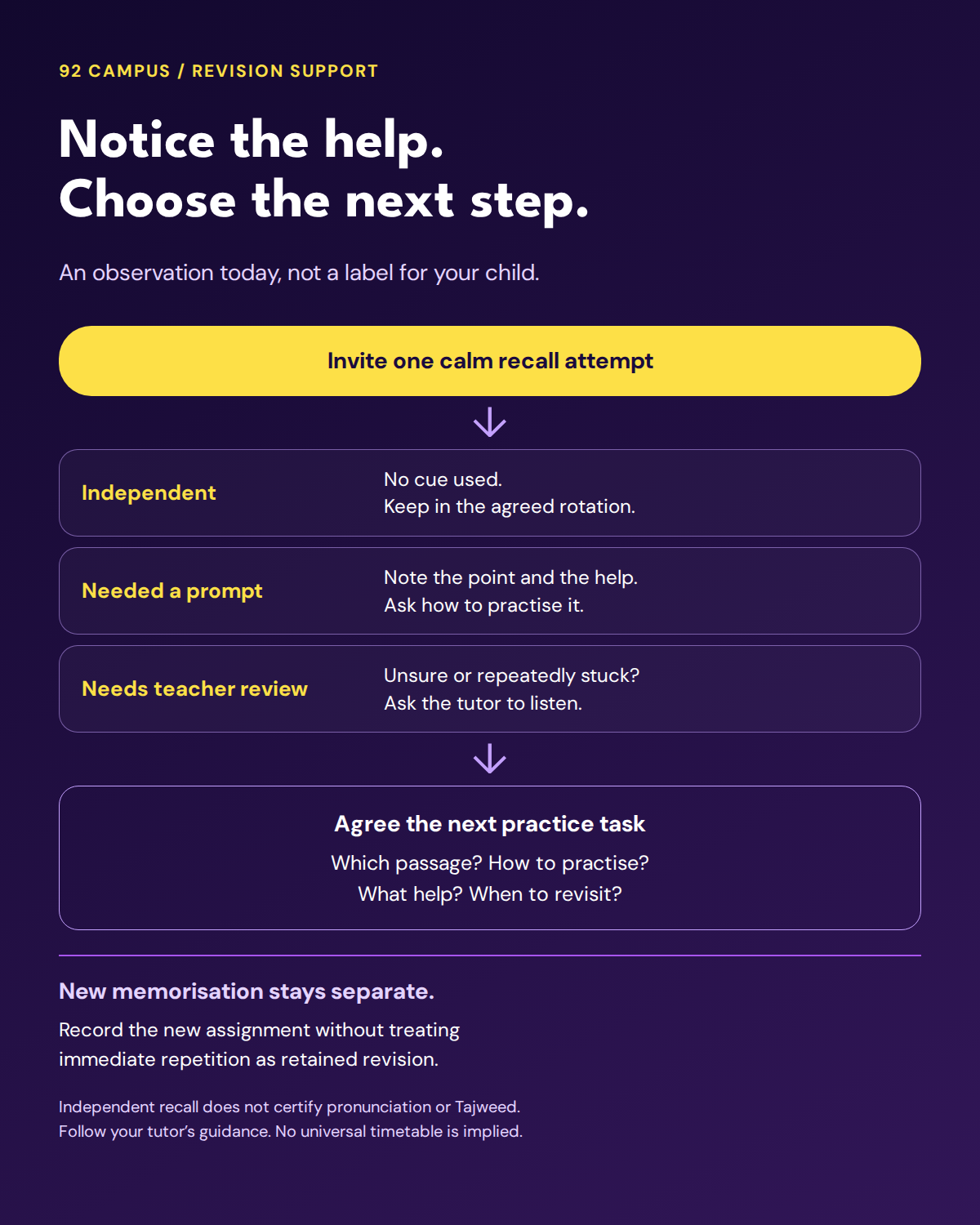
Use three observations rather than a pass or fail
- Independent: your child completed the selected passage without your cue or an audio lead. This does not certify Tajweed or pronunciation.
- Needed a prompt: your child continued after help. Record where and what kind of help, so the tutor knows what happened.
- Needs teacher review: you are unsure about wording or pronunciation, the child repeatedly loses the passage, or you cannot guide the correction confidently.
Use one main observation per attempt. If your child continues after a prompt but you are also unsure about pronunciation, choose “Needs teacher review” and explain both points. An observation can change at the next check; no surah has to move only forwards through fixed groups.
What should a parent say when a line is forgotten?
Your child reaches a familiar stopping point and asks you to finish the next line. Before supplying it, pause briefly and say: “Take your time. Would you like a moment to think, or shall we check the part your teacher gave us?”
If you know the passage accurately and the tutor has explained how to prompt, use that agreed cue. Help your child return to the connection between the two ayahs rather than reciting the whole surah for them. If you are uncertain, do not guess the Arabic or repeatedly rehearse a possible error. Note the point for the teacher.
Instead of “You knew this yesterday!”“Yesterday it came more easily. Today we have found the part to revisit.” Instead of “Start again until you get it right.”“Let’s work on this small part using your teacher’s instructions, then finish calmly.” When your child says “I can’t remember anything.”“You remembered the beginning. We will ask for help with the next part.” When you cannot check the recitation“I’m not sure enough to correct that. Let’s write it down for your teacher.”These are suggested parent-response phrases, not a teaching script every family must follow. Speak naturally. Praise something you actually observed: coming back to a difficult part, asking for help, or completing the agreed task.
When to refer the difficulty to the tutor
Contact the tutor when the same stopping point keeps returning, your child mixes passages, you hear a possible recurring pronunciation error, or practice regularly becomes distressing. Ask for clarification whenever you are unsure; you do not have to wait for a set number of mistakes.
Do not diagnose a wider learning difficulty from Quran revision alone. If your concerns extend beyond this task, discuss them with the appropriate education or health professional rather than using this sheet to make a diagnosis.
A filled short surah revision example
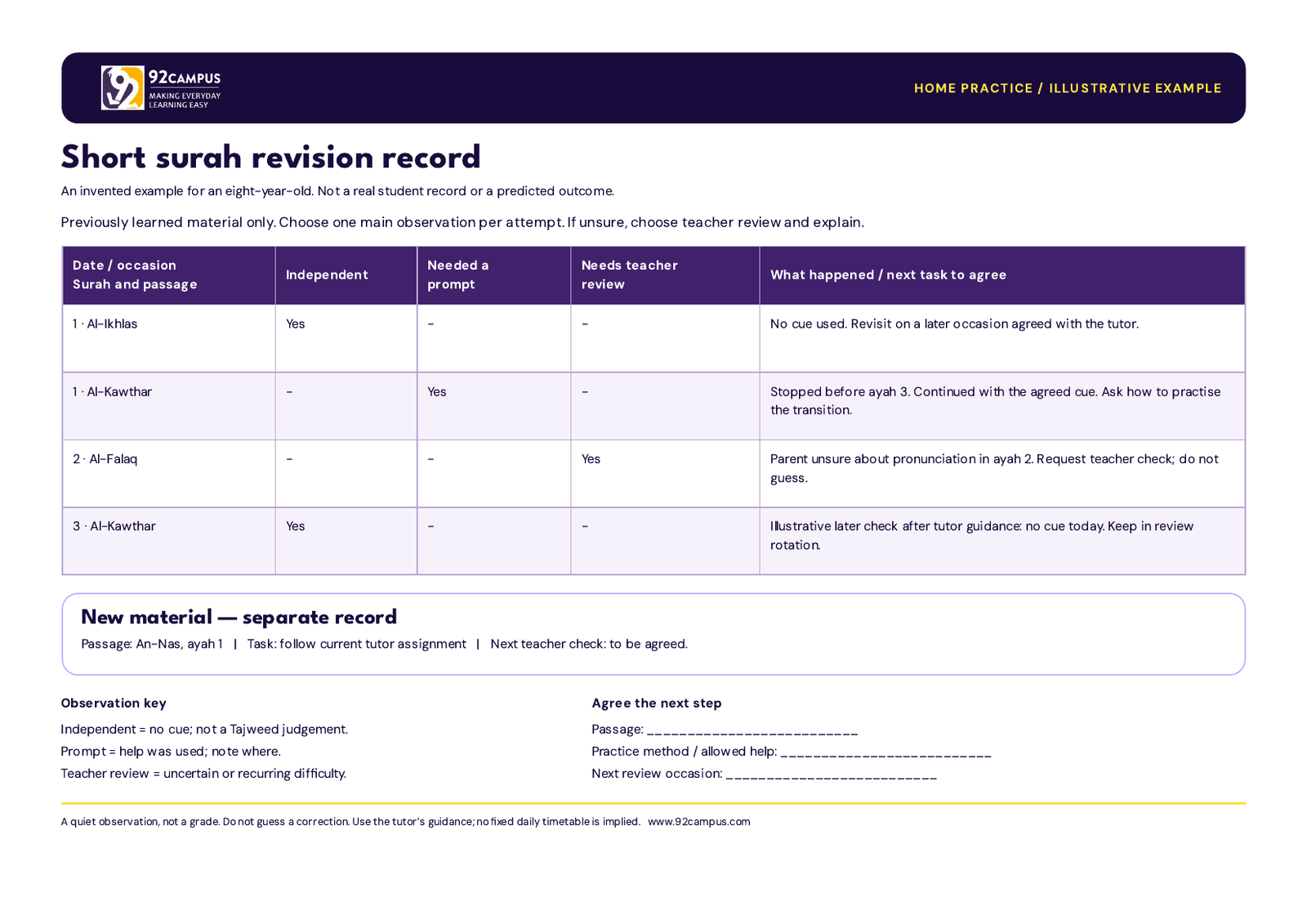
Illustrative example, not an actual student record: an eight-year-old has learned Al-Ikhlas, Al-Kawthar and Al-Falaq and is beginning An-Nas. Their parent samples the older surahs across three practice occasions. “Occasion” means the next suitable check, not a compulsory daily schedule.
Previously learned material only| Occasion and surah | Independent | Needed a prompt | Needs teacher review | Observation and next step |
|---|---|---|---|---|
| 1 · Al-Ikhlas | Yes | — | — | No cue used. Include again on a later occasion agreed with the tutor. |
| 1 · Al-Kawthar | — | Yes | — | Stopped before ayah 3; continued with the agreed cue. Ask how to practise the transition. |
| 2 · Al-Falaq | — | — | Yes | Parent unsure about pronunciation in ayah 2. Request a teacher check; do not guess. |
| 3 · Al-Kawthar | Yes | — | — | After the tutor’s transition practice, no cue needed today. Keep in the agreed review rotation. |
The last row is an invented possible outcome to demonstrate recording, not a prediction that one practice task will resolve a difficulty. The useful change is that the family has replaced “keeps forgetting” with a specific observation.
Keep new material in its own record
New-material entry: An-Nas · ayah 1 · follow the tutor’s current learning task · next teacher check: to be agreed. Do not place it in the “Independent” revision column just because your child can repeat it straight after listening. Record a later recall attempt when the tutor says it is appropriate.
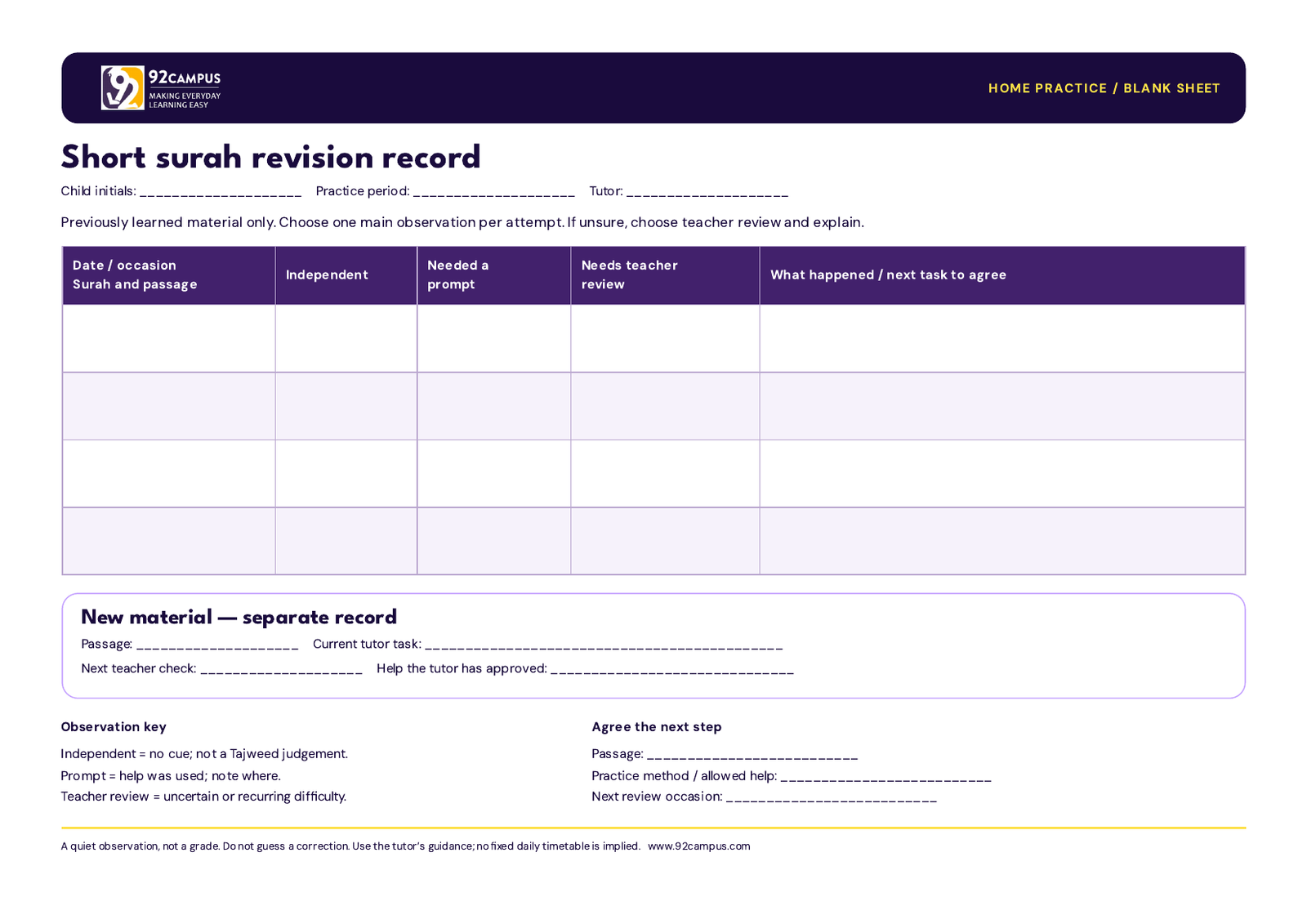
A blank Quran revision sheet to use with your tutor
Use the printable blank sheet for a small selection of surahs, not an examination of everything your child knows. Add dates when you use it. Keep completed sheets private and share them through your academy’s approved communication channel.
Open the blank revision sheet image · Open the filled example image
Blank sheet fields, in text: child’s first name or initials; date or occasion; surah and ayah range; Independent; Needed a prompt; Needs teacher review; what happened; next task to agree; next review occasion. A separate new-material area records the new passage, current teacher assignment and next teacher check.
If printing is inconvenient, copy those fields into a notebook. The observations matter more than the design. If you want additional practice aids, browse the 92 Campus learning resources.
Agree an adaptable revision plan rather than a universal timetable
Send the tutor the short record and ask which previously learned passage needs attention first. A useful message is:
“Al-Ikhlas was independent today. Al-Kawthar needed a cue before ayah 3. I was unsure about pronunciation in Al-Falaq, ayah 2. New work is An-Nas, ayah 1. Which part should we practise next, how should I help, and when would you like to hear it again?”
Ask for four things: the passage, the way to practise it, the help you may give, and the next review point. If an explanation is unclear, request a demonstration of that exact transition or pronunciation. A teacher-approved model or recording can help if the tutor provides one through the academy’s agreed channel; do not assume a sample is already available.
For a small collection of surahs, a practice occasion might include one comfortable recitation, one teacher-assigned repair task, and a return to an older passage. New work follows the tutor’s plan and may be reduced temporarily when earlier work needs attention. Neither a fixed number of minutes nor the same number of surahs suits every child.
In a busy UK school week, the practical choice may be a calm moment after a snack rather than immediately at the school gate. A US family may need a different window around homework and activities. Choose a moment your family can manage; the method does not require a particular clock time or country.
For organising the session itself, see our short home Quran practice routine. For keeping a broader record of skills and support, use the guide to monitoring Quran learning progress. This article addresses a narrower question: what happened when an already learned surah was recalled?
After a break or a difficult week
Resume with a smaller selection and update the observations. Do not turn missed sessions into a large catch-up test. If the same plan is repeatedly unfinished, tell the tutor what was realistic at home and agree a lighter task. Retain a place for older surahs that seem comfortable, rather than dropping them from the record entirely.
When individual recitation feedback can help
A parent can notice pauses, cues and confidence without being qualified to assess every recitation detail. The teacher’s role is to listen accurately, check the difficult passage and explain suitable practice.
92 Campus describes selected-surah learning and revision within its one-to-one Hifz support. Discuss your child’s reading level and actual revision need before choosing a course. A small collection of short surahs does not automatically require a full-Quran memorisation programme, and reading or Tajweed support may be a more suitable starting point.
For your next practice occasion, choose one already learned surah. Listen, record the help needed and leave with one clear next step. Your child does not need a bigger test; you need a clearer picture of what to work on together.
Share your child’s current memorisation and revision difficulty with 92 Campus, so a tutor can discuss a suitable next practice step. Tutor availability and any ongoing support are confirmed with the team.
Join the conversation
Comments are reviewed before publication. Your name and approved comment will be public. Please leave out private learner or contact details.