

Your child remembers the score, the missed chance, and exactly which player should have taken the penalty. At dinner, the match is still being discussed. By bedtime, there is one more clip they want to show you.
Perhaps they have been searching for Roma vs Real Madrid. Perhaps their excitement is about a local team, a weekend tournament, or the game they played at school. Either way, football has their attention.
For a Muslim parent, that attention opens a useful question: how can we help our children enjoy something they love while holding on to the values we want them to live by?
You do not need to turn every goal into a lecture. You can notice the moments that already carry a lesson: how your child treats an opponent, responds to disappointment, keeps a commitment, or reacts when it is time to switch off.
The aimGive football a clear place in family life, alongside prayer, learning, rest, and responsibilities. Let your own behavior make those priorities visible.
Start by understanding what your child loves
Football may mean more to your child than the result. It can be a shared language with friends, a chance to feel capable, or a way to spend time with you. Before you decide what needs limiting, find out what the game gives them.
Ask who they enjoy watching and why. Ask what happened at training. Let them explain a rule you do not know. A few minutes of real interest can make a later conversation about limits easier to begin.
Enjoyment needs room in family life
Children need opportunities to play, develop interests, and spend relaxed time with people who care about them. A family that takes faith seriously can still laugh at an unexpected goal, enjoy a kickabout, and celebrate a child’s effort.
For religious questions about a particular activity or situation, seek qualified guidance. This article focuses on parenting habits: fairness, self-control, responsible use of time, and a home environment where children can ask questions.
Playing and watching are different activities
Watching a match can be enjoyable family time. Playing involves movement and participation. The World Health Organization identifies benefits of physical activity for children, including physical fitness and development. Sitting through a broadcast does not provide the same activity as running, passing, or practicing outdoors.
Where possible, help enthusiasm for football lead to actual play as well as viewing. A short game in a safe space, a local club, or practice with a parent may give your child another way to enjoy the sport.
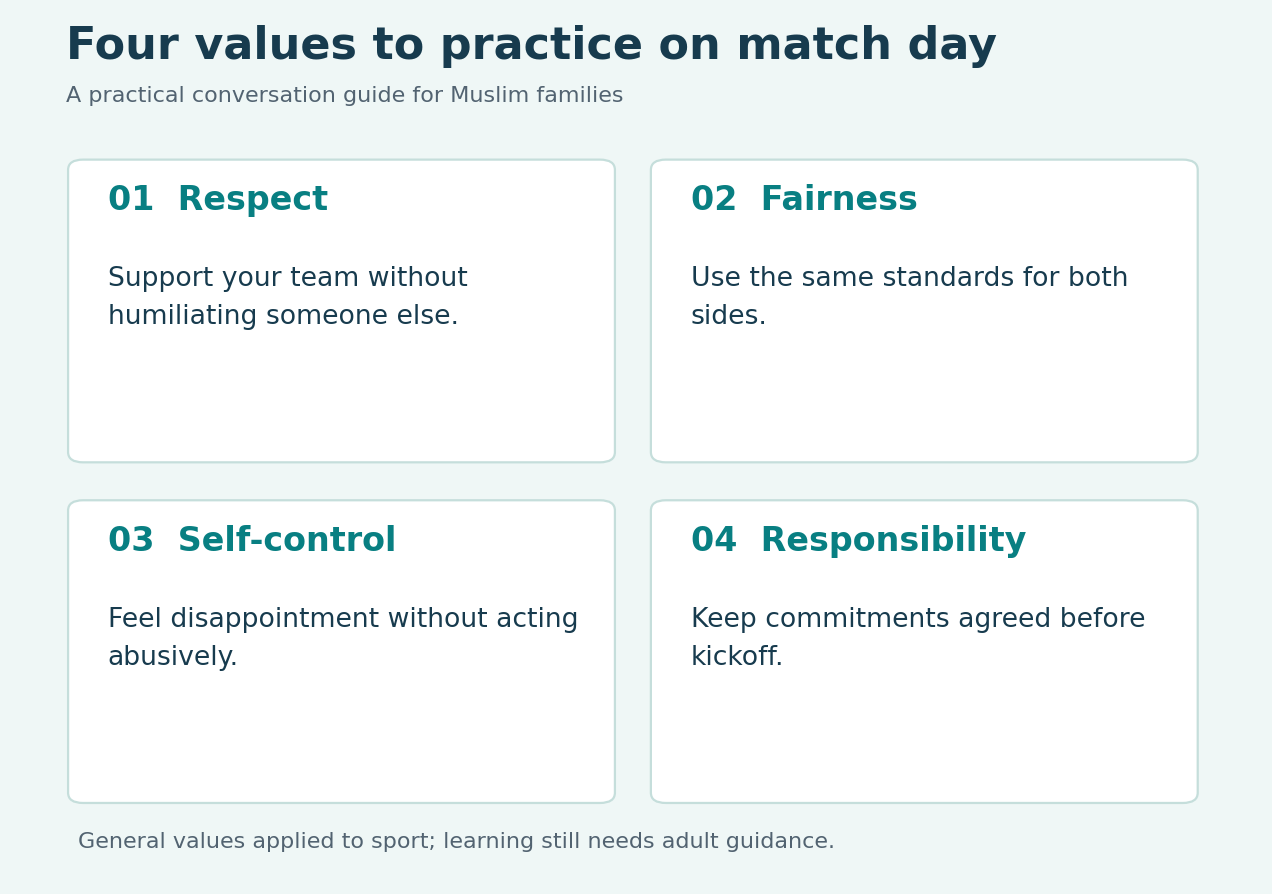
Islamic values become visible in the way we play
It is easy to talk about good manners when everyone is calm. Competition tests whether those manners survive frustration. A disputed foul or a last-minute defeat gives parents something concrete to work with.
Respect opponents, even when you want to win
In Surah Al-Hujurat 49:11, believers are warned against ridicule and offensive name-calling. A practical family application is to keep rivalry from becoming humiliation: no mocking a child who misses, no insulting a rival fan, and no treating another person as a target because of their team.
A child can say, “I think our team played better,” without saying, “Their fans are stupid.” Teach the difference while the conversation is still manageable.
Stay fair when your own team benefits
Surah Al-Ma’idah 5:8 teaches justice even where there is dislike. Applied to sport, that can mean admitting your favorite player committed a foul or recognizing a good performance by the opposition.
If you excuse every mistake your team makes, your child hears that fairness depends on who benefits. Try saying, “I wanted us to score, but that decision looks reasonable.”
Practice self-control after disappointment
Sahih al-Bukhari 6114 connects strength with controlling oneself in anger. You can discuss that teaching after a match without expecting a child to feel nothing.
Disappointment is allowed. Throwing the controller, shouting at a sibling, or sending an abusive message needs a boundary. Help your child pause, step away if needed, and repair any harm they caused.
Words to use after a loss“I can see you’re upset. You wanted them to win. Let’s take a moment, then talk about it without hurting anyone.”
Notice effort as well as the scoreboard
When your child plays, ask about a good pass, a teammate they encouraged, or something they practiced. If the only question is “Did you win?”, the result can crowd out the rest of the experience.
Specific praise is more useful than a general verdict: “You gave your teammate another chance after their mistake” tells a child exactly what you noticed.
Agree on match-day boundaries before kickoff
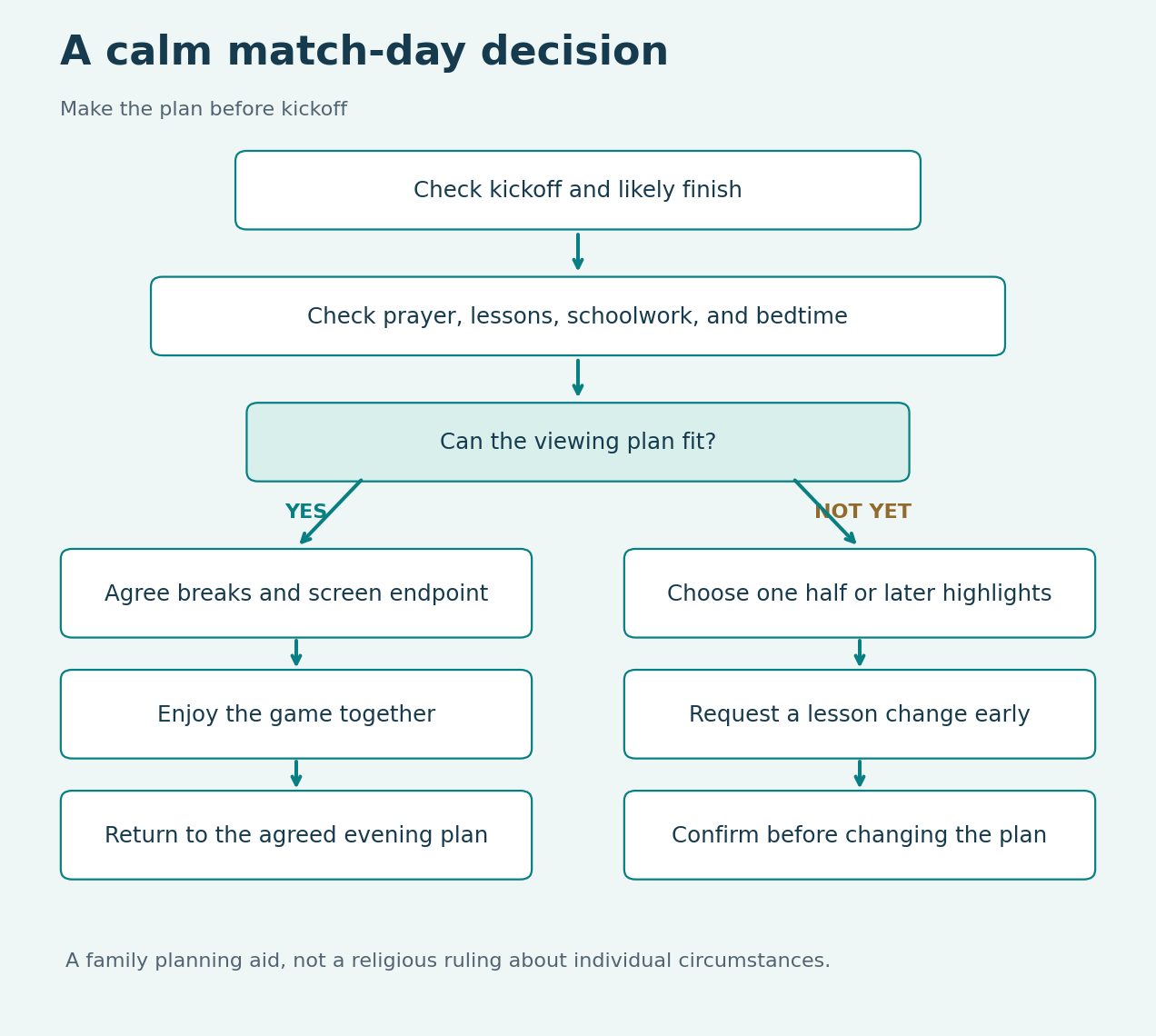
The hardest time to introduce a new limit is when the game is level and your child has just been told to turn it off. Agree on the plan while everyone can still think beyond the next goal.
Check the real time commitment
Under IFAB Law 7, a standard match has two 45-minute halves, with a halftime interval of no more than 15 minutes. Added time and, in some competitions, extra time or penalties can extend the event. Youth matches may use different durations under competition rules.
For planning, kickoff is only one detail. Check the finish time, your child’s bedtime, local prayer times, and existing commitments. Decide whether your child will watch the full match, one half, or highlights later.
Give Salah a clear place in the plan
Use reliable local prayer times and plan breaks in advance. Do not assume halftime will fall within the appropriate prayer window. For a child still learning to pray, keep expectations suited to their development and make preparation calm and familiar.
When you need to step away from the broadcast yourself, do so without acting as though prayer has spoiled the evening. Children notice whether your stated priority is also your practiced priority.
Set an endpoint for the clips afterward
The broadcast may end while the viewing continues: highlights, interviews, reactions, and another suggested video. Agree on what comes after the match, including when the device goes away.
Keep the arrangement specific: “We’ll watch one agreed highlight video, then put the tablet away.” If that plan repeatedly fails, simplify it. A shared screen can be easier to supervise than separate devices in bedrooms.
A match-day agreement to discuss together| Before watching | Decide as a family |
|---|---|
| Schoolwork | What must be finished, and what is scheduled for later? |
| Prayer | When will we prepare and step away if needed? |
| Viewing | Full match, one half, or highlights? |
| Existing lessons | Does anything overlap, and has an alternative been confirmed? |
| After the final whistle | What happens next, and when do screens go away? |
Show the boundary you want your child to learn
If you insult the referee, refuse to pause, or spend an hour arguing in a comment thread, your child receives a different lesson from the one you intended. You do not need to be flawless. When you get carried away, acknowledge it and correct your own behavior.

Keep a child’s whole week in view
One exciting match is usually less revealing than the pattern around it. Is your child getting to school ready to learn? Do they have time to play? Are family commitments repeatedly being pushed aside? Does every free moment become another football video?
Look at the week before treating one evening as a crisis. Then change the part that is causing difficulty.
Keep Quran learning connected to ordinary life
This is where a regular Quran learning routine belongs in the conversation. Children need chances to read and ask about their faith alongside school, recreation, and family life. When lessons are always the first thing canceled, the schedule quietly communicates their place in the family’s priorities.
Choose a manageable time and protect it. If a special match overlaps with a booked class, contact the teacher early and ask whether a change is possible. An alternative needs confirmation; a requested change does not mean the lesson has automatically moved.
Parents who want structured support can explore online Quran classes for families in the USA or Quran classes for families in the UK. Choose the course and schedule around the learner’s actual needs, not around an ideal week that never occurs.
A short review can keep the connection going
On a busy day, ask the teacher what a useful brief review would look like. It might be revisiting a difficult sound, reading a familiar passage, or talking about a meaning the child has studied.
That review does not automatically replace a booked lesson. It is a way to keep appropriate practice within a realistic day. 92 Campus learning resources can help parents find material to discuss with their child or teacher.
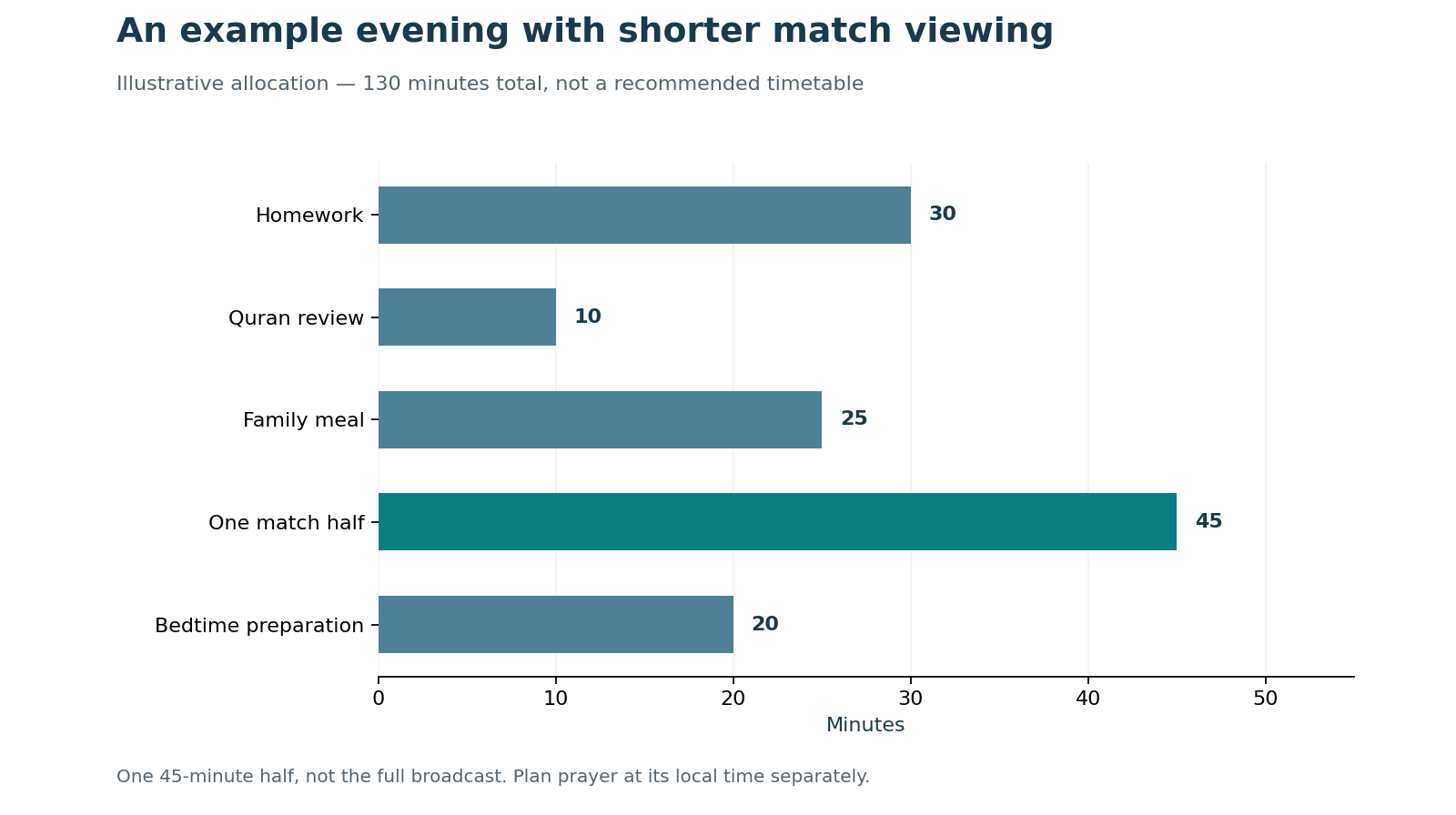
How a shorter viewing choice can fit into an evening
Illustrative allocation • minutes • not a recommended timetable
The point of the example is to make choices visible. If there is not enough room, choose a shorter viewing option or watch highlights another day. Avoid trying to fit every activity into a timetable that leaves everyone rushed.
Let the game open a conversation about values
A good question often reaches further than a long speech. Choose one moment your child noticed and explore it. You can talk while walking home from training, putting the ball away, or clearing dinner.
When a player helps an opponent
Ask, “Why do you think they stopped to help?” Discuss care for another person even during competition. The child does not need to reach a perfect answer for the conversation to be useful.
When a favorite player behaves badly
Ask, “You like how they play. Do you think that reaction was okay?” Help your child separate admiration for a skill from approval of every action. The same distinction applies to online personalities and other public figures.
When a teammate is left out
Ask what made inclusion difficult and what they could try next time. Perhaps a less experienced child needs encouragement or a chance in a different position. Keep the discussion practical rather than labeling your child as kind or unkind.
When rivalry becomes an online argument
Look at the behavior, not just the team being supported. Insults, abusive messages, and pile-ons need the same boundaries online as in person. If your child has hurt someone, discuss an appropriate repair and a clearer rule for future comments.
Keep faith from becoming a punishment
If every disagreement ends with “Now you must do extra Quran reading,” learning can become associated with being in trouble. Address the behavior directly and keep religious learning part of a steady, supportive routine.
You can say, “We need to fix what happened with your brother,” without turning the next lesson into a penalty.
Where 92 Campus can support your family
92 Campus offers one-to-one online learning in Noorani Qaida, Quran reading, Tajweed, and Islamic Studies. Parents can discuss the learner’s level and preferred local times, request a male or female tutor, and take a free trial before choosing a plan. Requested times and tutor matching depend on availability.
For a child whose week includes school and sport, the useful question is which schedule they can attend consistently. Share the activities that already matter to your family, then discuss a suitable starting point with the team.
Find a learning time that fits your family
Tell us your child’s age, reading level, city, and preferred local times. Meet a tutor and discuss the next step.
Request a free trialCompare current plans · Browse learning resources
The team checks availability before confirming your trial appointment.Frequently asked questions
How can I raise Muslim kids who enjoy football and keep their values?
Show interest in the sport, make family priorities clear, and use real situations to discuss respect, fairness, and self-control. Your own conduct while playing or watching helps make those values understandable.
Should I let my child watch a late match on a school night?
Consider their usual bedtime, the following morning, and how late the event may finish. One half or highlights later may work better. Make the decision before kickoff rather than negotiating at the most exciting point.
What should we do if a match overlaps with a Quran class?
Keep the booked lesson unless an alternative is confirmed. Contact the teacher or support team early to ask about options. Otherwise, choose a different way to follow the match.
How do I respond when my child gets angry after losing?
Acknowledge the disappointment and set a clear limit on harmful behavior. Allow a pause, then discuss what happened and any repair needed. Avoid demanding a conversation while the child is still overwhelmed.
Can football help with conversations about Islam?
It can provide familiar situations for discussing general Islamic values, such as fairness and avoiding ridicule. The activity itself does not guarantee good character; adults need to notice and guide the relevant moments.
Is this an article about a specific Roma vs Real Madrid fixture?
No. The matchup is an example of a football search that may interest families. This guide does not report a result, confirm a fixture date, or claim an affiliation with either club.
What your child carries home from the game
After the score is forgotten, your child may remember how you reacted when your team lost, whether you listened to their excitement, and how you treated the person supporting the other side.
Those ordinary moments give values a shape they can recognize.
Enjoy the match. Ask a good question. Keep the commitments you agreed. Help your child learn that enthusiasm and responsibility can share the same afternoon.
Sources and editorial notes
- Quran 49:11 — avoiding ridicule and offensive name-calling.
- Quran 5:8 — justice despite dislike.
- Sahih al-Bukhari 6114 — self-control in anger.
- IFAB Law 7 — standard match duration, halftime, and added time.
- WHO physical activity fact sheet — general benefits of activity for children.
- 92 Campus USA classes — service and scheduling information.
Religious references are paraphrased. Parenting examples apply general values to family situations; they are not claims that the texts address modern football specifically. Schedule figures are illustrative. Images show illustrative families, not actual students or endorsements. No fixture result or current search ranking is asserted.
Join the conversation
Ask a question or share your learning experience. Comments are reviewed before publication. Your name and approved comment will be public.