
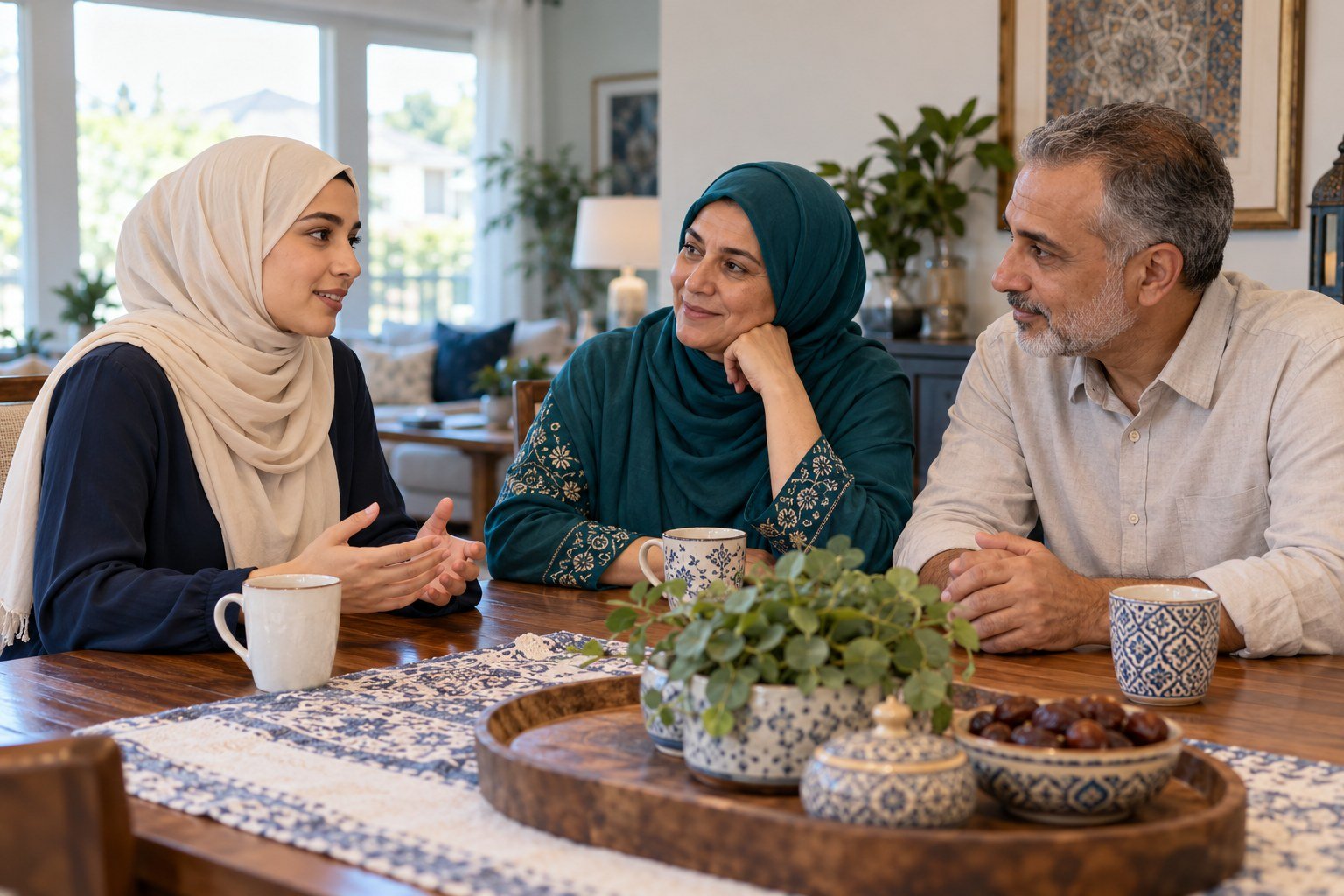
The conversation starts after dinner. A parent mentions someone’s son or daughter. A phone comes out, a profile appears, and within minutes everyone is discussing age, education, location, and family background. Then comes the question that changes the mood: “But would we actually be right for each other?”
For a family trying to help an adult child find a Muslim spouse in America, the search can feel surprisingly complicated. There may be introductions, community contacts, and matrimonial apps, yet few opportunities to understand someone beyond a carefully written profile.
Parents want reassurance. Their adult children want a meaningful say in a decision that will shape their lives. Both may want a marriage grounded in Islam while disagreeing about what that should look like in practice.
There is no single explanation for a difficult search, and being unmarried is not evidence of personal failure or inadequate upbringing. A more useful starting point is to understand the obstacles, agree on priorities, and create a process that protects dignity while allowing compatibility to become clear.
Why finding a Muslim spouse in America can feel difficult
A large country can still mean a small circle
A family may know many Muslims without knowing someone suitable, available, and interested in marriage. Age, religious expectations, location, and readiness all affect the pool of possible introductions. Outside established community networks, meeting families can require deliberate effort.
Distance adds another layer. An introduction between someone in Houston and someone in Chicago quickly raises questions about travel, employment, and relocation. Similar difficulties can arise for Muslim families in the UK, Canada, and Australia, although local communities and circumstances differ.
Parents and adult children may be evaluating different things
A parent might see shared language and familiar relatives as signs of security. Their daughter or son may be thinking about emotional openness, career flexibility, or how disagreements will be handled. Neither conversation becomes helpful when one side assumes the other is being unreasonable.
Culture can offer belonging and practical support. Problems arise when a preference becomes an unquestionable condition, or when compatibility is assumed simply because two families share a background.
Religious labels leave important questions unanswered
“Practising Muslim” can mean different things to different people. A profile rarely explains expectations about daily prayer, religious learning, social boundaries, household responsibilities, or raising children.
Likewise, a degree, profession, or confident manner cannot establish kindness or reliability. Families need opportunities to discuss everyday life and observe consistent behaviour, without turning the search into surveillance.
An Islamic perspective: what should guide the search?
The Quran describes marriage through tranquillity, affection, and mercy in Surah Ar-Rum, 30:21. This gives families a meaningful direction: look beyond whether a wedding would impress people and consider the life two people could build together.
In Sahih al-Bukhari 5090, the Prophet Muhammad ﷺ addresses choosing a wife and gives priority to religion over the other qualities people commonly seek. For parents, a practical application is to investigate what religious commitment looks like in conduct rather than relying on appearance alone.
Surah Al-Hujurat, 49:13 places honour before Allah in righteousness, rather than ancestry. Applied thoughtfully to a marriage search, this invites families to examine whether status or ethnic assumptions are overshadowing a person’s qualities. The verse is a general teaching about human dignity, not a complete ruling on every compatibility question.
Consent also matters. Sahih al-Bukhari 5136 explicitly addresses a woman’s consultation and permission in marriage. In family practice, make room for a clear, freely expressed answer; do not interpret fear or pressure as agreement.
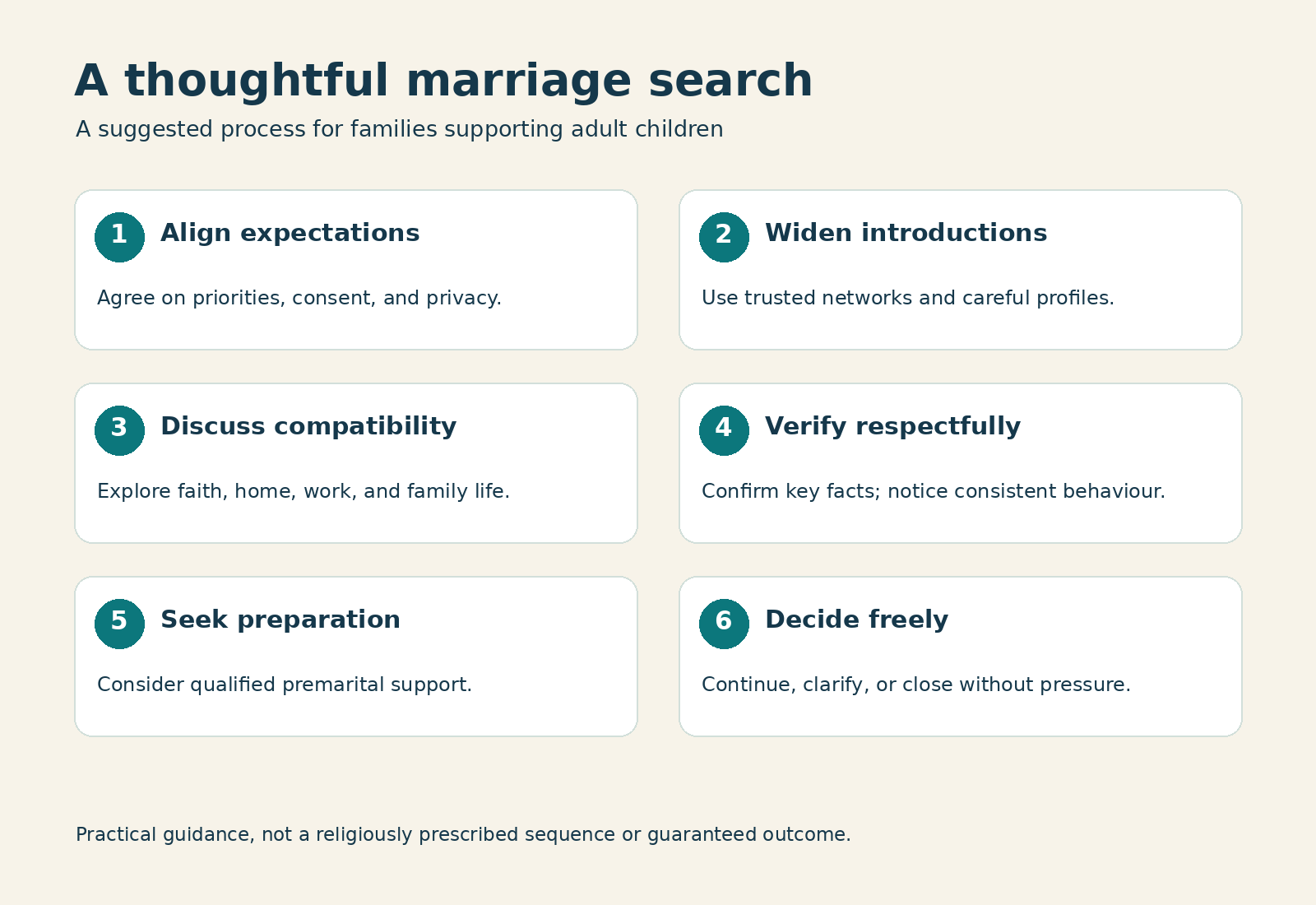
The steps below are practical suggestions, not religious rulings or a prescribed Islamic sequence. Families seeking guidance on guardianship, meeting boundaries, or a particular marriage situation should consult a qualified scholar familiar with their circumstances.
A practical approach to the Muslim marriage search
1. Begin with a private conversation at home
Before sharing a profile, ask whether your adult child wants help and what kind of involvement would feel useful. Agree on who may receive personal information, who will make initial contact, and how introductions can be declined.
Try asking, “What would help you feel understood during this process?” A parent may discover that their child welcomes introductions but dislikes having photographs circulated without permission. That is a workable boundary, not a rejection of family support.
2. Separate essential requirements from preferences
Write down what genuinely matters for a workable marriage. Include honesty, respectful behaviour, compatible religious expectations, and willingness to discuss responsibilities. Then identify preferences that allow flexibility.
| Area | A useful distinction |
|---|---|
| Religious life | Discuss actual practices and expectations rather than relying on a label. |
| Character | Look for honesty and respect, including when someone is disappointed. |
| Culture | Consider language and family customs without treating ethnicity as proof of compatibility. |
| Work and location | Discuss realistic arrangements rather than requiring a particular job title or postcode. |
| Personal connection | Allow the prospective couple to assess comfort and attraction without pressure. |
This is not an instruction to accept a person you do not want to marry. It is a way to distinguish a genuine incompatibility from a preference that deserves reconsideration.
3. Use several trusted routes for introductions
Consider trusted friends, relatives, local mosque marriage initiatives where available, and carefully chosen Muslim matrimonial platforms. Ask community organisers how introductions work, what information is shared, and whether any identity checks are actually performed.
A marriage profile should be brief and truthful: current life stage, general location, relevant commitments, and what the person hopes to build. Avoid circulating home addresses, identity documents, financial records, or private family histories.
Communities can also make introductions more welcoming to converts, divorced people, widowed people, and those outside dominant ethnic networks. Families should consider individuals fairly rather than treating a background category as a verdict.
4. Create space for purposeful conversations
Agree on a communication arrangement consistent with your religious guidance and everyone’s comfort. The prospective couple needs enough opportunity to ask questions directly. Parents can support the process without answering every question on their behalf.
Move from general intentions to specific examples. “I value family” tells you less than “My mother may need increasing support; how could we discuss that together?” Allow honest uncertainty rather than rewarding only polished answers.

5. Discuss the life after the wedding
Use these questions over several conversations rather than as a single interview:
- Religious practice: What does an ordinary week look like? How would we handle differences in understanding?
- Work and money: What commitments, debts, career plans, and spending expectations should we discuss?
- Home: Where would we live, and how would household tasks be managed?
- Extended family: What support do parents need, and what boundaries would protect the couple’s privacy?
- Children: Do we want children? How do we imagine schooling, caregiving, and Islamic education?
- Conflict: What happens when you are upset? How do you apologise or ask for help?
These are compatibility questions, not a substitute for learning Islamic rights and responsibilities. Discuss expectations openly and seek qualified guidance where religious or legal questions arise.
6. Verify respectfully and notice patterns
With appropriate consent, confirm identity and marital history and speak to references who know the person in ordinary life. Ask specific, fair questions about reliability and behaviour. Avoid gossip, intrusive demands, or assuming that a family introduction removes the need for care.
For online introductions, the US Federal Trade Commission warns against sending money or gifts to a romantic interest you have not met in person. Requests for emergency funds or investments deserve particular caution. A shared religious identity does not establish that an online account is genuine.
Pay attention to repeated disrespect, secrecy, contradictory information, or attempts to rush a decision. A legitimate concern should be examined before commitment, not dismissed because everyone likes the profile.
7. Consider premarital support and a clear next step
A qualified counsellor who understands Muslim family life can provide a structured setting to explore expectations. Ask about credentials, approach, fees, and confidentiality. An imam may offer religious preparation; clinical counselling requires its own relevant qualifications.
After each stage, agree whether to continue, clarify something, or end the introduction respectfully. There is no universal timetable. Enough time means enough opportunity to understand important issues, without leaving either person in indefinite uncertainty.
What parents of younger children can do now
Parents do not need to turn childhood into preparation for a marriage profile. They can help children become responsible, thoughtful people who understand faith, relationships, and their own choices.
Everyday moments offer practice. Let children explain a disagreement without interruption. Expect sons and daughters to contribute to the home. Model an apology when you speak unfairly. Discuss why honesty matters even when telling the truth is uncomfortable.
Make questions about Islam welcome. A young person who can discuss uncertainty at home has an opening for meaningful guidance. Avoid presenting faith mainly as a way to avoid family embarrassment or secure a desirable spouse.
These habits remain worth developing in adulthood. A difficult marriage search does not prove that someone’s parents failed, and an excellent upbringing cannot guarantee a particular marriage outcome.
Where Quran and Islamic learning fit naturally
Quran education matters as part of a child’s relationship with Allah and understanding of Islam. Alongside reading and recitation, families can discuss meanings, manners, responsibility, and mercy in ways appropriate to the learner’s age.
For example, after exploring the meaning of mercy, ask, “What would mercy look like when someone in our family makes a mistake?” This is a parenting application, not a claim that one lesson will produce emotional maturity or solve future marriage difficulties.
Families wanting teaching support can explore 92 Campus Islamic Studies classes, whose published topics include duas, manners, seerah, and everyday Islamic practice. Parents can ask how lessons match their child’s age and goals.
For reading foundations and recitation, the online Quran classes USA page explains one-to-one learning and scheduling requests. Share your city, time zone, and realistic availability; requested times and tutor preferences require confirmation.
Once learning goals are clear, choose a manageable budget. Review the current class plans and fee information and confirm currency, lesson duration, frequency, and final charges before enrolling. A sustainable routine is more useful than a commitment the family cannot maintain. Quran tuition supports religious learning; it is not a matchmaking or premarital counselling service.
A better search begins with a better conversation
Finding a Muslim spouse in America can require patience, broader connections, and difficult conversations. Families cannot control every outcome, but they can improve how the search feels and how carefully decisions are made.
Start with one conversation: what matters most, what can remain flexible, and how can we help without creating pressure? Then build a process that allows honesty, respectful verification, and a freely made decision.
For parents also strengthening everyday Islamic learning at home, you can request a free Quran or Islamic Studies trial with 92 Campus to discuss a suitable starting point. The team confirms the lesson after checking tutor availability.
Sources
- Quran 30:21 — marriage, affection, and mercy.
- Quran 49:13 — human diversity and righteousness.
- Sahih al-Bukhari 5090 — religion in choosing a wife.
- Sahih al-Bukhari 5136 — consultation and permission in marriage.
- FTC: Looking for love? Watch out for scammers — online introduction precautions.
- 92 Campus: Islamic Studies, USA classes, pricing, and trial requests. Pages checked 15 October 2026, Pakistan time.
Join the conversation
Ask a question or share your learning experience. Comments are reviewed before publication. Your name and approved comment will be public.